Key Takeaways
- Worker classification directly impacts payroll taxes, withholding, and reporting, with misclassification triggering back taxes plus penalties.
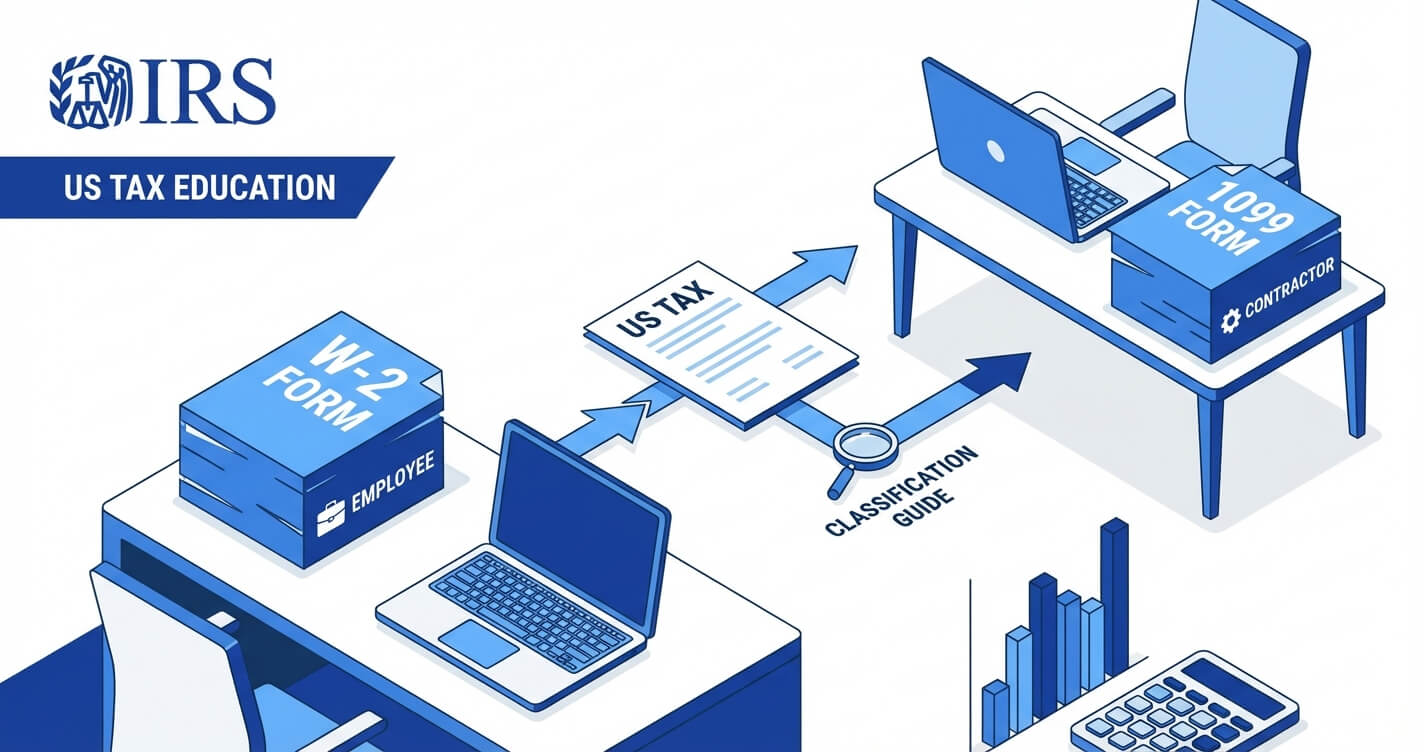
- W-2 employees require Form W-2, Form W-3, and quarterly Form 941 filings; contractors require Form 1099-NEC if payments exceed $600.
- The IRS uses a three-part test—behavioral, financial, and relationship—where no single factor is decisive.
- Employers may face 20%–40% penalties on unpaid employment taxes for incorrect classification.
- Form SS-8 can be filed to request an IRS determination, but it often increases audit risk.
- Remote compliance increases documentation importance for Indian CAs managing US clients.
Introduction
As Indian Chartered Accountants expand into US tax preparation, worker classification issues surface quickly—especially for SMB clients using freelancers, gig workers, or offshore teams. One incorrect W-2 vs 1099 decision can undo an otherwise clean tax filing.
This article is written for practitioners advising US employers, not individual workers. The goal is to equip you with a practical framework to evaluate worker status, document decisions, and manage risk while working remotely from India.
You will learn how the IRS distinguishes employees from independent contractors, the compliance obligations attached to each, and how to apply a checklist approach before onboarding workers. We also cover penalties, required forms, and a risk assessment model you can apply to real SMB scenarios.
Used correctly, this knowledge helps you move from form-filling to advisory—exactly where Indian CAs can add the most value in US tax practices.
W-2 vs 1099: Why Worker Classification Matters
What Is a W-2 Employee?
A W-2 employee is a worker under the employer’s direction and control. The business dictates how, when, and where work is performed and typically provides tools, training, and supervision.
For employers, this means mandatory payroll tax withholding, employer-side Social Security and Medicare contributions, and compliance with labor laws.
What Is a 1099 Independent Contractor?
An independent contractor operates an independent trade or business. They control how work is performed, often serve multiple clients, and bear their own business expenses.
The hiring company reports payments but does not withhold income or payroll taxes.
Why this matters: classification determines tax liability, compliance scope, and legal exposure. Misclassification is common in IT services, digital marketing, logistics, healthcare staffing, and startup environments.
Practitioner Tip: When advising US SMBs, always treat classification as a risk-management decision, not an HR formality.
Employee vs Contractor: Key Differences Explained
Tax Withholding and Payroll Obligations
W-2 employees require federal income tax withholding, plus employer and employee portions of Social Security and Medicare. Employers must file Form 941 quarterly and issue Form W-2 by January 31.
Contractors receive gross payments. If total payments exceed $600, the payer files Form 1099-NEC.
Benefits, Protections, and Legal Rights
Employees may be eligible for benefits, overtime protections, and unemployment insurance. Contractors receive none of these protections.
Misclassification can trigger Department of Labor and state-level labor law exposure.
Control, Independence, and Business Risk
| Factor | W-2 Employee | 1099 Contractor |
|---|---|---|
| Work Schedule | Set by employer | Self-determined |
| Tools & Equipment | Provided by employer | Provided by worker |
| Exclusivity | Often exclusive | Multiple clients |
| Business Risk | Employer bears risk | Worker bears risk |
Practitioner Tip: If a client wants “contractor flexibility” but operational control mirrors employment, flag the risk early.
IRS Classification Test: How Worker Status Is Determined
Behavioral Control Test
This examines whether the business controls how work is performed. Training, mandatory processes, and supervision indicate employee status.
Financial Control Test
This assesses whether the worker has a financial stake—investment in tools, unreimbursed expenses, and opportunity for profit or loss.
Type of Relationship Test
This looks at contracts, permanence, and whether services are integral to the business.
No single factor is determinative. The IRS evaluates the full relationship based on facts and circumstances.
Refer to IRS guidance on employee vs independent contractor classification for authoritative interpretation.
If uncertainty remains, employers may file Form SS-8, Determination of Worker Status, though this should be a last resort.
Practitioner Tip: Filing SS-8 can invite broader scrutiny—document your analysis before recommending it.
Classification Checklist: W-2 or 1099?
Operational Control Checklist
- Does the client dictate work hours?
- Is training mandatory?
- Are tasks closely supervised?
Financial Risk Checklist
- Does the worker invest in equipment?
- Are expenses reimbursed?
- Is payment hourly vs project-based?
Relationship and Contract Checklist
- Is there a written contractor agreement?
- Is the relationship ongoing?
- Are services core to the business?
Red flags: Long-term contractors doing core work with fixed schedules.
Maintain written classification memos and signed contracts—critical when managing compliance remotely.
Practitioner Tip: Store classification checklists alongside tax workpapers for audit defense.
Misclassification Penalties and Risk Assessment
IRS Penalties and Back Taxes
Employers may owe back payroll taxes, plus penalties of 20%–40% of unpaid amounts, interest, and information return penalties.
Department of Labor and State-Level Risks
State agencies may assess additional penalties for wage and hour violations, often exceeding federal exposure.
Forms Required for W-2 and 1099 Workers
| Worker Type | Forms Required |
|---|---|
| W-2 Employee | W-2, W-3, Form 941, Form 940 |
| 1099 Contractor | 1099-NEC |
Risk Assessment Framework: High risk if role is core + long-term + controlled. Medium risk if mixed indicators. Low risk if project-based and independent.
Practitioner Tip: Use this framework to prioritize remediation for SMB clients before filing season.
Conclusion
W-2 vs 1099 classification is one of the highest-risk advisory areas for US employers—and one of the highest-value services Indian CAs can offer. By applying the IRS tests systematically, documenting decisions, and educating clients early, you reduce audit exposure and strengthen client trust.
As you build US tax capabilities, integrate classification reviews into onboarding and year-end compliance. This positions you not just as a preparer, but as a compliance advisor managing risk across borders.
FAQs
Can a worker be both W-2 and 1099 for the same client?
Generally no. Performing similar services under both classifications is a strong misclassification indicator. Separate roles with distinct duties may be defensible but require documentation.
Is a written contract enough to prove contractor status?
No. Contracts help but do not override actual working conditions. The IRS focuses on substance over form.
Should Indian CAs recommend Form SS-8?
Only when classification risk is high and facts are unclear. It can trigger deeper IRS review. Always document internal analysis first.
What is the $600 threshold for 1099-NEC?
If total payments exceed $600 in a calendar year, Form 1099-NEC is required. Below this threshold, reporting is not mandatory.
Are offshore contractors treated differently?
Yes. Non-US contractors generally do not receive 1099s, but classification principles still matter for labor law risk.
How far back can the IRS assess misclassification penalties?
Typically three years, but up to six years if substantial underreporting exists.
Do startups face higher misclassification risk?
Yes. Startups often rely on long-term contractors performing core roles.
Can state rules differ from federal classification?
Yes. States may apply stricter tests, increasing exposure.
Is hourly pay automatic employee status?
No, but it is a strong indicator when combined with control factors.
How should remote firms document classification?
Maintain checklists, contracts, invoices, and annual reviews in digital workpapers.