
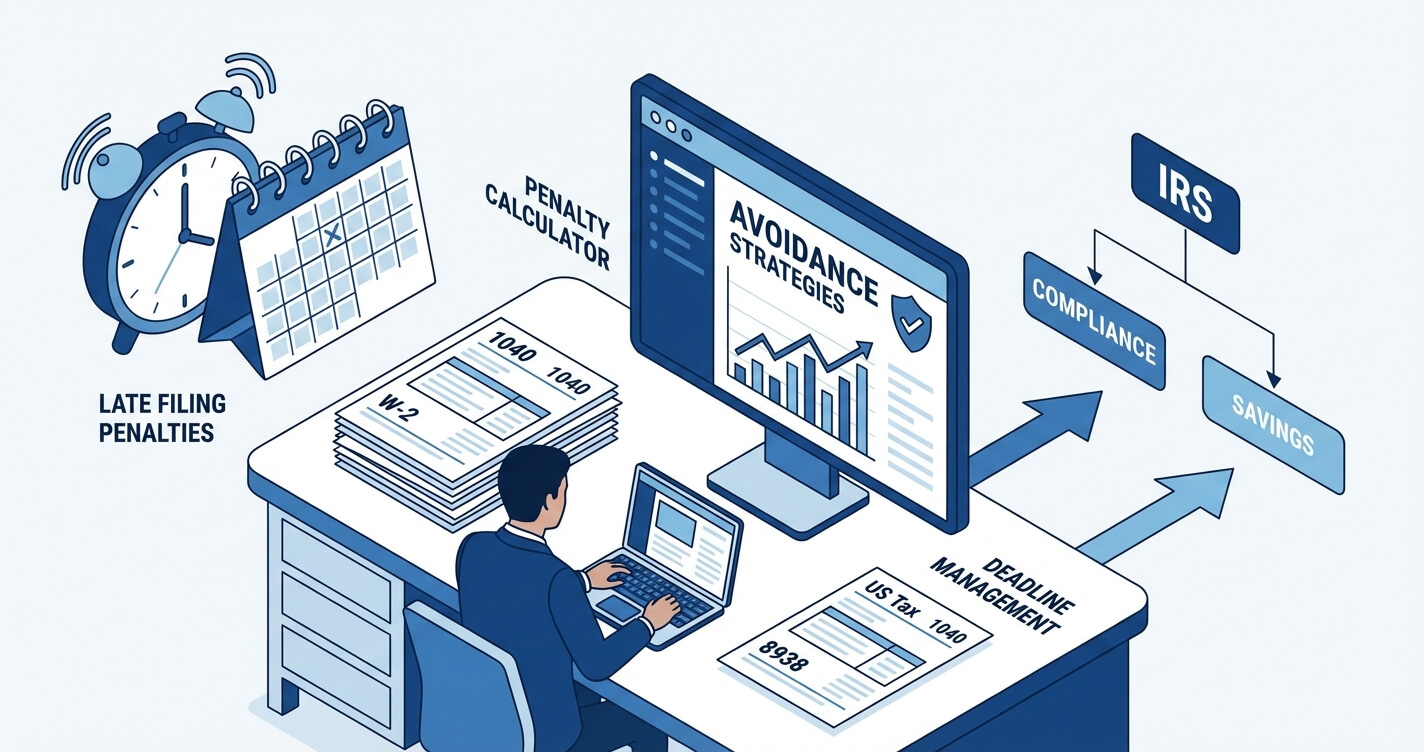
Late Filing Penalties and How to Avoid Them

Content
Contents

Key Takeaways

  • Failure to File (FTF) penalty is generally 5% per month of unpaid tax, capped at 25%.
  • Failure to Pay (FTP) penalty is generally 0.5% per month, also capped at 25%.
  • If both apply in the same month, the total penalty is typically limited to 5% per month.
  • The standard filing deadline is April 15; Form 4868 extends filing to October 15, not payment.
  • Returns over 60 days late may trigger a minimum penalty (lesser of a flat statutory amount or 100% of tax due).
  • Interest accrues separately on unpaid tax and penalties until full payment.
  • First Time Abate and Reasonable Cause relief can significantly reduce exposure if handled correctly.

Introduction

For Indian CAs building a US tax practice, late filing penalties are not just compliance issues—they directly affect client trust and retention. A single missed deadline can convert a routine Form 1040 engagement into a penalty resolution case.

Understanding late filing penalties and how to avoid them allows you to proactively protect clients, estimate exposure accurately, and implement systems that scale across 50, 100, or even 1,000 US returns.

This article breaks down Failure to File vs Failure to Pay penalties, walks through real-world calculation examples, explains mitigation options like First Time Abate and Offer in Compromise, and outlines firm-level systems to prevent recurring compliance failures.

Use this as a technical reference when advising clients—and as an internal framework for strengthening your US compliance workflows.

What Are Late Filing Penalties?

Failure to File Penalty Explained

The IRS imposes late filing penalties when a taxpayer misses the return deadline. For most individual returns, the due date is April 15.

The Failure to File (FTF) penalty is generally 5% of unpaid tax per month (or part of a month), up to a maximum of 25%. Even one day late counts as a full month.

If a return is more than 60 days late, a minimum penalty applies—typically the lesser of a statutory flat amount or 100% of the tax due.

Refer to the official IRS Failure to File penalty details for updated thresholds.

Failure to Pay Penalty Explained

The Failure to Pay (FTP) penalty applies when tax is not paid by the due date, even if the return is filed.

This penalty is generally 0.5% per month of unpaid taxes, capped at 25%. The rate may reduce to 0.25% during an approved installment agreement.

If both FTF and FTP apply in the same month, the FTF penalty is reduced by the FTP amount. Practically, the combined charge is usually limited to 5% per month.

How Interest Is Added to Tax Debt

Interest accrues separately on unpaid tax and on penalties. The rate is determined quarterly and compounds daily.

Importantly, filing an extension using Form 4868 extends the filing deadline to October 15, but not the payment deadline. For deeper operational guidance, refer to this US tax extensions Form 4868 and Form 7004 guide.

Practitioner Tip: Always estimate liability conservatively and advise clients to pay at least 90% by April 15 to minimize exposure.

Failure to File vs Failure to Pay: Key Differences

Why Failure to File Is More Expensive

Penalty TypeMonthly RateMaximum
Failure to File5%25%
Failure to Pay0.5%25%

The FTF penalty grows 10x faster than FTP. From a risk perspective, non-filing is significantly more expensive than non-payment.

When Both Penalties Apply

If a client neither files nor pays, both penalties apply in the same month. However, the total combined rate is typically limited to 5% per month.

This cap is critical when calculating projections for clients who are multiple months non-compliant.

What Happens If You File but Can’t Pay

If the return is filed on time but payment is not made, only the 0.5% per month FTP penalty applies.

For practitioners handling high-volume engagements, the compliance priority is clear: file first, resolve payment second.

Practitioner Tip: For returns nearing deadline without complete payment capacity, prioritize filing accuracy and timeliness to eliminate the higher FTF risk.

Penalty Calculation: Real-World Examples

Example 1: $4,000 Owed, 3 Months Late

Unpaid tax: $4,000

FTF: $4,000 × 5% × 3 months = $600

FTP: $4,000 × 0.5% × 3 months = $60

Since both apply, total monthly rate is limited to 5%. Total penalty ≈ $600 (combined effect), plus interest.

Example 2: Filed on Time, Paid 6 Months Late

Unpaid tax: $4,000

FTP only: $4,000 × 0.5% × 6 months = $120

No FTF applies. Interest accrues on $4,000 plus penalties.

Example 3: 8 Months Late with No Extension

FTF caps at 25%: $4,000 × 25% = $1,000

FTP continues until 25% cap is reached separately.

Step-by-step formula:

  1. Determine unpaid tax.
  2. Multiply by monthly penalty rate.
  3. Multiply by months late (or until cap reached).
  4. Add accrued interest.

Small delays compound quickly—especially beyond five months when FTF hits its maximum.

How to Avoid Late Filing Penalties

File for an Extension (Form 4868)

Form 4868 grants a 6-month extension to file, moving the deadline to October 15.

It does not extend payment. Ensure estimated tax is remitted by April 15.

Pay What You Can by the Deadline

Encourage clients to pay as much as possible—even partial payment reduces FTP exposure and interest.

Document advisory communication in engagement files.

Set Up an Installment Agreement

IRS installment agreements allow structured monthly payments. During an approved plan, the FTP rate may reduce.

Evaluate cash flow before proposing terms to avoid default.

Use Centralized Compliance Calendars and Dashboards

For firms managing high volumes, manual tracking is risky. Implement centralized compliance dashboards tracking:

  • Client document status
  • Estimated tax paid vs projected liability
  • Extension filed status
  • Federal and state due dates

Automated reminders and document collection systems dramatically reduce missed deadlines.

Practitioner Tip: Standardize a 30-60-90 day reminder sequence before April 15.

What If You Missed the Tax Deadline?

File Immediately to Stop the Failure to File Penalty

The FTF penalty stops accruing once the return is filed. Even if payment is not possible, file immediately.

Options to Pay What You Owe

Options include short-term payment plans, installment agreements, or temporary delay of collection for financial hardship (Currently Not Collectible status).

An Offer in Compromise may allow settlement for less than the full balance if strict eligibility criteria are met.

State-Level Penalties (Including Texas Example)

State penalties differ from IRS rules. For example, Texas franchise tax filings can attract 5% penalty after due date, increasing to 10% after 30 days, plus potential $50 per late report.

Always review state revenue department guidance separately from federal rules.

Penalty Relief and Mitigation Strategies

First Time Abate (FTA) Relief

FTA relief applies if the taxpayer has a clean compliance history for the prior three years. It can remove FTF and FTP penalties.

Reasonable Cause Relief

Valid grounds include serious illness, natural disasters, or destruction of records. Documentation is essential.

Requests can be made by written submission or phone, depending on case facts.

Proactive Systems to Minimize Future Penalties

Interest is generally statutory and rarely removed. See the IRS penalties and interest overview for technical details.

Mitigation strategies include internal checklists, automated document extraction, real-time diagnostics, and standardized workflows.

For scaling US tax practices, process discipline is the strongest defense against recurring penalties.

Conclusion

Late filing penalties can erode client value quickly, but they are largely preventable with disciplined systems and technical clarity. The 5% vs 0.5% distinction alone should shape how your firm prioritizes deadline management.

For Indian CAs expanding into US tax, the focus should be twofold: accurate penalty computation when issues arise, and proactive compliance infrastructure that prevents them altogether. Strong extension management, early document collection, and structured payment planning convert reactive firefighting into predictable advisory work.

Mastering these rules strengthens both client outcomes and firm scalability.

FAQ

1. How do I calculate combined Failure to File and Failure to Pay penalties?

Calculate each separately using monthly rates. If both apply in the same month, the combined rate is typically limited to 5%. Apply the cap rules carefully once 25% is reached. Always add interest separately.

2. Does filing Form 4868 eliminate penalties?

No. It extends the filing deadline to October 15. Payment is still due by April 15. Failure to Pay penalties apply to unpaid balances.

3. What is the minimum penalty for returns over 60 days late?

A minimum penalty applies and is generally the lesser of a statutory flat amount or 100% of unpaid tax. This rule is often overlooked in small-balance cases. Always verify the applicable year’s threshold.

4. Can interest be removed through penalty abatement?

Interest is statutory and generally not removed. It may be reduced only if the underlying penalty is removed. Standalone interest relief is rare.

5. How does an installment agreement affect penalties?

The Failure to Pay rate may reduce while the agreement is active. However, interest continues to accrue. Defaulting reinstates higher exposure.

6. What qualifies for First Time Abate relief?

The taxpayer must have a clean compliance history for the prior three years. All required returns must be filed. Outstanding tax must be paid or under arrangement.

7. When should I consider an Offer in Compromise?

When the client cannot pay in full and meets strict financial eligibility tests. The IRS evaluates reasonable collection potential. Detailed financial disclosure is required.

8. What is Currently Not Collectible status?

It is a temporary delay of collection due to financial hardship. Penalties and interest continue to accrue. The IRS periodically reviews financial status.

9. Are state penalties always similar to IRS penalties?

No. Each state has independent rules. For example, Texas imposes 5–10% penalties plus potential $50 per late report for certain filings. Always verify state statutes separately.

10. How can my firm prevent recurring late filing penalties?

Implement centralized compliance dashboards, automated reminders, and standardized workflows. Track extension status and estimated payments in real time. Build a structured pre-deadline communication system.

Key Takeaways

  • Failure to File (FTF) penalty is generally 5% per month of unpaid tax, capped at 25%.
  • Failure to Pay (FTP) penalty is generally 0.5% per month, also capped at 25%.
  • If both apply in the same month, the total penalty is typically limited to 5% per month.
  • The standard filing deadline is April 15; Form 4868 extends filing to October 15, not payment.
  • Returns over 60 days late may trigger a minimum penalty (lesser of a flat statutory amount or 100% of tax due).
  • Interest accrues separately on unpaid tax and penalties until full payment.
  • First Time Abate and Reasonable Cause relief can significantly reduce exposure if handled correctly.

Introduction

For Indian CAs building a US tax practice, late filing penalties are not just compliance issues—they directly affect client trust and retention. A single missed deadline can convert a routine Form 1040 engagement into a penalty resolution case.

Understanding late filing penalties and how to avoid them allows you to proactively protect clients, estimate exposure accurately, and implement systems that scale across 50, 100, or even 1,000 US returns.

This article breaks down Failure to File vs Failure to Pay penalties, walks through real-world calculation examples, explains mitigation options like First Time Abate and Offer in Compromise, and outlines firm-level systems to prevent recurring compliance failures.

Use this as a technical reference when advising clients—and as an internal framework for strengthening your US compliance workflows.

What Are Late Filing Penalties?

Failure to File Penalty Explained

The IRS imposes late filing penalties when a taxpayer misses the return deadline. For most individual returns, the due date is April 15.

The Failure to File (FTF) penalty is generally 5% of unpaid tax per month (or part of a month), up to a maximum of 25%. Even one day late counts as a full month.

If a return is more than 60 days late, a minimum penalty applies—typically the lesser of a statutory flat amount or 100% of the tax due.

Refer to the official IRS Failure to File penalty details for updated thresholds.

Failure to Pay Penalty Explained

The Failure to Pay (FTP) penalty applies when tax is not paid by the due date, even if the return is filed.

This penalty is generally 0.5% per month of unpaid taxes, capped at 25%. The rate may reduce to 0.25% during an approved installment agreement.

If both FTF and FTP apply in the same month, the FTF penalty is reduced by the FTP amount. Practically, the combined charge is usually limited to 5% per month.

How Interest Is Added to Tax Debt

Interest accrues separately on unpaid tax and on penalties. The rate is determined quarterly and compounds daily.

Importantly, filing an extension using Form 4868 extends the filing deadline to October 15, but not the payment deadline. For deeper operational guidance, refer to this US tax extensions Form 4868 and Form 7004 guide.

Practitioner Tip: Always estimate liability conservatively and advise clients to pay at least 90% by April 15 to minimize exposure.

Failure to File vs Failure to Pay: Key Differences

Why Failure to File Is More Expensive

Penalty TypeMonthly RateMaximum
Failure to File5%25%
Failure to Pay0.5%25%

The FTF penalty grows 10x faster than FTP. From a risk perspective, non-filing is significantly more expensive than non-payment.

When Both Penalties Apply

If a client neither files nor pays, both penalties apply in the same month. However, the total combined rate is typically limited to 5% per month.

This cap is critical when calculating projections for clients who are multiple months non-compliant.

What Happens If You File but Can’t Pay

If the return is filed on time but payment is not made, only the 0.5% per month FTP penalty applies.

For practitioners handling high-volume engagements, the compliance priority is clear: file first, resolve payment second.

Practitioner Tip: For returns nearing deadline without complete payment capacity, prioritize filing accuracy and timeliness to eliminate the higher FTF risk.

Penalty Calculation: Real-World Examples

Example 1: $4,000 Owed, 3 Months Late

Unpaid tax: $4,000

FTF: $4,000 × 5% × 3 months = $600

FTP: $4,000 × 0.5% × 3 months = $60

Since both apply, total monthly rate is limited to 5%. Total penalty ≈ $600 (combined effect), plus interest.

Example 2: Filed on Time, Paid 6 Months Late

Unpaid tax: $4,000

FTP only: $4,000 × 0.5% × 6 months = $120

No FTF applies. Interest accrues on $4,000 plus penalties.

Example 3: 8 Months Late with No Extension

FTF caps at 25%: $4,000 × 25% = $1,000

FTP continues until 25% cap is reached separately.

Step-by-step formula:

  1. Determine unpaid tax.
  2. Multiply by monthly penalty rate.
  3. Multiply by months late (or until cap reached).
  4. Add accrued interest.

Small delays compound quickly—especially beyond five months when FTF hits its maximum.

How to Avoid Late Filing Penalties

File for an Extension (Form 4868)

Form 4868 grants a 6-month extension to file, moving the deadline to October 15.

It does not extend payment. Ensure estimated tax is remitted by April 15.

Pay What You Can by the Deadline

Encourage clients to pay as much as possible—even partial payment reduces FTP exposure and interest.

Document advisory communication in engagement files.

Set Up an Installment Agreement

IRS installment agreements allow structured monthly payments. During an approved plan, the FTP rate may reduce.

Evaluate cash flow before proposing terms to avoid default.

Use Centralized Compliance Calendars and Dashboards

For firms managing high volumes, manual tracking is risky. Implement centralized compliance dashboards tracking:

  • Client document status
  • Estimated tax paid vs projected liability
  • Extension filed status
  • Federal and state due dates

Automated reminders and document collection systems dramatically reduce missed deadlines.

Practitioner Tip: Standardize a 30-60-90 day reminder sequence before April 15.

What If You Missed the Tax Deadline?

File Immediately to Stop the Failure to File Penalty

The FTF penalty stops accruing once the return is filed. Even if payment is not possible, file immediately.

Options to Pay What You Owe

Options include short-term payment plans, installment agreements, or temporary delay of collection for financial hardship (Currently Not Collectible status).

An Offer in Compromise may allow settlement for less than the full balance if strict eligibility criteria are met.

State-Level Penalties (Including Texas Example)

State penalties differ from IRS rules. For example, Texas franchise tax filings can attract 5% penalty after due date, increasing to 10% after 30 days, plus potential $50 per late report.

Always review state revenue department guidance separately from federal rules.

Penalty Relief and Mitigation Strategies

First Time Abate (FTA) Relief

FTA relief applies if the taxpayer has a clean compliance history for the prior three years. It can remove FTF and FTP penalties.

Reasonable Cause Relief

Valid grounds include serious illness, natural disasters, or destruction of records. Documentation is essential.

Requests can be made by written submission or phone, depending on case facts.

Proactive Systems to Minimize Future Penalties

Interest is generally statutory and rarely removed. See the IRS penalties and interest overview for technical details.

Mitigation strategies include internal checklists, automated document extraction, real-time diagnostics, and standardized workflows.

For scaling US tax practices, process discipline is the strongest defense against recurring penalties.

Conclusion

Late filing penalties can erode client value quickly, but they are largely preventable with disciplined systems and technical clarity. The 5% vs 0.5% distinction alone should shape how your firm prioritizes deadline management.

For Indian CAs expanding into US tax, the focus should be twofold: accurate penalty computation when issues arise, and proactive compliance infrastructure that prevents them altogether. Strong extension management, early document collection, and structured payment planning convert reactive firefighting into predictable advisory work.

Mastering these rules strengthens both client outcomes and firm scalability.

FAQ

1. How do I calculate combined Failure to File and Failure to Pay penalties?

Calculate each separately using monthly rates. If both apply in the same month, the combined rate is typically limited to 5%. Apply the cap rules carefully once 25% is reached. Always add interest separately.

2. Does filing Form 4868 eliminate penalties?

No. It extends the filing deadline to October 15. Payment is still due by April 15. Failure to Pay penalties apply to unpaid balances.

3. What is the minimum penalty for returns over 60 days late?

A minimum penalty applies and is generally the lesser of a statutory flat amount or 100% of unpaid tax. This rule is often overlooked in small-balance cases. Always verify the applicable year’s threshold.

4. Can interest be removed through penalty abatement?

Interest is statutory and generally not removed. It may be reduced only if the underlying penalty is removed. Standalone interest relief is rare.

5. How does an installment agreement affect penalties?

The Failure to Pay rate may reduce while the agreement is active. However, interest continues to accrue. Defaulting reinstates higher exposure.

6. What qualifies for First Time Abate relief?

The taxpayer must have a clean compliance history for the prior three years. All required returns must be filed. Outstanding tax must be paid or under arrangement.

7. When should I consider an Offer in Compromise?

When the client cannot pay in full and meets strict financial eligibility tests. The IRS evaluates reasonable collection potential. Detailed financial disclosure is required.

8. What is Currently Not Collectible status?

It is a temporary delay of collection due to financial hardship. Penalties and interest continue to accrue. The IRS periodically reviews financial status.

9. Are state penalties always similar to IRS penalties?

No. Each state has independent rules. For example, Texas imposes 5–10% penalties plus potential $50 per late report for certain filings. Always verify state statutes separately.

10. How can my firm prevent recurring late filing penalties?

Implement centralized compliance dashboards, automated reminders, and standardized workflows. Track extension status and estimated payments in real time. Build a structured pre-deadline communication system.

Latest from our blogs

Latest from our blogs

View All
]