Key Takeaways
- Most US tax software requires a valid PTIN renewed annually by 31 December and an EFIN approval that can take 2–6 weeks, even if preparation work is done offshore.
- Desktop tools like UltraTax CS and Drake Tax offer deeper controls but create VPN, hosting, and multi-user challenges for India-based teams.
- Cloud-native tools such as ProConnect and CCH Axcess simplify access from India but are priced per return, impacting margins at scale.
- For beginners to US tax (not accounting), Drake Tax, ProConnect, and TaxAct Professional have the lowest learning curve.
- Advanced use cases—K-1 allocations, crypto reporting, FBAR/FATCA—require careful tool selection and reviewer workflows.
- Software alone does not solve scaling; many Indian CA firms use white-label or hybrid models to avoid licensing friction.
Introduction: Why US Tax Software Matters for Indian CA Firms
Indian CA firms are increasingly asked to support US tax filings—Form 1040s for residents, partnerships with K-1s, and cross-border disclosures like FBAR and FATCA. This demand is coming not just from NRIs, but from US CPA firms outsourcing work and Indian business groups with US footprints.
US tax software is fundamentally different from Indian ITR or GST tools. It embeds IRS forms, diagnostics, e-file schemas, and audit trails aligned to US regulations. Spreadsheets or generic compliance tools are not viable once volumes increase or complexity crosses basic 1040s.
For practitioners, the core question is practical: which US tax software actually works for an Indian CA firm? Cost, access from India, licensing, PTIN/EFIN ownership, and team workflows matter as much as features.
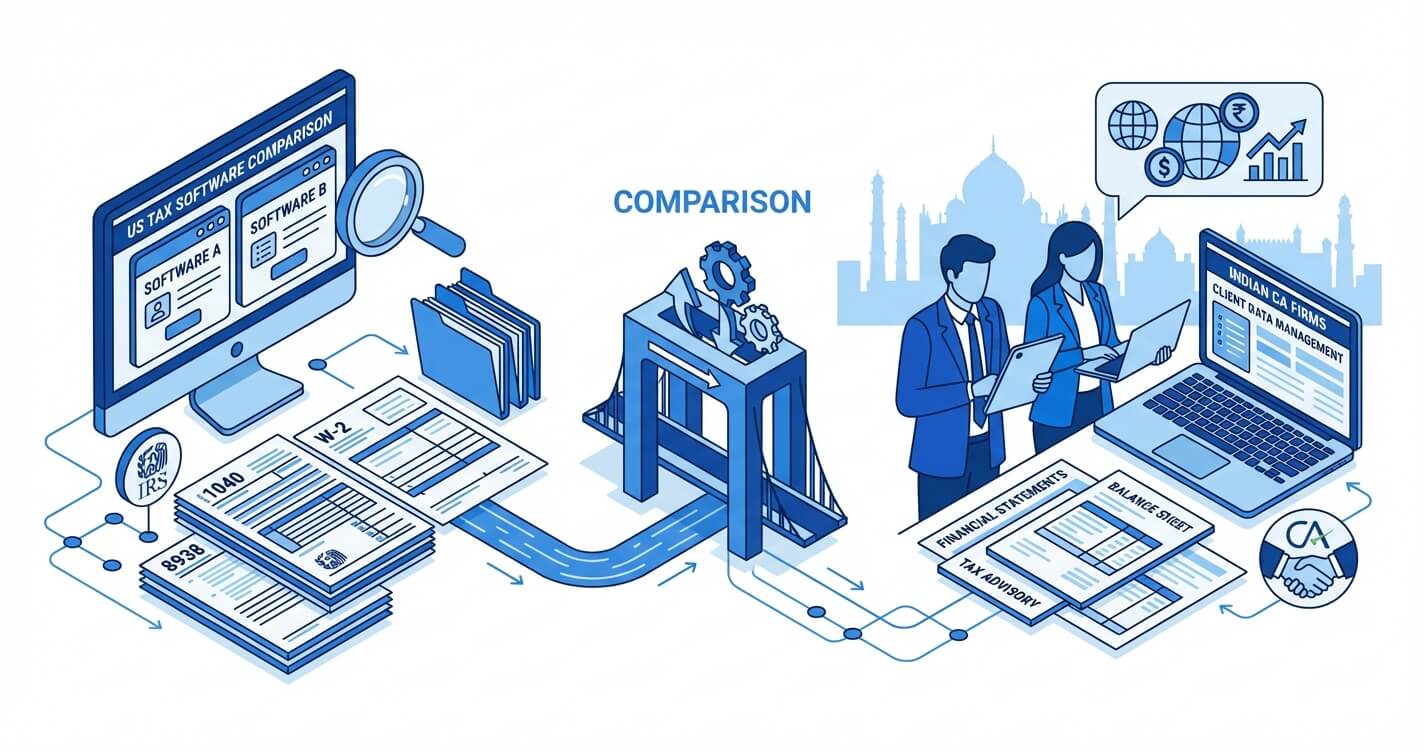
This article compares leading US tax software from an India-specific lens, explains access and licensing realities, and helps you decide what fits your firm’s size and growth plans.
What Software Do US Tax Preparers Use?
Industry-standard US tax preparation platforms
US CPA and EA firms typically rely on a small set of mature platforms. The most common are UltraTax CS (Thomson Reuters), Drake Tax, Lacerte (Intuit), ProConnect (Intuit), CCH Axcess (Wolters Kluwer), and TaxAct Professional.
These tools support core forms like 1040, 1065, 1120, 1120-S, along with extensions, amended returns, and e-filing. Differences emerge in workflow depth, review controls, and pricing models.
Desktop vs cloud-based tax software
Desktop software (UltraTax CS, Drake Tax, Lacerte desktop) is installed on a Windows environment. For Indian teams, this usually means US-hosted servers or VPN setups, adding IT overhead.
Cloud-native platforms (ProConnect, CCH Axcess, TaxAct Online) run in the browser. They simplify offshore access but often charge per return and limit deep customization. This trade-off is critical when designing an offshore delivery model.
Practitioner Tip: Before evaluating features, decide whether your firm wants to manage servers and VPNs or prefers a browser-only environment for staff.
Can Indian CA Firms Access US Tax Software?
Licensing, geography, and compliance barriers
Legally, most US tax software can be accessed from India. Practically, onboarding is not always straightforward. Vendors assume a US-based firm with US banking, address, and compliance credentials.
Almost all software requires a preparer with a valid PTIN. The IRS mandates this under the IRS PTIN requirements for tax return preparers. PTINs are individual-level and must be renewed annually.
PTIN, EFIN, and user credential requirements
To e-file returns, the firm (or sponsoring entity) needs an EFIN, obtained through the IRS EFIN and authorized e-file provider process. EFIN approval can take several weeks and requires background checks.
Common challenges for Indian CA firms include lack of a US address, inability to pay via US cards, IP restrictions, and limitations on concurrent users.
Most firms solve this by operating under a US CPA/EA partner’s credentials, setting up a US entity, or using white-label service providers who already hold PTIN/EFIN ownership.
Practitioner Tip: Clarify upfront who owns the PTIN and EFIN. This impacts liability, client ownership, and your ability to switch software later.
Detailed Comparison of Popular US Tax Software
UltraTax CS
UltraTax CS is widely used in mid-to-large US CPA firms. It supports complex returns, consolidated entities, multi-state filings, FBAR, and FATCA. Integration with the CS Professional Suite enables strong document management and reviewer tracking.
It is desktop-based, requiring hosted servers for Indian teams. The learning curve is steep, especially for partnership allocations and diagnostics.
Drake Tax
Drake Tax is popular with small firms due to its unlimited return pricing. It supports 1040, 1065, 1120-S, K-1s, and basic crypto reporting. Audit trails and activity logs are adequate but not enterprise-grade.
Desktop deployment means VPN or remote desktop setups, but the UI is relatively intuitive for new US tax preparers.
Lacerte
Lacerte offers powerful diagnostics and strong handling of complex partnerships and S-corps. It integrates with QuickBooks and other Intuit products.
However, licensing is expensive, and offshore access often requires careful IT configuration and credential management.
ProConnect
ProConnect is Intuit’s cloud-native professional tool. It supports most individual and business returns, K-1s, and crypto imports. Collaboration and reviewer notes are built in.
Pricing is per return, which can be costly at scale, but access from India is straightforward.
CCH Axcess
CCH Axcess is a full cloud suite designed for larger firms. It excels in audit trails, permission controls, and compliance monitoring for distributed teams.
For small Indian CA firms, cost and complexity can be prohibitive without significant volume.
TaxAct Professional
TaxAct Professional is budget-friendly and cloud-accessible. It supports core forms and e-filing with a simpler interface.
Advanced partnership allocations and large K-1 volumes can feel constrained compared to premium tools.
Practitioner Tip: If your client base includes funds or multi-tier partnerships, test K-1 allocation scenarios before committing to a tool.
US Tax Software Comparison Table (India-Specific View)
| Software | Deployment | Indicative Cost (USD) | Ease for Beginners | India Access Issues | Best Use Case |
|---|---|---|---|---|---|
| UltraTax CS | Desktop | 8,000–12,000/year | Low | Server hosting, VPN | Large, complex engagements |
| Drake Tax | Desktop | 1,800–2,500/year | High | Remote access setup | Small firms, high volume 1040s |
| Lacerte | Desktop/Hosted | 4,000–10,000/year | Medium | Licensing, cost | Complex partnerships |
| ProConnect | Cloud | 80–120/return | High | Payment method | Flexible offshore teams |
| CCH Axcess | Cloud | 10,000+/year | Low | Cost | Large distributed teams |
| TaxAct Pro | Cloud | 1,500–3,000/year | High | Feature limits | Entry-level US tax work |
What Are the Costs of US Tax Software?
License models and pricing structures
US tax software is priced either per return or as an unlimited annual license. Per-return models reduce upfront cost but compress margins once volumes exceed 50–70 returns.
Unlimited licenses favor scale but require confidence in consistent US tax demand.
Hidden and indirect costs for Indian firms
Indirect costs include hosting servers, paying for additional state modules, e-file fees, and currency conversion charges. Some vendors restrict non-US cards.
Practitioner Tip: Model ROI assuming conservative volumes and include IT and compliance overhead, not just license fees.
Which US Tax Software Is Best for Beginners?
Evaluation criteria for first-time users
For Indian CAs, “beginner” means new to US tax law and forms, not to accounting. Clear diagnostics, form-level guidance, and training resources matter more than automation.
Best beginner-friendly options
Drake Tax, ProConnect, and TaxAct Professional are easiest to adopt. They offer cleaner interfaces and fewer configuration layers.
Tools like UltraTax CS and CCH Axcess are powerful but can overwhelm small teams without dedicated reviewers.
Beyond Software: Scaling US Tax Prep Without Licensing Headaches
Why software alone does not solve scaling
As volumes grow, firms face document management issues, reviewer bottlenecks, and seasonal spikes around 15 April and 15 October.
Alternative operating models for Indian CA firms
Many firms adopt white-label or hybrid models where US tax software, PTIN/EFIN ownership, and review layers are handled externally, while client relationships remain with the CA firm.
Platforms like FlowTax.ai illustrate how firms can bypass licensing friction and focus on delivery quality rather than software administration.
If you are evaluating such models, a walkthrough can clarify whether this fits your growth plans.
Conclusion: Choosing the Right US Tax Software as an Indian CA Firm
No single US tax software fits every Indian CA firm. The right choice depends on return volume, complexity, budget, and how much operational control you want.
Evaluate software alongside PTIN/EFIN ownership, reviewer workflows, and scalability. For many firms, combining the right tool with an efficient operating model delivers better margins and lower risk.
If you are exploring US tax services as a growth line, consider assessing both software and alternative delivery models before committing long term.
FAQs
Do Indian CAs need their own PTIN to prepare US returns?
Anyone who prepares or assists in preparing a US tax return for compensation needs a PTIN. Indian staff typically work under a US credential holder’s supervision. PTIN ownership should be clearly documented.
Can an Indian firm hold an EFIN?
EFINs are generally issued to US-based entities. Indian firms usually operate under a US partner’s EFIN. This affects e-filing control and compliance responsibility.
Which software handles complex K-1 allocations best?
UltraTax CS and Lacerte are strongest for advanced partnership allocations. Drake and ProConnect handle standard K-1s but have limits in complex waterfalls.
Is cloud software safer for offshore teams?
Cloud tools reduce VPN and server risks. However, data access controls and user permissions must be configured carefully. Reviewer audit trails are critical.
How is crypto reporting handled in US tax software?
Most tools now support basic crypto imports. Complex DeFi or high-volume trading still requires manual review and reconciliation.
What is the typical learning curve for Indian staff?
For basic 1040s, expect 4–6 weeks of supervised training. Business returns and K-1s take longer.
Can one license be shared across multiple users?
Most vendors restrict concurrent users. Sharing credentials violates terms and risks access suspension.
How important is audit trail functionality?
For offshore teams, audit trails are essential for quality control and IRS inquiries. Enterprise tools offer deeper tracking.
Are per-return tools viable at scale?
They work well up to a threshold. Beyond 100–150 returns, unlimited licenses or alternative models are more economical.
Should software selection come before client acquisition?
Ideally, validate demand first. Pilot with a small tool or partner model before locking into expensive licenses.