Key Takeaways
- Any person preparing or assisting with a US federal tax return for compensation must hold a valid PTIN renewed annually.
- Indian CA firms engaged in offshore US tax preparation are subject to the same due diligence rules as US-based preparers.
- Form 8867 is mandatory for returns claiming EIC, CTC/ACTC, AOTC, or Head of Household status.
- Due diligence records must be retained for a minimum of 3 years from the later of filing or due date.
- Penalties under IRC §6695 apply per return and can exceed USD 600+ per failure (inflation adjusted).
- Client consent and data security controls are critical when outsourcing work outside the US.
Introduction
Indian Chartered Accountants are increasingly building US tax practices through outsourcing and white-label arrangements with US CPA and EA firms. While the technical aspects of US return preparation can be mastered with training and software, compliance obligations for tax return preparers are often underestimated.
The IRS does not distinguish between onshore and offshore preparers when it comes to preparer compliance failures. Due diligence lapses, missing documentation, or data security weaknesses by an Indian preparation team can directly expose the US firm—and indirectly the Indian CA firm—to penalties, audits, and reputational damage.
This article is written from a practitioner-to-practitioner perspective. It explains the US tax preparer compliance requirements Indian CAs must follow when handling US returns for clients, including PTIN rules, due diligence under Form 8867, record retention, and penalty avoidance strategies.
We will also address outsourcing disclosures, data security alignment with IRS expectations, and practical workflows Indian firms can implement to deliver compliant US tax services at scale.
Overview of US Tax Preparer Compliance Requirements
Who is considered a tax return preparer?
Under IRS rules, a paid tax return preparer is any individual who prepares, or assists in preparing, all or a substantial portion of a US federal tax return for compensation. This definition includes offshore preparers working for Indian CA firms, CPA firms, or captive delivery centers.
The rule applies regardless of whether the preparer signs the return. Even team members performing calculations, credit eligibility analysis, or data validation may fall within this definition.
Why compliance matters for Indian preparers
Indian CA firms are often non-signing preparers, but this does not reduce their compliance exposure. Due diligence penalties, data security breaches, or systemic errors can result in IRS scrutiny of the entire preparation chain.
Practitioner Tip: Treat every US return prepared offshore as if it will be reviewed by the IRS with full visibility into preparer workflows.
What Are Preparer Compliance Requirements?
Credential and registration requirements (PTIN)
Anyone preparing US federal tax returns for pay must obtain a Preparer Tax Identification Number (PTIN) from the IRS. PTINs must be renewed annually before the start of each filing season.
This requirement applies to Indian CAs and staff members involved in preparation, even if the US firm signs the return.
Ethical and professional standards
All preparers are subject to Circular 230, which sets standards for competence, due diligence, confidentiality, and integrity. Preparers must not take positions lacking reasonable basis or ignore information that appears incorrect or inconsistent.
Scope of responsibility in outsourced engagements
When US tax work is outsourced offshore, the IRS expects proper client disclosure and consent. US firms must inform clients that their data may be accessed outside the US, and Indian preparers must adhere to agreed confidentiality and security standards.
Practitioner Tip: Ensure engagement letters explicitly cover offshore preparation and data access permissions.
Due Diligence Requirements for Tax Preparers
EIC Due Diligence and covered credits
Due diligence requirements apply to returns claiming:
- Earned Income Credit (EIC)
- Child Tax Credit (CTC) and Additional CTC
- American Opportunity Tax Credit (AOTC)
- Head of Household filing status
Detailed guidance is available under IRS due diligence requirements for tax return preparers.
Completion and submission of Form 8867
Form 8867 must be completed and attached to the return for each applicable credit. Preparers must also complete worksheets, ask required questions, and document client responses.
Knowledge standards and reasonable inquiries
Preparers must not ignore red flags. If information appears incomplete, inconsistent, or incorrect, additional questions are mandatory. Failure to inquire constitutes a due diligence failure.
Practitioner Tip: Maintain written interview notes showing how eligibility was verified.
Record Retention and Documentation Rules
What records must be maintained
Preparers must retain copies of:
- Form 8867
- Credit worksheets
- Client-provided documents
- Interview notes and follow-up queries
Record retention period and format
Records must be retained for at least 3 years from the later of the return due date or filing date. Digital storage is permitted if records are retrievable and secure.
Best practices for Indian firms handling US data
Indian CA firms should align with IRS Publication 4557 and FTC Safeguards expectations. This includes access controls, audit trails, encryption, and incident response planning aligned with the NIST Cybersecurity Framework.
Practitioner Tip: Use role-based access and maintain logs of file access and changes.
Preparer Penalties and Consequences of Non-Compliance
Preparer penalties under IRC §6695
IRC §6695 imposes penalties for failures including missing PTINs, unsigned returns, and due diligence violations.
Due diligence penalty amounts
Penalties are assessed per return and are inflation-adjusted annually. Regulatory details are outlined in 26 CFR §1.6695-2 due diligence penalty regulations.
Other civil and criminal exposure
Severe or repeated failures can lead to PTIN revocation, injunctions, audits, and termination of outsourcing relationships.
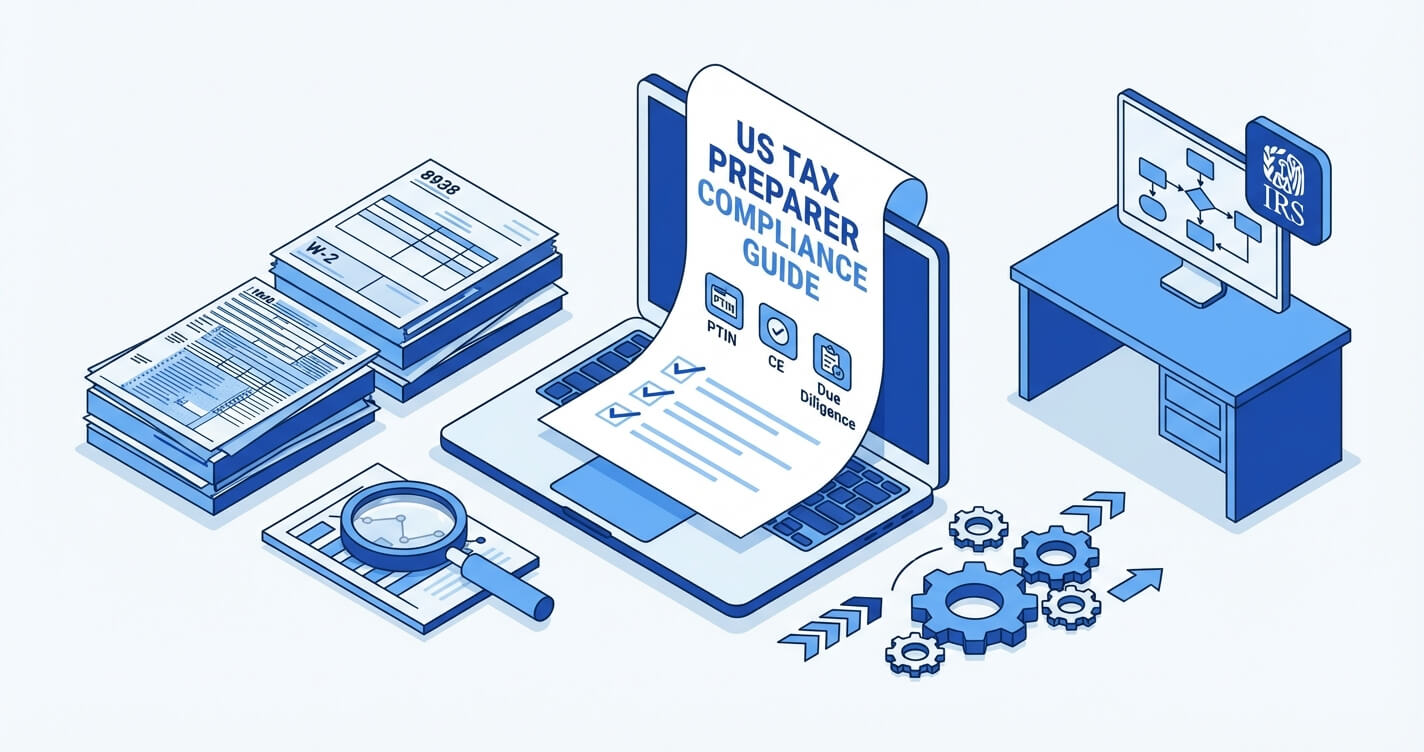
Compliance Checklist for Indian Tax Preparers
Pre-season compliance setup
- ✅ Obtain and renew PTINs
- ✅ Update engagement letters and consent disclosures
- ✅ Train staff on Form 8867 workflows
During-return preparation checks
- ✅ Standardized intake questionnaires
- ✅ Mandatory red-flag escalation
- ✅ Peer review before submission
Post-filing review and retention
- ✅ Secure document archiving
- ✅ Access log review
- ✅ Periodic internal audits
Penalty Avoidance Guide and Practical Scenarios
Common mistakes made by offshore preparers
Typical failures include skipped questions, undocumented assumptions, and reliance on prior-year data without verification.
How to demonstrate reasonable due diligence
Documented follow-ups, clear notes, and completed worksheets provide strong defense during IRS examinations.
Using technology to reduce compliance risk
Automated validations, workflow controls, and review checkpoints—often discussed in US tax software comparisons for Indian CA firms—significantly reduce exposure.
Conclusion
US tax preparer compliance requirements are not optional checklists—they define the credibility and scalability of an Indian CA firm’s US tax practice. From PTIN registration to Form 8867 due diligence and secure record retention, each obligation protects both the client and the preparer.
Indian CAs who invest early in compliant workflows, documentation discipline, and data security alignment position themselves as reliable long-term partners to US firms. The next step is to formalize internal controls, train teams annually, and integrate compliance checks into daily preparation processes.
FAQs
Do Indian CAs need a PTIN if they do not sign US returns?
Yes. Any individual preparing or assisting with US federal returns for pay must obtain a PTIN, regardless of signing authority.
Is Form 8867 required if the US firm signs the return?
Yes. Due diligence obligations apply to the preparation work itself, not just the signing preparer.
How long must due diligence records be retained?
Records must be retained for at least three years from the later of the filing date or due date.
Can penalties be imposed on offshore preparers?
Yes. While enforcement is often through the US firm, offshore preparers can face contractual and regulatory consequences.
What constitutes a red flag in due diligence?
Inconsistent income, unclear dependency claims, or vague living arrangements are common red flags.
Is client consent required for offshore preparation?
Yes. Clients must be informed that their data may be accessed outside the US.
Are Indian data protection laws sufficient for IRS compliance?
No. Firms must align with IRS Publication 4557 and FTC Safeguards expectations.
Can software alone ensure compliance?
No. Technology supports compliance, but documented human judgment is essential.
What happens if Form 8867 is incomplete?
Each incomplete form can trigger a separate due diligence penalty.
How can Indian firms scale US tax work safely?
By combining standardized workflows, trained reviewers, and secure technology platforms.