Key Takeaways
- Indian CAs can legally prepare US tax returns by obtaining a PTIN annually and optionally becoming an Enrolled Agent (EA).
- Key US filing deadlines include March 15 (partnerships, S-corps), April 15 (individuals, C-corps), and October 15 (extended returns).
- US taxation is citizenship-based, requiring worldwide income reporting even for India-based clients.
- Core forms to master include Form 1040, 1065, 1120, along with FBAR (FinCEN 114) and FATCA (Form 8938).
- The US–India DTAA helps avoid double taxation using Form 1116 or treaty positions.
- White-label platforms allow Indian CAs to scale US tax work without adding headcount or compliance risk.
Introduction
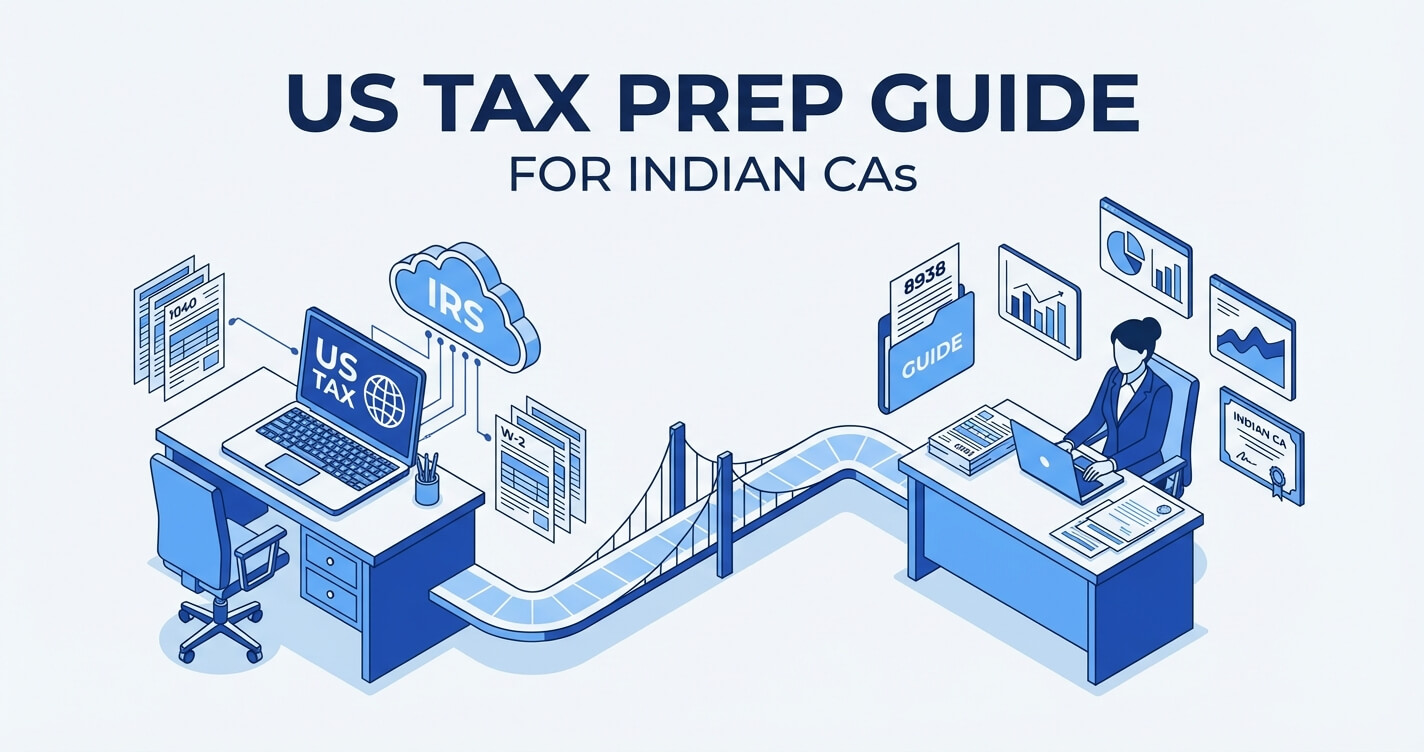
For Indian Chartered Accountants, US tax preparation is no longer a niche offshore activity. It has evolved into a scalable, recurring service line driven by US firms outsourcing compliance work and global clients with cross-border tax obligations.
This guide is written by one practitioner for another. The focus is not on taxpayer education, but on how you, as an Indian CA, can competently prepare, review, and scale US tax returns for your clients.
You will learn how the US tax system works from an Indian lens, how it differs fundamentally from Indian taxation, which forms and disclosures matter most, and what credentials you need to operate confidently. We also cover practical DTAA applications, treatment of Indian investments on US returns, and a step-by-step roadmap to enter and scale in the US tax market.
Used correctly, this knowledge allows you to expand your firm’s offerings, increase dollar-denominated revenues, and build a defensible international practice.
Introduction: Why US Tax Preparation Is a Major Opportunity for Indian CAs
Rising demand for offshore US tax preparation
US accounting firms face chronic talent shortages and rising costs. As a result, preparation of Forms 1040, 1065, and 1120 is increasingly outsourced to India. This demand is structural, not cyclical.
Why Indian CAs are uniquely positioned
Indian CAs already possess strong fundamentals in accounting standards, compliance workflows, and audit discipline. With targeted US tax training, this skill set transfers efficiently.
Practitioner Tip: Position US tax prep as an extension of your compliance vertical, not a separate experiment.
Overview of the US Tax System (From an Indian CA’s Lens)
Who administers US taxes: Role of the IRS
The Internal Revenue Service (IRS) administers federal taxes, issues guidance, conducts audits, and enforces compliance. Indian CAs should regularly consult IRS guidance for tax professionals and preparers.
Federal, state, and local tax layers
Unlike India’s relatively centralized system, US taxation operates at federal, state, and sometimes local levels. Each state may have its own filing requirements.
Calendar year, filing deadlines, and extensions
Most US taxpayers follow the calendar year. Key deadlines include March 15, April 15, and extended deadlines of October 15.
Side-by-Side Comparison: Indian vs US Tax System
| Aspect | India | United States |
|---|---|---|
| Basis of taxation | Residency-based | Citizenship & residency-based |
| Scope of income | Primarily Indian-source | Worldwide income |
| Deductions vs credits | Deductions dominate | Credits directly reduce tax |
| Audit culture | Scrutiny assessments | Notice-based IRS audits |
Practitioner Tip: Always identify whether an item is a deduction or a credit; US credits have disproportionately higher value.
What Indian CAs Need to Know to Prepare US Tax Returns
US tax residency tests
Filing obligations depend on citizenship, green card status, or the Substantial Presence Test.
Worldwide income reporting
US residents must disclose global income and assets, even if taxed in India.
Ethics and compliance under Circular 230
Circular 230 governs preparer conduct, accuracy standards, and penalties.
Core US Tax Forms Every Indian CA Must Master
Form 1040 – Individual Income Tax Return
Includes income schedules, adjustments, credits, and tax computation.
Form 1065 – Partnership Return
Income flows through via Schedule K-1 to partners.
Form 1120 – Corporate Return
C-Corporations are taxed at a flat 21% federal rate.
Common international and disclosure forms
FBAR (FinCEN 114) and FATCA (Form 8938) are critical for foreign assets.
US-India Cross-Border Taxation and DTAA
Overview of the US-India DTAA
The treaty allocates taxing rights and provides relief from double taxation.
Foreign Tax Credit vs Foreign Earned Income Exclusion
Most India-linked cases use Form 1116 rather than FEIE.
Tax treatment of Indian income and assets
Indian bank interest, mutual funds, and PF accounts are reportable and often taxable in the US.
Practitioner Tip: Indian mutual funds are usually treated as PFICs, requiring careful analysis.
Qualifications Indian CAs Need to Practice US Tax Preparation
PTIN registration requirements
A valid PTIN is mandatory and renewed annually. See detailed steps in this guide on PTIN application for non-US residents.
Becoming an Enrolled Agent (EA)
EAs are federally authorized to represent taxpayers before the IRS. The SEE exam can be scheduled from India. Refer to Official IRS information on Enrolled Agents and SEE exam and this detailed breakdown on Enrolled Agent exam for Indian CA.
Role of AICPA and other bodies
EAs and CPAs have representation rights; non-credentialed preparers do not.
Step-by-Step Roadmap for Indian CAs Entering the US Tax Market
Learning and credentialing phase
Start with individual taxation, obtain PTIN, then pursue EA.
Initial client acquisition
Begin with white-label preparation for US firms.
Scaling operations
Technology platforms allow scaling without hiring spikes.
Soft CTA: Many Indian firms explore modern, white-label platforms like FlowTax.ai to handle compliance, review, and delivery while they focus on client relationships.
Operational Challenges in US Tax Prep (and How Indian CAs Solve Them)
Document collection
Standardized organizers and portals reduce back-and-forth.
Quality control
Multi-level review is essential.
Peak-season workloads
Workflow automation smooths capacity constraints.
Compliance, Ethics, and Risk Management for US Tax Preparers
Circular 230 obligations
Due diligence and accuracy are mandatory.
Data security
Use SOC2/ISO-aligned systems.
Remote servicing
Engagement letters and clear scope reduce liability.
Conclusion
US tax preparation offers Indian CAs a high-margin, recurring revenue opportunity when approached systematically. Mastery of forms, credentials, DTAA application, and ethics is non-negotiable.
Serious practitioners should invest in structured learning, obtain EA credentials, and adopt modern platforms to scale responsibly. Exploring white-label solutions like FlowTax.ai can accelerate entry while minimizing operational risk.
FAQs
Can an Indian CA prepare US tax returns without an EA?
Yes, with a valid PTIN. However, representation rights are limited.
Is EA mandatory to sign US returns?
No, but it enhances credibility and scope.
How long does the SEE exam take?
Most CAs clear it within 6–9 months.
Are Indian mutual funds taxable in the US?
Often yes, and may fall under PFIC rules.
Which DTAA article applies to salary income?
Article 16 generally governs employment income.
Can Indian CAs work directly with US clients?
Yes, subject to IRS and data security compliance.
What is the FBAR threshold?
Aggregate foreign balances exceeding $10,000.
Is Form 8938 mandatory with FBAR?
Often yes; they serve different laws.
Can US tax prep be seasonal?
Yes, but extensions create year-round work.
How do I scale without hiring?
By using standardized workflows and white-label platforms.