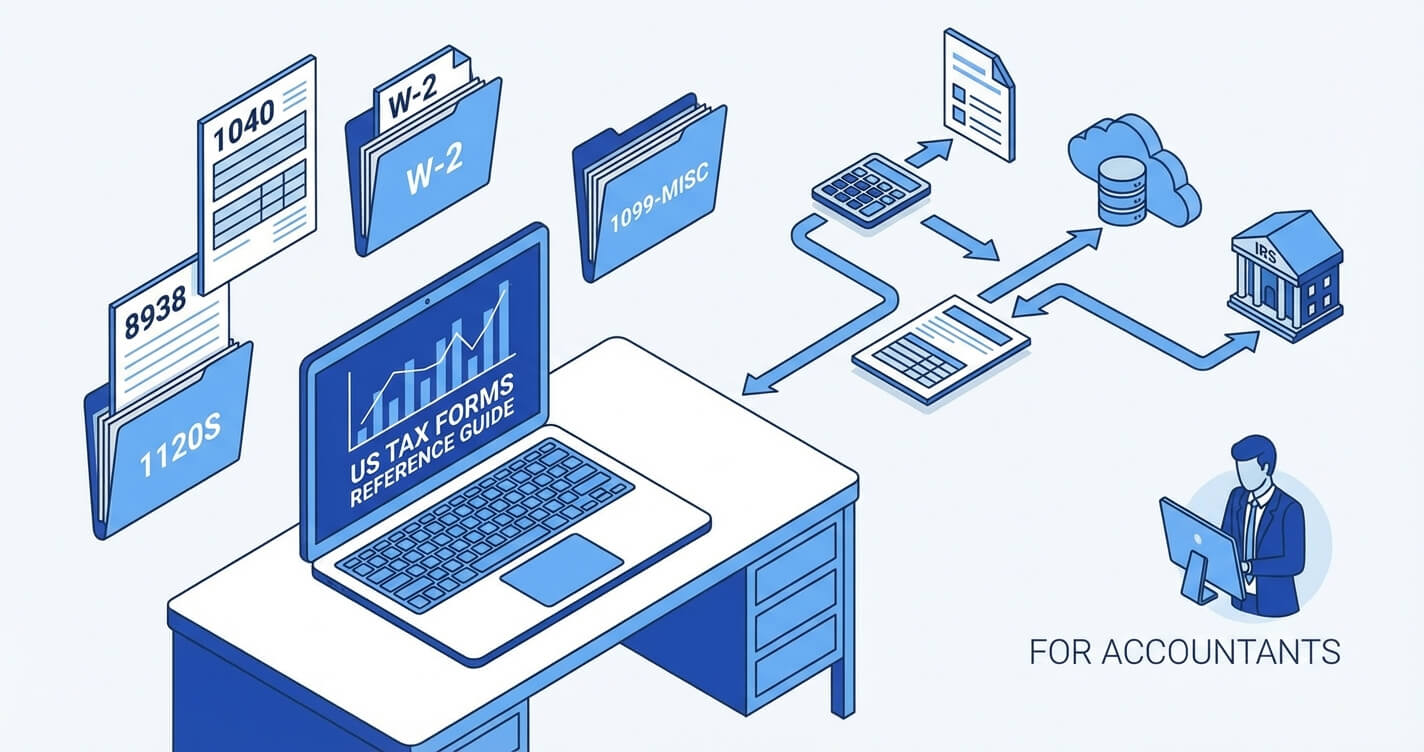
US Tax Forms Reference Guide: Comprehensive List & Uses

Content
Contents

Key Takeaways

  • Form 1040 is the core individual return, supported by schedules; 1040-NR applies to nonresidents with US-source income.
  • Information returns (W-2, 1099 series) are filed by payers, not taxpayers, but must reconcile to the return to avoid IRS notices.
  • 1099-NEC applies to contractor payments over $600; incorrect W-2 vs 1099 classification triggers payroll tax exposure.
  • Business returns follow entity classification: 1065 (partnerships), 1120 (C-corps), 1120-S (S-corps), with K-1 flow-through.
  • Employment tax forms (941, 940) are time-sensitive; late filings attract penalties starting at 2% and escalating.
  • Extensions via Forms 4868 and 7004 extend filing, not payment obligations.

Introduction

For Indian Chartered Accountants building or scaling a US tax practice, form mastery is non-negotiable. Unlike Indian compliance, US taxation revolves around a dense ecosystem of primary returns, schedules, and information returns, each serving a precise reporting function.

This article is designed as a practitioner-first US tax forms reference guide comprehensive list. It helps you answer one core question repeatedly: which form applies to this client scenario, and why.

You will learn how the IRS structures forms, how individual and business returns interlink, and where preparers commonly make errors. We also include decision-tree logic you can use to train junior staff and standardize reviews.

Whether you handle 50 or 1,000+ US returns annually, this guide is meant to be a living reference you return to during review, onboarding, and quality control.

How the IRS Organizes Tax Forms

Returns vs schedules vs information returns

The IRS categorizes forms into primary tax returns, schedules, and information returns. Primary returns such as Forms 1040, 1065, and 1120 calculate tax liability.

Schedules are attachments that support the main return. They never stand alone and are only filed if triggered by income type or deductions.

Information returns (W-2, 1099 series) report payments and are matched by the IRS against the recipient’s return.

Who files vs who receives

Understanding filing responsibility is critical. Employers file W-2s, businesses file 1099s, while taxpayers report the income on their return.

The IRS provides centralized access to all forms via IRS official forms and instructions, which should always be your primary technical reference.

Practitioner Tip: Build an internal matrix mapping “issuer vs reporter” to reduce notice risk during reconciliation.

1040 Series: Individual Income Tax Returns

Form 1040 – U.S. Individual Income Tax Return

Form 1040 is filed by US citizens and residents meeting filing thresholds based on filing status and age. It aggregates all income, adjustments, taxes, and credits.

Supporting documents typically include Forms W-2, 1099s, and Schedule K-1.

Form 1040-SR – Seniors

Form 1040-SR is an alternate format for taxpayers aged 65+. Substantively identical to Form 1040, it offers readability advantages only.

Form 1040-NR – Nonresident Aliens

Form 1040-NR applies when a client does not meet the substantial presence test but has US-source income. Common triggers include US rental income and US partnership allocations.

Amended and prior-year returns

Form 1040-X is used to amend previously filed returns. The statute of limitations is generally 3 years from filing or 2 years from payment, whichever is later.

Practitioner Tip: Always attach revised schedules when filing Form 1040-X; partial amendments invite correspondence.

1040 Schedules: Income, Adjustments, Taxes, and Credits

Schedule 1 – Additional Income & Adjustments

Schedule 1 reports income not shown on W-2, such as interest income or business income not on Schedule C, and adjustments like IRA deductions.

Schedule 2 & 3 – Additional Taxes and Credits

Schedule 2 covers self-employment tax and other taxes. Schedule 3 reports non-refundable and refundable credits.

Schedule A – Itemized Deductions

Schedule A is filed only if itemized deductions exceed the standard deduction.

Schedule B, C, D, E, F, SE

Schedule C reports sole proprietorship income, while Schedule E applies to rental and pass-through income. Schedule D handles capital gains, and Schedule SE computes self-employment tax.

Practitioner Tip: Misclassifying rental activity on Schedule C instead of E is a common audit trigger.

1099 Series: Income and Transaction Reporting

1099-NEC vs 1099-MISC

Form 1099-NEC reports nonemployee compensation over $600. Form 1099-MISC covers rents, prizes, and other income.

Investment and government forms

Forms 1099-INT, DIV, and B report investment income. Form 1099-G reports government payments like state tax refunds.

Retirement and benefits reporting

Form 1099-R reports distributions from retirement accounts. Form 1099-SA reports HSA distributions.

Digital asset reporting (new forms)

Form 1099-DA reports digital asset proceeds, increasing IRS matching in crypto transactions.

Practitioner Tip: Reconcile all 1099s to gross receipts before finalizing returns to avoid CP2000 notices.

W Forms and Payroll-Related Tax Forms

Form W-2 and W-3

Employers issue Form W-2 to employees and file Form W-3 as a transmittal.

Form W-4 and withholding compliance

Form W-4 drives payroll withholding calculations and must be updated for life events.

Forms W-9 and backup withholding

Form W-9 collects taxpayer information to support 1099 issuance and avoid backup withholding.

For worker classification, see this W-2 vs 1099 classification guide.

Business Income Tax Forms

Form 1065 – Partnerships

Form 1065 is filed by partnerships, issuing Schedule K-1s to partners.

Form 1120 and 1120-S – Corporations

C-corporations file Form 1120 and pay entity-level tax. S-corporations file Form 1120-S with pass-through taxation.

Schedule K-1 reporting

K-1s flow income, deductions, and credits to owners’ individual returns.

Refer to IRS small business and self-employed tax guidance for entity-level compliance.

Practitioner Tip: Always validate entity elections before selecting the return type.

Employer and Employment Tax Forms

Form 941 – Quarterly payroll taxes

Form 941 reports federal income tax withholding and FICA taxes quarterly.

Form 940 – FUTA

Form 940 reports federal unemployment tax annually.

Forms 943, 944, 945 – Special employer cases

Form 943 applies to agricultural employers, Form 944 to very small employers, and Form 945 to non-payroll withholding.

Information Returns Beyond the 1099 Series

Form 1098 series

Form 1098 reports mortgage interest; Form 1098-T reports qualified tuition payments.

Form 5498 – Retirement contributions

Form 5498 substantiates IRA contributions and is issued by custodians.

Form 1095 – Health insurance coverage

Forms 1095-B and 1095-C support ACA compliance and reconciliation.

Specialized and Less Common IRS Forms

Form 4797 – Sale of business property

Form 4797 reports gains from sale of business-use assets, separate from Schedule D.

Form 1116 & 2555 – Foreign income

Form 1116 claims foreign tax credit, while Form 2555 excludes foreign earned income.

Form 8938 & FBAR context

Form 8938 reports foreign financial assets under FATCA, distinct from FBAR filing.

For entity-level foreign reporting, see Form 8858 foreign disregarded entity reporting.

Form Selection Decision Trees (Practical Use Cases)

Individual taxpayer decision tree

Start with residency status, then income types, then deductions and credits.

Self-employed and freelancer decision tree

Identify trade or business income, then assess Schedule C, SE, and estimated taxes.

Business entity decision tree

Confirm entity classification, election status, and filing deadlines.

Practitioner Tip: Use these trees as onboarding tools for new team members.

Filing Requirements, Deadlines, and Penalties Summary

Who must file and when

Individuals generally file by April 15. Partnerships and S-corps file by March 15.

Extension forms and relief options

Form 4868 extends individual filings; Form 7004 extends business returns.

Practitioner Tip: Extensions do not extend payment deadlines.

How to Use This Guide to Scale Your US Tax Practice

Reducing errors through form standardization

Create master checklists by client type to ensure no form is missed.

Systemizing document-to-form mapping

Decision trees allow delegation while maintaining review control.

As volumes increase, many firms explore automation or white-label support to manage complexity efficiently.

Conclusion

US tax compliance is ultimately a form-selection exercise driven by facts. For Indian CAs, mastering these forms builds confidence, reduces rework, and protects margins.

This guide gives you a structured framework to identify, prepare, and review the right IRS forms across individual and business clients.

As your US practice scales, consider whether standardized workflows, automation, or white-label partnerships like FlowTax.ai can support your growth without increasing risk.

FAQs

Which US tax forms should Indian CAs learn first?

Start with Forms 1040, W-2, 1099-NEC, and Schedule C. These cover most individual and freelancer cases. Add business forms as your client base expands.

Who files 1099 forms and who reports them?

The payer files the 1099 with the IRS. The recipient reports the income on their return. Mismatches trigger IRS notices.

When is Form 1040-NR required?

It applies to nonresident aliens with US-source income. Residency tests drive the decision, not citizenship.

How do K-1s affect individual returns?

K-1s pass income, losses, and credits to owners. They must be reconciled to avoid underreporting.

What is the risk of misclassifying workers?

Misclassification leads to back payroll taxes, penalties, and interest. Always document classification analysis.

Is Form 1099-DA mandatory for crypto exchanges?

Yes, it increases reporting transparency for digital asset transactions. Expect higher IRS matching.

Do extensions avoid penalties?

Extensions avoid late filing penalties but not late payment penalties. Estimate and pay taxes due.

When is Form 4797 required?

When selling business-use assets like equipment or real estate. It separates ordinary and capital gains.

What is the purpose of Form 5498?

It substantiates IRA contributions. Taxpayers use it for records but do not file it.

How can Indian CAs scale US tax compliance?

Standardize form selection, train teams using decision trees, and consider automation or white-label support.

Key Takeaways

  • Form 1040 is the core individual return, supported by schedules; 1040-NR applies to nonresidents with US-source income.
  • Information returns (W-2, 1099 series) are filed by payers, not taxpayers, but must reconcile to the return to avoid IRS notices.
  • 1099-NEC applies to contractor payments over $600; incorrect W-2 vs 1099 classification triggers payroll tax exposure.
  • Business returns follow entity classification: 1065 (partnerships), 1120 (C-corps), 1120-S (S-corps), with K-1 flow-through.
  • Employment tax forms (941, 940) are time-sensitive; late filings attract penalties starting at 2% and escalating.
  • Extensions via Forms 4868 and 7004 extend filing, not payment obligations.

Introduction

For Indian Chartered Accountants building or scaling a US tax practice, form mastery is non-negotiable. Unlike Indian compliance, US taxation revolves around a dense ecosystem of primary returns, schedules, and information returns, each serving a precise reporting function.

This article is designed as a practitioner-first US tax forms reference guide comprehensive list. It helps you answer one core question repeatedly: which form applies to this client scenario, and why.

You will learn how the IRS structures forms, how individual and business returns interlink, and where preparers commonly make errors. We also include decision-tree logic you can use to train junior staff and standardize reviews.

Whether you handle 50 or 1,000+ US returns annually, this guide is meant to be a living reference you return to during review, onboarding, and quality control.

How the IRS Organizes Tax Forms

Returns vs schedules vs information returns

The IRS categorizes forms into primary tax returns, schedules, and information returns. Primary returns such as Forms 1040, 1065, and 1120 calculate tax liability.

Schedules are attachments that support the main return. They never stand alone and are only filed if triggered by income type or deductions.

Information returns (W-2, 1099 series) report payments and are matched by the IRS against the recipient’s return.

Who files vs who receives

Understanding filing responsibility is critical. Employers file W-2s, businesses file 1099s, while taxpayers report the income on their return.

The IRS provides centralized access to all forms via IRS official forms and instructions, which should always be your primary technical reference.

Practitioner Tip: Build an internal matrix mapping “issuer vs reporter” to reduce notice risk during reconciliation.

1040 Series: Individual Income Tax Returns

Form 1040 – U.S. Individual Income Tax Return

Form 1040 is filed by US citizens and residents meeting filing thresholds based on filing status and age. It aggregates all income, adjustments, taxes, and credits.

Supporting documents typically include Forms W-2, 1099s, and Schedule K-1.

Form 1040-SR – Seniors

Form 1040-SR is an alternate format for taxpayers aged 65+. Substantively identical to Form 1040, it offers readability advantages only.

Form 1040-NR – Nonresident Aliens

Form 1040-NR applies when a client does not meet the substantial presence test but has US-source income. Common triggers include US rental income and US partnership allocations.

Amended and prior-year returns

Form 1040-X is used to amend previously filed returns. The statute of limitations is generally 3 years from filing or 2 years from payment, whichever is later.

Practitioner Tip: Always attach revised schedules when filing Form 1040-X; partial amendments invite correspondence.

1040 Schedules: Income, Adjustments, Taxes, and Credits

Schedule 1 – Additional Income & Adjustments

Schedule 1 reports income not shown on W-2, such as interest income or business income not on Schedule C, and adjustments like IRA deductions.

Schedule 2 & 3 – Additional Taxes and Credits

Schedule 2 covers self-employment tax and other taxes. Schedule 3 reports non-refundable and refundable credits.

Schedule A – Itemized Deductions

Schedule A is filed only if itemized deductions exceed the standard deduction.

Schedule B, C, D, E, F, SE

Schedule C reports sole proprietorship income, while Schedule E applies to rental and pass-through income. Schedule D handles capital gains, and Schedule SE computes self-employment tax.

Practitioner Tip: Misclassifying rental activity on Schedule C instead of E is a common audit trigger.

1099 Series: Income and Transaction Reporting

1099-NEC vs 1099-MISC

Form 1099-NEC reports nonemployee compensation over $600. Form 1099-MISC covers rents, prizes, and other income.

Investment and government forms

Forms 1099-INT, DIV, and B report investment income. Form 1099-G reports government payments like state tax refunds.

Retirement and benefits reporting

Form 1099-R reports distributions from retirement accounts. Form 1099-SA reports HSA distributions.

Digital asset reporting (new forms)

Form 1099-DA reports digital asset proceeds, increasing IRS matching in crypto transactions.

Practitioner Tip: Reconcile all 1099s to gross receipts before finalizing returns to avoid CP2000 notices.

W Forms and Payroll-Related Tax Forms

Form W-2 and W-3

Employers issue Form W-2 to employees and file Form W-3 as a transmittal.

Form W-4 and withholding compliance

Form W-4 drives payroll withholding calculations and must be updated for life events.

Forms W-9 and backup withholding

Form W-9 collects taxpayer information to support 1099 issuance and avoid backup withholding.

For worker classification, see this W-2 vs 1099 classification guide.

Business Income Tax Forms

Form 1065 – Partnerships

Form 1065 is filed by partnerships, issuing Schedule K-1s to partners.

Form 1120 and 1120-S – Corporations

C-corporations file Form 1120 and pay entity-level tax. S-corporations file Form 1120-S with pass-through taxation.

Schedule K-1 reporting

K-1s flow income, deductions, and credits to owners’ individual returns.

Refer to IRS small business and self-employed tax guidance for entity-level compliance.

Practitioner Tip: Always validate entity elections before selecting the return type.

Employer and Employment Tax Forms

Form 941 – Quarterly payroll taxes

Form 941 reports federal income tax withholding and FICA taxes quarterly.

Form 940 – FUTA

Form 940 reports federal unemployment tax annually.

Forms 943, 944, 945 – Special employer cases

Form 943 applies to agricultural employers, Form 944 to very small employers, and Form 945 to non-payroll withholding.

Information Returns Beyond the 1099 Series

Form 1098 series

Form 1098 reports mortgage interest; Form 1098-T reports qualified tuition payments.

Form 5498 – Retirement contributions

Form 5498 substantiates IRA contributions and is issued by custodians.

Form 1095 – Health insurance coverage

Forms 1095-B and 1095-C support ACA compliance and reconciliation.

Specialized and Less Common IRS Forms

Form 4797 – Sale of business property

Form 4797 reports gains from sale of business-use assets, separate from Schedule D.

Form 1116 & 2555 – Foreign income

Form 1116 claims foreign tax credit, while Form 2555 excludes foreign earned income.

Form 8938 & FBAR context

Form 8938 reports foreign financial assets under FATCA, distinct from FBAR filing.

For entity-level foreign reporting, see Form 8858 foreign disregarded entity reporting.

Form Selection Decision Trees (Practical Use Cases)

Individual taxpayer decision tree

Start with residency status, then income types, then deductions and credits.

Self-employed and freelancer decision tree

Identify trade or business income, then assess Schedule C, SE, and estimated taxes.

Business entity decision tree

Confirm entity classification, election status, and filing deadlines.

Practitioner Tip: Use these trees as onboarding tools for new team members.

Filing Requirements, Deadlines, and Penalties Summary

Who must file and when

Individuals generally file by April 15. Partnerships and S-corps file by March 15.

Extension forms and relief options

Form 4868 extends individual filings; Form 7004 extends business returns.

Practitioner Tip: Extensions do not extend payment deadlines.

How to Use This Guide to Scale Your US Tax Practice

Reducing errors through form standardization

Create master checklists by client type to ensure no form is missed.

Systemizing document-to-form mapping

Decision trees allow delegation while maintaining review control.

As volumes increase, many firms explore automation or white-label support to manage complexity efficiently.

Conclusion

US tax compliance is ultimately a form-selection exercise driven by facts. For Indian CAs, mastering these forms builds confidence, reduces rework, and protects margins.

This guide gives you a structured framework to identify, prepare, and review the right IRS forms across individual and business clients.

As your US practice scales, consider whether standardized workflows, automation, or white-label partnerships like FlowTax.ai can support your growth without increasing risk.

FAQs

Which US tax forms should Indian CAs learn first?

Start with Forms 1040, W-2, 1099-NEC, and Schedule C. These cover most individual and freelancer cases. Add business forms as your client base expands.

Who files 1099 forms and who reports them?

The payer files the 1099 with the IRS. The recipient reports the income on their return. Mismatches trigger IRS notices.

When is Form 1040-NR required?

It applies to nonresident aliens with US-source income. Residency tests drive the decision, not citizenship.

How do K-1s affect individual returns?

K-1s pass income, losses, and credits to owners. They must be reconciled to avoid underreporting.

What is the risk of misclassifying workers?

Misclassification leads to back payroll taxes, penalties, and interest. Always document classification analysis.

Is Form 1099-DA mandatory for crypto exchanges?

Yes, it increases reporting transparency for digital asset transactions. Expect higher IRS matching.

Do extensions avoid penalties?

Extensions avoid late filing penalties but not late payment penalties. Estimate and pay taxes due.

When is Form 4797 required?

When selling business-use assets like equipment or real estate. It separates ordinary and capital gains.

What is the purpose of Form 5498?

It substantiates IRA contributions. Taxpayers use it for records but do not file it.

How can Indian CAs scale US tax compliance?

Standardize form selection, train teams using decision trees, and consider automation or white-label support.

Latest from our blogs

Latest from our blogs

View All
]