Key Takeaways
- An IRS extension provides more time to file, not more time to pay—taxes are still due by the original deadline.
- Form 4868 extends individual returns (Form 1040) from April 15 to October 15.
- Form 7004 extends business returns like 1065, 1120-S, and 1120, typically by 6 months.
- Failure-to-file penalties (up to 5% per month) are much higher than failure-to-pay penalties (0.5% per month).
- Safe Harbor generally requires paying 90% of current-year tax or 100% of prior-year tax (110% for high-income individuals).
- Federal extensions do not automatically extend state returns—state-specific action is often required.
Introduction
For Indian Chartered Accountants building or scaling a US tax practice, extension season is where operational discipline meets technical accuracy. Unlike Indian tax filings, US extensions are routine, automatic, and often strategic—but only when handled correctly.
This article is written for practitioners advising US-connected clients, not end taxpayers. We focus on how to decide when an extension makes sense, how to estimate and protect payments, and how to avoid the compliance traps that create penalties or rework later.
You will learn how Forms 4868 and 7004 operate across entity types, how deadlines differ for individuals and businesses, and how Safe Harbor rules influence payment strategy. We also cover state extensions, international filer nuances, and a practical decision framework your firm can standardize during peak season.
Understanding IRS Tax Extensions: The Big Picture
What a tax extension really does (and doesn’t)
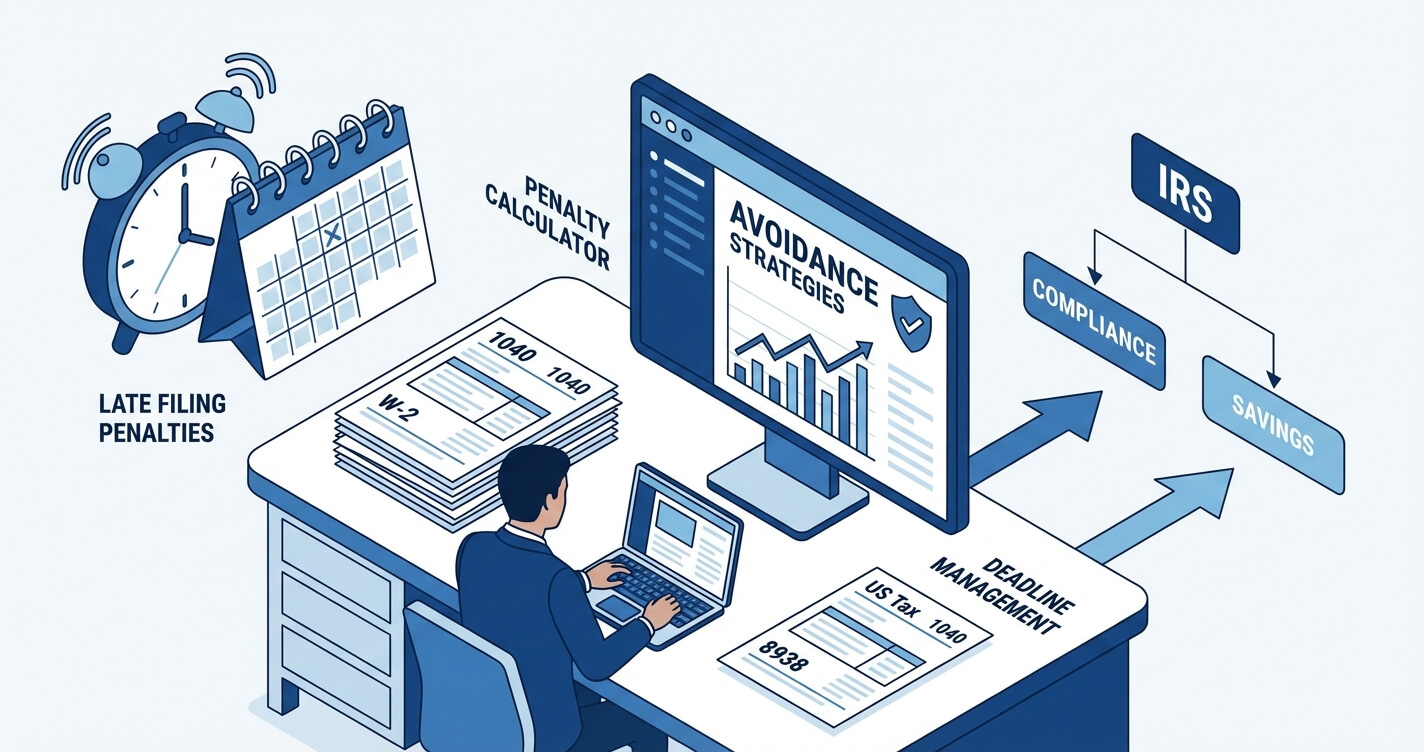
An IRS extension grants additional time to file the return, not to pay the tax. This distinction is critical when advising clients who assume extensions eliminate penalties.
If tax due is unpaid by the original deadline, interest accrues immediately, and failure-to-pay penalties may apply—even when a valid extension is on file.
Who typically needs an extension
Extensions are common for clients with delayed K-1s, complex investment income, multi-state reporting, or incomplete foreign disclosures. From a practitioner standpoint, extensions reduce the risk of errors caused by missing data.
Why extensions matter for compliance-focused firms
For firms handling high volumes of Forms 1040, 1065, and 1120-S, extensions are a workflow tool. They allow prioritization without compromising accuracy or exposing clients to failure-to-file penalties.
Practitioner Tip: Treat extensions as a planning decision, not a last-minute rescue. Document the rationale for each extension in your workpapers.
How Do Tax Extensions Work? A Step-by-Step Overview
Automatic vs approval-based extensions
Most IRS extensions are automatic. When filed correctly and on time, the IRS does not require an explanation or approval notice.
Extension timelines for individuals vs businesses
Each return has its own original and extended deadline. Extensions apply per return, not per taxpayer or EIN.
Fiscal year vs calendar year considerations
Fiscal-year entities calculate deadlines based on the year-end date. The extension period is added to the original due date tied to that fiscal close.
Practitioner Tip: Maintain a deadline matrix by entity type and year-end to avoid miscalculations during extension filing.
What Is Form 4868? Individual Tax Extension Explained
Purpose of Form 4868
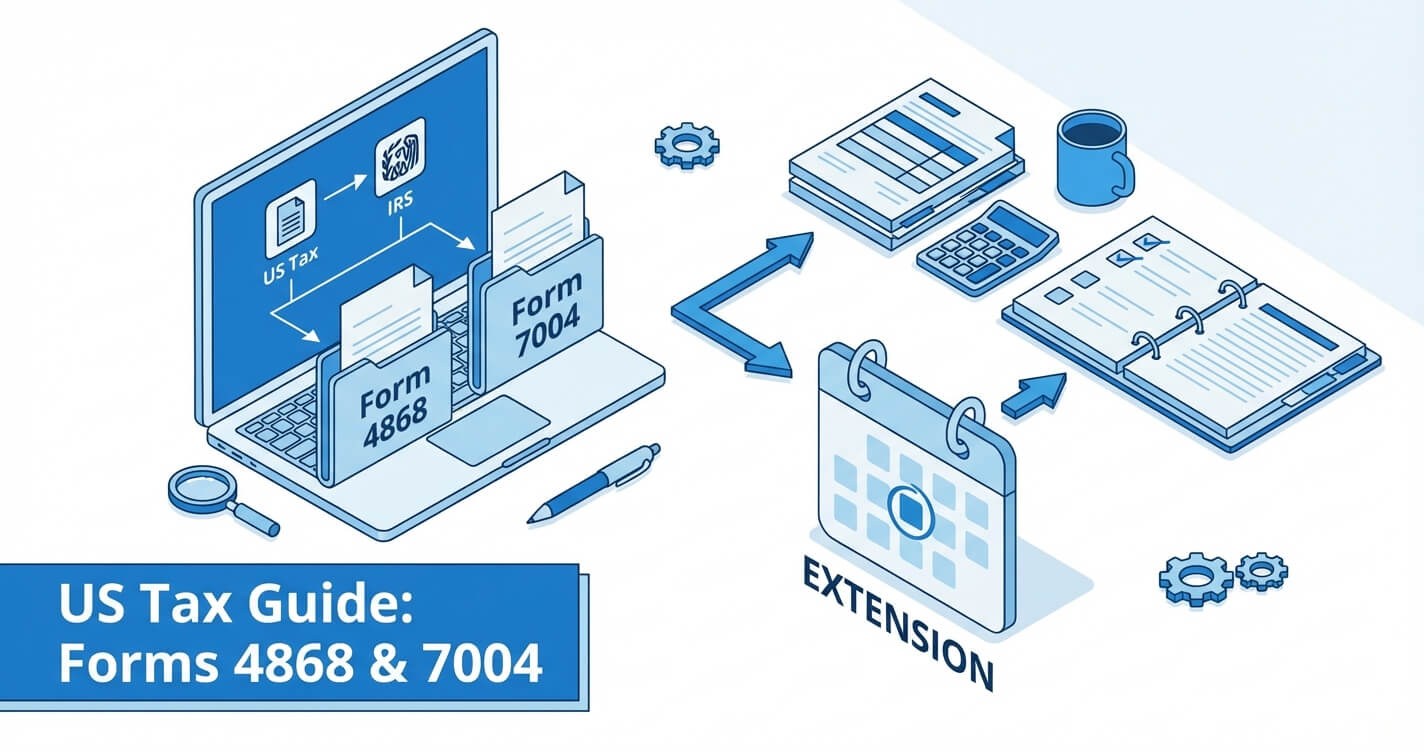
Form 4868 extends the filing deadline for individual income tax returns, primarily Form 1040, by six months.
The IRS provides detailed guidance in the IRS overview of Form 4868.
Who should file Form 4868
Common filers include individuals, sole proprietors, and single-member LLCs disregarded for tax purposes. Many of your US-connected clients will fall into this category.
Tax returns covered by Form 4868
The extension moves the deadline from April 15 to October 15. It can be e-filed standalone or submitted with an estimated payment.
Practitioner Tip: Even when no tax is expected, file Form 4868 to protect against late-filing penalties if information is incomplete.
What Is Form 7004? Business Tax Extension Explained
Purpose of Form 7004
Form 7004 is used to extend business income tax returns, including partnerships, corporations, and trusts.
Refer to the IRS overview of Form 7004 for entity-specific coverage.
Entities and returns covered
This includes Forms 1065, 1120, 1120-S, and 1041. EIN accuracy is essential—errors can invalidate the extension.
How extension periods vary by entity type
Most entities receive a 6-month extension. Certain trusts receive 5.5 months. Partnerships and S-Corps generally start earlier in March.
Practitioner Tip: Validate EINs against prior-year filings before transmitting Form 7004.
Form 7004 vs Form 4868: Key Differences at a Glance
| Aspect | Form 4868 | Form 7004 |
|---|---|---|
| Filer Type | Individuals | Businesses |
| Common Returns | 1040 | 1065, 1120, 1120-S |
| Original Deadline | April 15 | March 15 / April 15 |
| Extension Length | 6 months | Up to 6 months |
| Payment Required | Yes | Yes |
Extension Deadlines You Must Know (With Timeline Table)
Original filing deadlines by entity type
Extended deadlines (including October 15)
International and out-of-country filers
| Entity | Original Due Date | Extended Due Date |
|---|---|---|
| Individuals (1040) | April 15 | October 15 |
| Partnerships & S-Corps | March 15 | September 15 |
| C-Corps | April 15 | October 15 |
Out-of-country filers receive an automatic 2-month filing extension, but interest still accrues from the original due date.
Payment Requirements During an Extension
Why payment still matters
Taxes must be paid by the original due date to avoid penalties and interest. Extensions do not pause IRS collections.
Penalties vs interest explained
The failure-to-file penalty can reach 5% per month, capped at 25%. The failure-to-pay penalty is 0.5% per month. Interest accrues at IRS-set rates.
Safe Harbor rules and thresholds
Safe Harbor is met by paying 90% of current-year tax or 100% of prior-year tax (110% if AGI exceeds $150,000). Proper estimates significantly reduce exposure.
Estimating Tax Payments: Practical Methods That Work
Prior-year tax method
Using last year’s tax liability is the simplest Safe Harbor approach, especially when income is stable.
YTD income extrapolation
For growing businesses, annualize year-to-date income and adjust for seasonality.
Withholding and estimated tax reconciliation
Factor in W-2 withholding and quarterly estimates already paid. Intentional overpayment can reduce risk when data quality is low.
Extension Decision Framework: Should You File an Extension?
Document readiness assessment
Missing K-1s, brokerage statements, or foreign disclosures are strong indicators for extension.
Complexity and risk evaluation
Multi-state filings, foreign tax credits, and pass-through structures increase error risk if rushed.
Client communication and expectation setting
Explain that extensions are compliance tools, not red flags. Set payment expectations clearly.
Soft CTA: Firms handling dozens or hundreds of extensions often explore automation and AI-assisted preparation to standardize decisions and reduce seasonal overload.
Common Mistakes, State Extensions, and Ongoing Obligations
Thinking extensions delay payment
This misconception causes most penalties.
State tax extension mismatches
Many states require separate extensions or payments. Federal extensions do not guarantee state relief.
Estimated taxes during the extension period
Quarterly estimates remain due during the extension window.
Amended returns and extensions
Extensions do not limit the ability to file amended returns later.
Conclusion
For Indian CAs, mastering US tax extensions is about process, judgment, and communication. Forms 4868 and 7004 are simple mechanically, but the surrounding decisions—payments, Safe Harbor, and state compliance—define practitioner quality.
As your US tax practice scales, consider how standardized frameworks and technology can support consistent extension decisions and reduce peak-season stress, while maintaining technical accuracy.
FAQs
Do extensions reduce IRS scrutiny?
No. Extensions neither increase nor decrease audit risk. They simply provide more time to file accurately.
Can we file Form 4868 with zero payment?
Yes, but penalties and interest apply if tax is ultimately due. Advisable only when confident no balance exists.
Does Form 7004 extend partner K-1 deadlines?
Yes. Extending Form 1065 extends the partnership return and K-1 issuance.
Are state extensions automatic with federal ones?
Often no. Many states require separate filings or payments.
How do extensions affect quarterly estimated taxes?
They do not. Quarterly estimates remain due on their normal schedule.
Can amended returns be filed after an extension?
Yes. Extensions do not restrict amendment rights.
What happens if EIN is wrong on Form 7004?
The extension may be invalid, exposing the client to late-filing penalties.
Do international clients always get extra time?
They get an automatic 2-month filing extension, but payment is still due April 15.
Is Safe Harbor mandatory?
No, but meeting it significantly reduces penalty exposure.
How should firms document extension decisions?
Use a standardized checklist covering document readiness, estimates, and client approval.