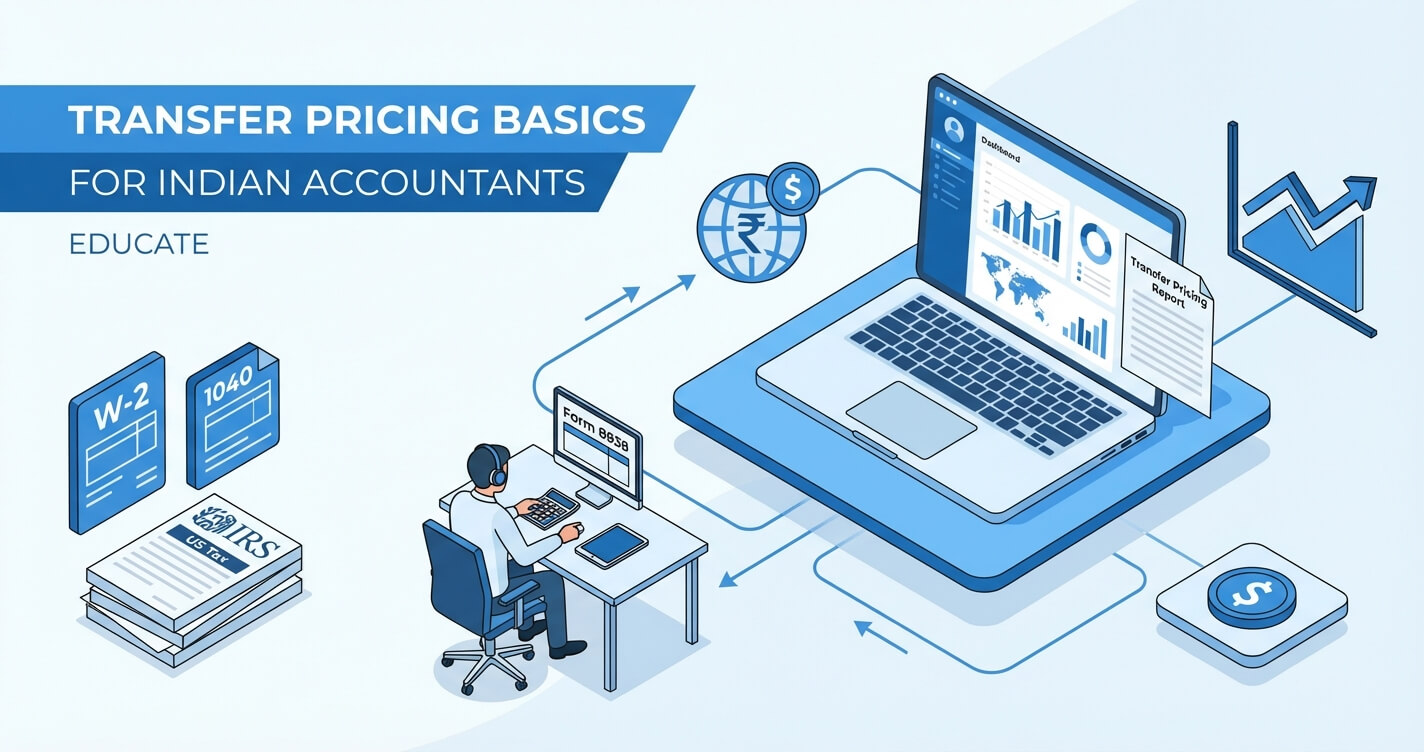
Transfer Pricing Basics for Indian Accountants

Content
Contents

Key Takeaways

  • Transfer pricing applies to all international transactions with Associated Enterprises, including those of startups and SMEs.
  • Indian transfer pricing law is governed by Sections 92 to 92F and detailed rules under Rule 10D.
  • The Arm’s Length Principle requires pricing comparable to unrelated parties, with limited tolerance ranges in specific cases.
  • Local file documentation is mandatory every year; Master File and CbCR apply only beyond prescribed thresholds.
  • Penalties for non-compliance can go up to 2% of transaction value, even without tax evasion intent.
  • Safe Harbour Rules and APAs can significantly reduce litigation risk for eligible small businesses.

Introduction: Transfer Pricing Basics for Indian Accountants

Why transfer pricing matters in India

As Indian CA firms increasingly support clients with overseas subsidiaries, US parent companies, or cross-border service arrangements, transfer pricing has become a routine compliance issue rather than a niche specialization. Even a simple captive service entity or overseas holding structure can trigger transfer pricing obligations.

Who should read this guide (with focus on small businesses)

This guide is written for Indian Chartered Accountants advising small and mid-sized businesses with international footprints. The focus is not on theory, but on how to handle transfer pricing practically for your clients.

You will learn the legal framework, documentation expectations, common SME mistakes, and cost-effective ways to stay compliant. The article also connects Indian transfer pricing to global concepts you may encounter while building US tax advisory capabilities.

What Is Transfer Pricing Under Indian Tax Law?

Meaning of transfer pricing

Transfer pricing refers to the pricing of goods, services, financing, or intangibles exchanged between related parties. The tax authority examines whether such pricing reflects market reality.

Legal framework: Sections 92 to 92F of the Income-tax Act, 1961

In India, transfer pricing is governed by Sections 92 to 92F, supported by detailed rules. These provisions mandate that income from international transactions be computed at arm’s length.

Practitioners should regularly refer to CBDT transfer pricing provisions and guidance for updates, forms, and clarifications.

Role of Section 482 conceptually (international context)

While Section 482 is a US tax provision, it mirrors the same global principle: preventing profit shifting through related-party pricing. Understanding this helps Indian CAs align Indian documentation with US expectations when supporting cross-border clients.

Associated Enterprises and Scope of Transfer Pricing

Associated Enterprises (AE): meaning and tests

An Associated Enterprise exists where there is ownership, control, or significant influence. Tests include shareholding of 26% or more, common management, dependence on intangibles, or funding relationships.

International transactions

International transactions include sale of goods, services, lending, guarantees, cost sharing, and use of IP between AEs across borders. Even management fees or reimbursements are covered.

Specified Domestic Transactions (SDT)

SDTs apply mainly to transactions between related Indian entities where profit-linked deductions are involved. The applicability threshold is ₹20 crore in aggregate value.

Practitioner Tip: SMEs often miss AE status due to informal control or funding arrangements. Always review shareholder agreements and loan terms.

Arm’s Length Standard Explained Simply

What is the Arm’s Length Principle?

The Arm’s Length Principle requires that related-party pricing mirror what independent parties would agree to under similar conditions.

Why arm’s length pricing is required

This principle prevents artificial profit shifting and ensures fair tax allocation across jurisdictions. It is globally accepted and forms the backbone of Indian transfer pricing law.

Tolerance range and practical challenges

Indian law allows a limited tolerance range, generally ±1% for wholesale trading and ±3% for other transactions, subject to conditions. This is not a standard deduction but a marginal relief.

For conceptual clarity, practitioners may refer to the OECD transfer pricing guidelines.

Methods to Determine Arm’s Length Price

Overview of prescribed methods

The prescribed methods include CUP, RPM, CPM, PSM, TNMM, and the Other Method. TNMM is most commonly used for captive service providers.

Selecting the most appropriate method

The selection depends on functions performed, assets used, and risks assumed (FAR analysis). Consistency and defensibility matter more than optimization.

Use of comparables in practice

Comparable selection involves database searches, functional screening, and adjustments. For SMEs, limited data often necessitates broader filters.

Practitioner Tip: Document why rejected comparables were excluded; this is critical during TPO scrutiny.

Transfer Pricing Documentation Requirements in India

Local file documentation

Rule 10D mandates detailed local file documentation covering business overview, transaction details, FAR analysis, method selection, and comparables.

Master file and country-by-country reporting

Master File applies if consolidated group revenue exceeds ₹500 crore and certain transaction thresholds are met. CbCR applies when group revenue exceeds €750 million.

Maintenance period and filing timelines

Documentation must be contemporaneous and maintained for 8 years. Form 3CEB is filed by 30 November of the assessment year.

Indian CAs advising on global mobility or US-linked structures may also encounter overlaps with issues like India–US totalization agreement compliance.

Practical Documentation Templates for Small Businesses

Minimum documentation checklist

At a minimum, maintain AE agreements, invoices, FAR analysis, and benchmarking summary.

Simple transfer pricing study structure

An SME-friendly study includes business description, transaction mapping, method justification, and a concise comparables table.

Common supporting documents

Emails, cost allocation workings, and intercompany policies are often decisive during assessments.

Transfer Pricing Compliance, Assessments, and Adjustments

Role of the Transfer Pricing Officer (TPO)

Cases are referred to the TPO during scrutiny. The TPO examines pricing and may propose adjustments.

Assessment and adjustment process

Adjustments increase taxable income and may trigger secondary adjustments.

Dispute resolution mechanisms

Options include Safe Harbour, APA, and Mutual Agreement Procedure (MAP). MAP is relevant where double taxation arises, especially with US entities.

Penalties for Non-Compliance With Transfer Pricing Rules

Penalties for documentation failures

Section 271AA imposes a penalty of 2% of transaction value for inadequate documentation.

Penalties for misreporting or adjustment

Section 270A can result in penalties of 50% to 200% of tax on under-reported income.

Other consequences

Interest, prolonged litigation, and reputational risk often outweigh tax cost.

Special Topics Indian Accountants Should Know

Safe Harbour Rules

Safe Harbour provides deemed arm’s length margins for eligible transactions. It is particularly useful for low-risk IT and KPO services.

Advance Pricing Agreements (APA)

APAs can be unilateral, bilateral, or multilateral, offering certainty for up to 5 years with rollback benefits.

Section 115BAB and transfer pricing impact

Companies opting for 115BAB must still comply with transfer pricing; aggressive pricing can jeopardize the concessional regime.

Conclusion: Getting Transfer Pricing Right From Day One

For Indian accountants, transfer pricing is no longer optional knowledge. Even small clients with overseas links face real compliance exposure.

Getting the arm’s length analysis and documentation right from day one reduces disputes and builds credibility with global clients. As you expand into US tax and cross-border advisory, structured tools, templates, and expert platforms can make transfer pricing manageable and scalable.

Exploring practitioner-focused solutions like FlowTax.ai can help simplify documentation and support your firm’s international growth.

FAQs

Does transfer pricing apply to small Indian startups?

Yes. There is no minimum turnover exemption for international transactions. Even early-stage startups with foreign parents or investors may be covered.

Is Form 3CEB mandatory every year?

Yes. If there is any international transaction or SDT, Form 3CEB must be filed annually by the due date.

Can TNMM be used for most service entities?

In practice, yes. TNMM is widely accepted for captive, low-risk service providers when CUP is not feasible.

What is the biggest risk area for SMEs?

Poor documentation. Many SMEs have correct pricing but cannot substantiate it during assessment.

Are Safe Harbour Rules automatic?

No. The taxpayer must opt in and meet strict eligibility and margin conditions.

When should an APA be considered?

When transaction values are large or litigation risk is recurring. APAs provide long-term certainty.

What triggers Master File filing?

Group revenue above ₹500 crore plus transaction thresholds relating to intangibles or services.

How does MAP help Indian taxpayers?

MAP resolves double taxation arising from bilateral adjustments, especially with US entities.

Does Section 115BAB reduce TP scrutiny?

No. In fact, authorities closely examine transfer pricing to prevent base erosion under concessional regimes.

Can Indian CAs handle TP without in-house specialists?

Yes, with structured templates, databases, and expert support platforms, SMEs can be serviced efficiently.

Key Takeaways

  • Transfer pricing applies to all international transactions with Associated Enterprises, including those of startups and SMEs.
  • Indian transfer pricing law is governed by Sections 92 to 92F and detailed rules under Rule 10D.
  • The Arm’s Length Principle requires pricing comparable to unrelated parties, with limited tolerance ranges in specific cases.
  • Local file documentation is mandatory every year; Master File and CbCR apply only beyond prescribed thresholds.
  • Penalties for non-compliance can go up to 2% of transaction value, even without tax evasion intent.
  • Safe Harbour Rules and APAs can significantly reduce litigation risk for eligible small businesses.

Introduction: Transfer Pricing Basics for Indian Accountants

Why transfer pricing matters in India

As Indian CA firms increasingly support clients with overseas subsidiaries, US parent companies, or cross-border service arrangements, transfer pricing has become a routine compliance issue rather than a niche specialization. Even a simple captive service entity or overseas holding structure can trigger transfer pricing obligations.

Who should read this guide (with focus on small businesses)

This guide is written for Indian Chartered Accountants advising small and mid-sized businesses with international footprints. The focus is not on theory, but on how to handle transfer pricing practically for your clients.

You will learn the legal framework, documentation expectations, common SME mistakes, and cost-effective ways to stay compliant. The article also connects Indian transfer pricing to global concepts you may encounter while building US tax advisory capabilities.

What Is Transfer Pricing Under Indian Tax Law?

Meaning of transfer pricing

Transfer pricing refers to the pricing of goods, services, financing, or intangibles exchanged between related parties. The tax authority examines whether such pricing reflects market reality.

Legal framework: Sections 92 to 92F of the Income-tax Act, 1961

In India, transfer pricing is governed by Sections 92 to 92F, supported by detailed rules. These provisions mandate that income from international transactions be computed at arm’s length.

Practitioners should regularly refer to CBDT transfer pricing provisions and guidance for updates, forms, and clarifications.

Role of Section 482 conceptually (international context)

While Section 482 is a US tax provision, it mirrors the same global principle: preventing profit shifting through related-party pricing. Understanding this helps Indian CAs align Indian documentation with US expectations when supporting cross-border clients.

Associated Enterprises and Scope of Transfer Pricing

Associated Enterprises (AE): meaning and tests

An Associated Enterprise exists where there is ownership, control, or significant influence. Tests include shareholding of 26% or more, common management, dependence on intangibles, or funding relationships.

International transactions

International transactions include sale of goods, services, lending, guarantees, cost sharing, and use of IP between AEs across borders. Even management fees or reimbursements are covered.

Specified Domestic Transactions (SDT)

SDTs apply mainly to transactions between related Indian entities where profit-linked deductions are involved. The applicability threshold is ₹20 crore in aggregate value.

Practitioner Tip: SMEs often miss AE status due to informal control or funding arrangements. Always review shareholder agreements and loan terms.

Arm’s Length Standard Explained Simply

What is the Arm’s Length Principle?

The Arm’s Length Principle requires that related-party pricing mirror what independent parties would agree to under similar conditions.

Why arm’s length pricing is required

This principle prevents artificial profit shifting and ensures fair tax allocation across jurisdictions. It is globally accepted and forms the backbone of Indian transfer pricing law.

Tolerance range and practical challenges

Indian law allows a limited tolerance range, generally ±1% for wholesale trading and ±3% for other transactions, subject to conditions. This is not a standard deduction but a marginal relief.

For conceptual clarity, practitioners may refer to the OECD transfer pricing guidelines.

Methods to Determine Arm’s Length Price

Overview of prescribed methods

The prescribed methods include CUP, RPM, CPM, PSM, TNMM, and the Other Method. TNMM is most commonly used for captive service providers.

Selecting the most appropriate method

The selection depends on functions performed, assets used, and risks assumed (FAR analysis). Consistency and defensibility matter more than optimization.

Use of comparables in practice

Comparable selection involves database searches, functional screening, and adjustments. For SMEs, limited data often necessitates broader filters.

Practitioner Tip: Document why rejected comparables were excluded; this is critical during TPO scrutiny.

Transfer Pricing Documentation Requirements in India

Local file documentation

Rule 10D mandates detailed local file documentation covering business overview, transaction details, FAR analysis, method selection, and comparables.

Master file and country-by-country reporting

Master File applies if consolidated group revenue exceeds ₹500 crore and certain transaction thresholds are met. CbCR applies when group revenue exceeds €750 million.

Maintenance period and filing timelines

Documentation must be contemporaneous and maintained for 8 years. Form 3CEB is filed by 30 November of the assessment year.

Indian CAs advising on global mobility or US-linked structures may also encounter overlaps with issues like India–US totalization agreement compliance.

Practical Documentation Templates for Small Businesses

Minimum documentation checklist

At a minimum, maintain AE agreements, invoices, FAR analysis, and benchmarking summary.

Simple transfer pricing study structure

An SME-friendly study includes business description, transaction mapping, method justification, and a concise comparables table.

Common supporting documents

Emails, cost allocation workings, and intercompany policies are often decisive during assessments.

Transfer Pricing Compliance, Assessments, and Adjustments

Role of the Transfer Pricing Officer (TPO)

Cases are referred to the TPO during scrutiny. The TPO examines pricing and may propose adjustments.

Assessment and adjustment process

Adjustments increase taxable income and may trigger secondary adjustments.

Dispute resolution mechanisms

Options include Safe Harbour, APA, and Mutual Agreement Procedure (MAP). MAP is relevant where double taxation arises, especially with US entities.

Penalties for Non-Compliance With Transfer Pricing Rules

Penalties for documentation failures

Section 271AA imposes a penalty of 2% of transaction value for inadequate documentation.

Penalties for misreporting or adjustment

Section 270A can result in penalties of 50% to 200% of tax on under-reported income.

Other consequences

Interest, prolonged litigation, and reputational risk often outweigh tax cost.

Special Topics Indian Accountants Should Know

Safe Harbour Rules

Safe Harbour provides deemed arm’s length margins for eligible transactions. It is particularly useful for low-risk IT and KPO services.

Advance Pricing Agreements (APA)

APAs can be unilateral, bilateral, or multilateral, offering certainty for up to 5 years with rollback benefits.

Section 115BAB and transfer pricing impact

Companies opting for 115BAB must still comply with transfer pricing; aggressive pricing can jeopardize the concessional regime.

Conclusion: Getting Transfer Pricing Right From Day One

For Indian accountants, transfer pricing is no longer optional knowledge. Even small clients with overseas links face real compliance exposure.

Getting the arm’s length analysis and documentation right from day one reduces disputes and builds credibility with global clients. As you expand into US tax and cross-border advisory, structured tools, templates, and expert platforms can make transfer pricing manageable and scalable.

Exploring practitioner-focused solutions like FlowTax.ai can help simplify documentation and support your firm’s international growth.

FAQs

Does transfer pricing apply to small Indian startups?

Yes. There is no minimum turnover exemption for international transactions. Even early-stage startups with foreign parents or investors may be covered.

Is Form 3CEB mandatory every year?

Yes. If there is any international transaction or SDT, Form 3CEB must be filed annually by the due date.

Can TNMM be used for most service entities?

In practice, yes. TNMM is widely accepted for captive, low-risk service providers when CUP is not feasible.

What is the biggest risk area for SMEs?

Poor documentation. Many SMEs have correct pricing but cannot substantiate it during assessment.

Are Safe Harbour Rules automatic?

No. The taxpayer must opt in and meet strict eligibility and margin conditions.

When should an APA be considered?

When transaction values are large or litigation risk is recurring. APAs provide long-term certainty.

What triggers Master File filing?

Group revenue above ₹500 crore plus transaction thresholds relating to intangibles or services.

How does MAP help Indian taxpayers?

MAP resolves double taxation arising from bilateral adjustments, especially with US entities.

Does Section 115BAB reduce TP scrutiny?

No. In fact, authorities closely examine transfer pricing to prevent base erosion under concessional regimes.

Can Indian CAs handle TP without in-house specialists?

Yes, with structured templates, databases, and expert support platforms, SMEs can be serviced efficiently.
Latest from our blogs

Latest from our blogs

View All
]