Key Takeaways
- CP2000 is an IRS Underreporter Notice, not a formal audit, triggered by document matching mismatches.
- Clients typically have 30 days from the notice date to respond before proposed tax is assessed.
- Most CP2000s involve unreported 1099 income, stock sales without cost basis, or corrected payer forms.
- Practitioners can respond by agreeing, partially agreeing, or disagreeing, using the enclosed response form and a detailed letter.
- Failure to respond results in automatic assessment and potential escalation to a Notice of Deficiency (90-day letter).
- Use Form 2848 to represent clients and centralize IRS communication.
Introduction
As Indian Chartered Accountants expand into US tax preparation, CP2000 notices are among the most common IRS communications you will handle for clients. These notices often arrive unexpectedly and can concern clients, even when the issue is a simple reporting mismatch.
This article is written for practitioners who want a clear, repeatable framework for responding to CP2000 notices professionally and efficiently. You will learn how CP2000 notices are generated, how to analyze the IRS adjustments, and how to respond—whether you agree or disagree with the proposed changes.
We also include a practical CP2000 response letter template and a documentation checklist you can reuse across cases. Mastering CP2000 responses helps you protect clients from unnecessary assessments while positioning your firm as a reliable US tax advisor.
What Is a CP2000 Notice?
CP2000 as an Underreporter Notice
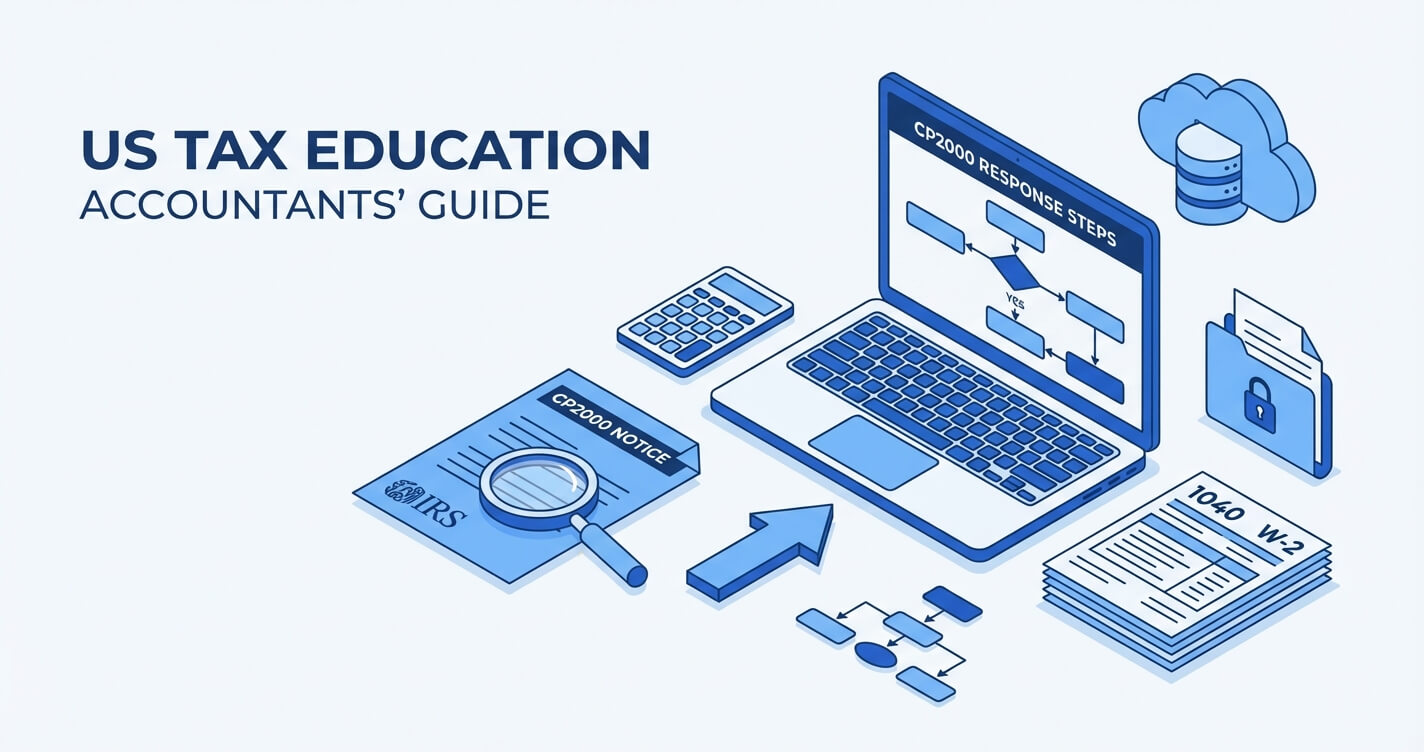
A CP2000 is an IRS Underreporter Notice issued when income reported on third-party documents does not match what was reported on the filed return. It is important to explain to clients that this is not a formal audit.
The notice proposes changes to income, tax, penalties, and interest, giving the taxpayer an opportunity to respond before any assessment is made.
How CP2000 Is Generated
The IRS runs automated matching programs comparing filed returns against Forms W-2, 1099, K-1, and brokerage statements received from payers. Any mismatch triggers a CP2000.
For official context, refer to IRS guidance on CP2000 Underreporter Notices.
What CP2000 Is Not
A CP2000 is not a final tax bill and does not mean the IRS is accusing fraud. The response window is typically 30 days, and common taxes affected include income tax, self-employment tax, and refundable credits.
Practitioner Tip: Position CP2000s as routine compliance issues to reduce client anxiety and improve cooperation.
Why Did Your Client Receive a CP2000?
Common Income Mismatches
The most frequent trigger is unreported or underreported income, such as missing Forms 1099-NEC, 1099-INT, 1099-DIV, or W-2. This often happens when clients overlook small income streams.
Reporting vs Timing Issues
Stock sales reported on Form 1099-B without cost basis are a major CP2000 driver. The IRS assumes zero basis unless properly reported, inflating taxable income.
Timing differences, such as income reported in the wrong tax year, can also trigger mismatches.
Third-Party Reporting Errors
Payers sometimes issue duplicate or corrected forms. In many CP2000 cases, the client did not omit income—the payer misreported it.
Practitioner Tip: Always confirm whether income was omitted or merely mischaracterized before drafting a response.
Review the CP2000 Notice Carefully
Understanding the Notice Layout
The CP2000 includes an income comparison table showing IRS figures versus reported amounts. Start here to identify the source of the mismatch.
Comparing IRS Figures to the Tax Return
Reconcile each line item with the filed return and source documents. Pay attention to the tax year and the notice number, which must be referenced in all correspondence.
Identifying What the IRS Changed
The notice will show proposed tax, penalties, and interest. Determine whether the IRS adjusted income, disallowed deductions, or reversed credits.
Practitioner Tip: Create a reconciliation worksheet—this becomes the backbone of your response letter.
How to Respond to a CP2000 Notice (Step-by-Step)
Decide Whether You Agree, Partially Agree, or Disagree
There are three response paths: agree fully, partially agree, or disagree. Each requires completing the response form attached to the notice.
Prepare the CP2000 Response Letter
A detailed response letter is recommended when disagreeing or partially agreeing. Reference each proposed adjustment clearly and attach supporting documents.
If more time is needed, request an extension in writing before the deadline. The IRS often grants reasonable extensions.
Submit Your Response to the IRS
Responses can be submitted by mail or fax as instructed in the notice. Online options may be available in limited cases.
When representing a client, include Form 2848 (Power of Attorney) to authorize you to act on their behalf.
For broader context on IRS correspondence handling, see our IRS notices and correspondence guide for preparers. The IRS also outlines general notice procedures in IRS Tax Topic 652 on notices and bills.
If You Agree With the CP2000
Agreeing Completely
If the proposed changes are correct, sign and return the response form indicating agreement. Advise clients to pay promptly to limit interest accrual.
Payment Options
Payments can be made using Form 1040-V or IRS Direct Pay. If full payment is not possible, consider installment plans.
For detailed setup guidance, refer to IRS installment agreement setup.
Practitioner Tip: Always confirm the IRS posts payment correctly after agreement.
If You Disagree With the CP2000
Disagreeing Completely
Clearly state the basis of disagreement in the response letter. Reference IRS figures and explain why they are incorrect.
Partially Agreeing With Adjustments
In partial agreements, specify which items you accept and which you dispute. This often leads to faster resolution.
What Happens After You Disagree
The IRS will review your response and may issue a revised CP2000, a no-change letter, or escalate to a Notice of Deficiency. After a Notice of Deficiency, the client has 90 days to petition the US Tax Court.
Practitioner Tip: Many cases resolve favorably at the CP2000 stage if documentation is clear.
CP2000 Response Letter Template (Unique Angle)
Required Elements of a Strong Response Letter
A strong letter includes taxpayer details, notice number, tax year, a clear position, and line-by-line explanations tied to the CP2000.
Sample CP2000 Response Letter
Re: CP2000 Notice – Tax Year [YYYY]
Taxpayer Name: [Name]
SSN/ITIN: [XXX-XX-XXXX]
Notice Number: [CP2000 Reference]
I am responding to the CP2000 notice dated [date]. I [agree/disagree/partially agree] with the proposed changes for the reasons outlined below.
Line Item Explanation:
1. Form 1099-B income of $[amount]: Correct cost basis of $[amount] is attached, resulting in no additional taxable gain.
Supporting documents are enclosed. Please contact me if additional information is required.
Sincerely,
[Authorized Representative]
Supporting Documentation Checklist (Unique Angle)
Common Documents to Include
- Forms W-2, 1099 series, and K-1s
- Brokerage statements with cost basis
- Bank statements and income reconciliation schedules
- Corrected or amended payer forms
Best Practices for Submitting Documentation
Label all documents clearly and cross-reference them to your response letter. Never send original documents—only copies.
Practitioner Tip: Use a cover index listing attachments for faster IRS review.
What Happens If You Don’t Respond?
Default IRS Action
If no response is received, the IRS will assess the proposed tax automatically. Interest and penalties continue to accrue.
Escalation to Notice of Deficiency
The case may escalate to a Notice of Deficiency, limiting dispute options and increasing compliance costs.
Conclusion
CP2000 notices are a routine but critical part of US tax compliance. For Indian CAs, handling them correctly demonstrates technical competence and builds client trust.
By following a structured review process, using clear response letters, and submitting proper documentation, most CP2000 cases can be resolved without escalation. As you build US tax capabilities, develop standardized templates and checklists to streamline responses across clients.
FAQ
Is a CP2000 the same as an IRS audit?
No. A CP2000 is an automated underreporter notice, not a field or correspondence audit. It is based on document matching.
Can a CA based in India respond to CP2000 on behalf of a client?
Yes, with a valid Form 2848 authorizing representation. The IRS accepts responses from authorized foreign practitioners.
What is the typical response deadline?
Most CP2000 notices allow 30 days from the notice date. Always confirm the exact deadline on the notice.
Can we request more time to respond?
Yes. A written extension request submitted before the deadline is often granted.
What if the client accidentally underreported income?
Acknowledge the omission, agree with the adjustment, and focus on minimizing penalties and interest.
Does responding stop interest accrual?
No. Interest continues until payment is made, but timely response avoids additional penalties.
What happens after a Notice of Deficiency?
The client has 90 days to petition the US Tax Court. Missing this window finalizes the assessment.
Should we file an amended return instead?
Generally, respond directly to the CP2000. Amended returns are usually not required unless instructed.
How long does IRS take to reply?
Processing can take 8–12 weeks or longer, depending on complexity.
Can CP2000 issues recur in future years?
Yes, if underlying reporting issues are not corrected. Educate clients to prevent repeat notices.