Key Takeaways
- US tax preparers are not mandated by the IRS to carry E&O insurance, but most US clients and partner firms require proof before onboarding.
- Typical E&O limits for small practices range from $250,000 to $1 million per claim, with claims-made policies being standard.
- Retroactive dates are critical because claims can arise years after a return is filed, especially for 1040, 1065, and 1120-S filings.
- Cyber liability coverage is increasingly expected due to handling of SSNs, EINs, and bank data for US clients.
- Indian professional indemnity policies are often not accepted by US firms; US-issued E&O policies are preferred.
- Coverage requirements should scale with return volume, complexity, and whether the firm operates as a white-label service provider.
Introduction
As more Indian Chartered Accountants expand into US tax preparation, professional risk management becomes as important as technical compliance. Serving US clients from India introduces a different liability landscape, driven not by Indian regulations but by US client expectations and legal norms.
Professional liability insurance—commonly referred to as Errors and Omissions (E&O) coverage—is one of the most misunderstood areas for Indian CAs entering the US tax services market. Many assume it is optional or that Indian professional indemnity policies are sufficient.
This article explains how professional liability insurance works for US tax preparers, what is required versus what the market expects, and how Indian firms can obtain appropriate coverage from India. The focus is practical: how to structure insurance based on your service model, client base, and scale, so you can confidently offer US tax preparation services.
What Is Professional Liability Insurance for US Tax Preparers?
Errors and Omissions (E&O) vs Professional Liability vs Malpractice Coverage
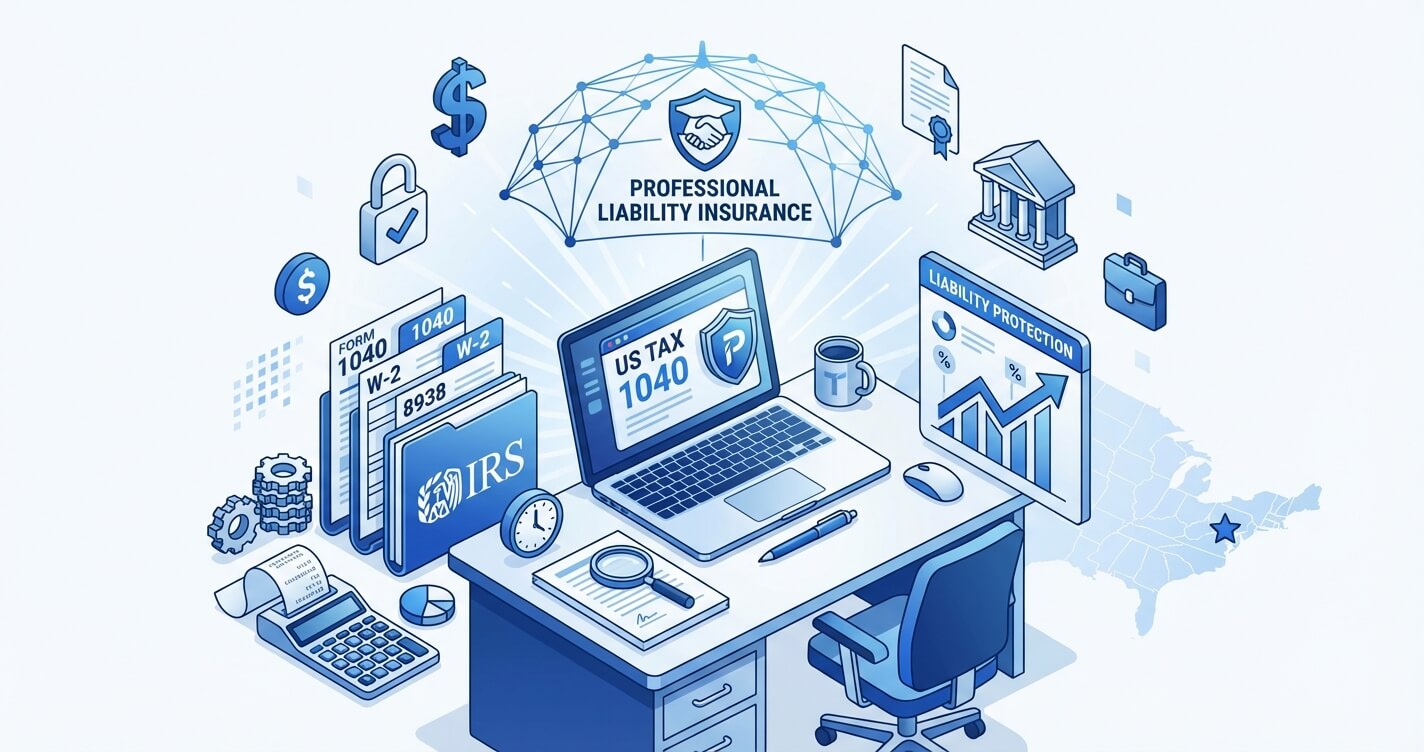
Professional liability insurance for US tax preparers is typically referred to as Errors and Omissions (E&O) coverage. The terms professional liability, E&O, and malpractice are often used interchangeably in insurance documents, with no meaningful difference in scope for tax professionals.
These policies are almost always claims-made, meaning the policy in force when a claim is made—not when the work was performed—responds to the claim. This makes retroactive dates and continuous coverage critical.
Why US tax preparation carries cross-border risk
US tax returns involve statutory deadlines, elections, and disclosures that can trigger financial loss if handled incorrectly. Exposure exists across individual and entity filings, including Forms 1040, 1065, 1120-S, as well as FBAR and FATCA compliance.
For Indian CAs, cross-border risk increases because clients are subject to US law while services are delivered offshore. Jurisdictional issues do not eliminate liability; they often complicate defense and settlement.
Practitioner Tip: Treat US tax E&O as a business prerequisite, not a compliance afterthought, especially when serving clients directly.
Do Indian Tax Preparers Need E&O Insurance to File US Returns?
IRS requirements vs client and market expectations
The IRS does not mandate E&O insurance for tax return preparers. IRS compliance focuses on registration and conduct, including IRS PTIN requirements for tax return preparers and adherence to IRS Circular 230 requirements for tax professionals.
However, market expectations differ sharply. US clients, CPA firms, and online marketplaces frequently require a Certificate of Insurance (COI) before engagement.
Who is most exposed to liability risk
Independent preparers, freelancers, and white-label service providers face the highest exposure. Even when work is reviewed by a US CPA, claims can name all parties involved.
Outsourcing does not eliminate liability. If your firm prepares or substantially contributes to a return, you can still be named in a negligence claim.
Practitioner Tip: Align your insurance coverage with client contracts and engagement letters to avoid uninsured gaps.
What Coverage Is Required or Recommended for Indian Preparers?
Core E&O / Professional Liability coverage
For small to mid-sized firms, recommended E&O limits typically range from $250,000 to $1 million per claim. Coverage generally includes negligence, filing errors, missed elections, and incorrect tax advice.
Defense costs coverage is critical, as legal expenses can exceed settlement amounts. Confirm whether defense costs are inside or outside policy limits.
Coverage limits, deductibles, and retroactive dates
Retroactive coverage ensures protection for prior-year returns. Without it, claims related to earlier filings may be excluded.
Deductibles vary, but many policies offer $2,500–$10,000 deductibles depending on firm size and claims history.
What is typically excluded from coverage
Standard exclusions include intentional fraud, criminal acts, penalties, and unpaid taxes. Policies cover professional negligence—not tax liabilities themselves.
Firms focused only on 1040 preparation may require lower limits than those handling entities, elections, or advisory work.
Practitioner Tip: Review exclusions carefully when expanding from compliance-only work to advisory services.
Additional Insurance Indian US Tax Preparers Should Consider
Cyber liability and data breach risk
US tax preparation involves handling sensitive data such as SSNs, EINs, and bank details. Cyber liability insurance addresses data breaches, ransomware, and notification costs.
Many E&O policies exclude cyber incidents, making standalone cyber coverage essential.
General liability and BOP considerations
General Liability becomes relevant if the firm has a US office or client-facing presence. Some insurers bundle E&O, cyber, and general liability into a Business Owner’s Policy (BOP).
Workers’ compensation and subcontractor issues
Using contractors or seasonal staff can create coverage gaps. Misclassification risks are common in cross-border delivery models.
Practitioner Tip: Map your data flow and staffing model before selecting cyber and ancillary coverages.
How to Get Professional Liability Insurance from India
US insurers that write policies for non-US preparers
Several US insurers and brokers offer E&O policies to foreign-based tax preparers. These policies are governed by US law and recognized by US clients.
Indian vs US-issued policies: what clients accept
Indian professional indemnity policies often lack territorial scope or US jurisdiction acceptance. US-issued E&O policies are generally preferred and sometimes contractually required.
Application, underwriting, and compliance process
Underwriting typically requires details on annual revenue, number of returns prepared, services offered, and staff credentials. Policies are issued digitally, with COIs available immediately.
Claims can be reported from India, with defense coordinated through US counsel.
Practitioner Tip: Maintain documentation of workflows and reviews; insurers may request this during underwriting.
Coverage Recommendations Based on Firm Size and Service Model
Solo preparers and freelancers
For 50–200 returns annually, $250k–$500k limits are common. Focus on strong retroactive coverage and cyber add-ons.
Small firms and white-label service providers
Firms handling 500–1,000+ returns or entity work should consider $1M or higher limits. Advisory services and white-label arrangements justify higher coverage.
Standardized workflows, as discussed in US tax preparer compliance requirements, reduce claim frequency and premiums.
Practitioner Tip: Reassess coverage annually as return volume and complexity increase.
Conclusion
Professional liability insurance is not an IRS mandate, but it is a practical necessity for Indian CAs offering US tax services. The real driver is market expectation—clients, partners, and platforms want assurance that professional risks are insured.
Choosing the right E&O coverage requires understanding claims-made policies, retroactive dates, and how cyber risks intersect with tax work. Indian firms can access US-issued policies from India, provided underwriting information is clear and accurate.
As you scale US tax offerings, align insurance limits with service complexity, contracts, and delivery models. This approach protects your firm while reinforcing credibility with US clients.
FAQ
Is E&O insurance mandatory for US tax preparers?
No, the IRS does not require E&O insurance. However, most US clients and partner firms expect it. In practice, lack of coverage can block engagements. It is effectively a market requirement.
Can Indian CAs use Indian professional indemnity insurance?
Indian policies are often not accepted by US clients. They may lack US jurisdiction coverage. US-issued E&O policies are generally preferred. Always verify client contract requirements.
What retroactive date should we select?
The retroactive date should cover the earliest year of US returns prepared. Claims can arise years later. Gaps in retroactive coverage create uninsured exposure. Continuous coverage is key.
Does E&O cover IRS penalties and client taxes?
No, penalties and unpaid taxes are excluded. E&O covers negligence and defense costs. It does not pay client tax liabilities. This distinction should be explained to clients.
How much coverage is enough for a small firm?
$250k–$1M per claim is common for small firms. Entity work and advisory services justify higher limits. Coverage should align with engagement risk. Annual reviews are recommended.
Is cyber liability really necessary for tax preparers?
Yes, due to sensitive data handling. E&O often excludes cyber incidents. Separate cyber coverage addresses breaches and ransomware. Many clients now expect it.
Can claims be handled from India?
Yes, claims can be reported from India. Insurers coordinate defense through US counsel. Communication is typically digital. Time zone differences should be planned for.
What information do insurers ask during underwriting?
They ask about revenue, return volume, services, and credentials. Prior claims history is reviewed. Workflow controls may be requested. Accuracy is important for coverage validity.
Does white-label work increase liability?
Yes, white-label providers are often named in claims. Review agreements carefully. Higher limits are advisable. Insurance should mirror contractual risk.
How often should coverage be reviewed?
At least annually or after service expansion. Changes in volume or complexity affect risk. Insurers adjust premiums accordingly. Regular reviews prevent gaps.