Key Takeaways
- An Offer in Compromise (OIC) is a discretionary IRS settlement under IRC §7122, not an entitlement.
- Most accepted OICs are based on Doubt as to Collectibility, driven by Reasonable Collection Potential (RCP).
- All required tax returns must be filed, and clients must be current on estimated taxes and payroll deposits before applying.
- The IRS generally rejects offers below calculated RCP, which includes asset equity plus future income.
- Lump-sum cash offers use a 12-month future income multiplier; periodic payment offers use 24 months.
- Pre-screening using IRS tools and internal checklists materially improves acceptance rates and protects preparer credibility.
Introduction
As Indian Chartered Accountants expand into US tax representation, collections resolution is a capability that immediately differentiates a serious practice from basic compliance providers. Clients with IRS debt often ask about “settlements,” and the Offer in Compromise (OIC) is usually the first concept they hear about—often with unrealistic expectations.
This article is written from a preparer-to-preparer perspective. It explains how OICs actually work, how the IRS evaluates them, and—most importantly—how you should pre-screen cases before recommending this path. Understanding OIC mechanics allows you to advise clients accurately, avoid low-probability filings, and position yourself as a trusted US tax advisor rather than a form-filler.
We will cover OIC types, eligibility rules, Reasonable Collection Potential (RCP) calculations, offer computation methodology, and common mistakes. The goal is not just knowledge, but a practical framework you can apply when evaluating client cases.
What Is an Offer in Compromise (OIC)?
Definition and statutory purpose
An Offer in Compromise is a formal IRS program that allows a taxpayer to settle federal tax liabilities for less than the full amount owed. The authority for OICs comes from IRC §7122, which permits the IRS to compromise tax debts under prescribed circumstances.
From a preparer’s perspective, an OIC is a collections alternative—not a right. The IRS evaluates whether accepting less than the full balance makes economic sense compared to continued collection efforts. For background, refer to the IRS Offer in Compromise program overview.
When an OIC makes sense vs. other IRS resolutions
An OIC is appropriate when the IRS cannot reasonably collect the full liability before the statute expires. In contrast, clients with positive cash flow and realizable assets are usually better suited for installment agreements or other arrangements.
As advisors, you must compare OICs against alternatives such as IRS installment agreement options, Currently Not Collectible (CNC) status, or—in limited cases—bankruptcy coordination. Practitioner Tip: Always frame OICs as one option in a resolution strategy, not the default solution.
Types of IRS Offers in Compromise
Doubt as to Collectibility
Doubt as to Collectibility (DATC) applies when the taxpayer’s assets and income are insufficient to pay the full liability. This is by far the most common OIC type you will handle for individuals and small business owners.
DATC cases are entirely driven by Reasonable Collection Potential. If RCP equals or exceeds the liability, acceptance is unlikely.
Doubt as to Liability
Doubt as to Liability applies when there is a genuine dispute about whether the tax is legally owed. This is not a financial hardship analysis.
Preparers should consider this only when there are strong technical grounds—incorrect assessments, audit errors, or misapplied payments. Financial disclosures are minimal, but documentation standards are high.
Effective Tax Administration
Effective Tax Administration (ETA) applies when full collection would be inequitable despite ability to pay. These cases are rare and heavily scrutinized.
ETA is usually limited to extraordinary circumstances (serious illness, advanced age) and is not a planning tool for typical clients.
Who Qualifies for an Offer in Compromise?
IRS eligibility requirements
Before submission, all required tax returns must be filed. For individuals, this includes prior-year Forms 1040. For businesses, all payroll and income tax filings must be current.
Clients must also be compliant with estimated tax payments and federal tax deposits. Non-compliance is an automatic disqualifier.
Disqualifying conditions
Taxpayers in an active bankruptcy proceeding are not eligible for an OIC. The IRS will return the offer without review.
Open audits or unfiled returns often delay or derail cases, even if not technically disqualifying.
Common preparer misconceptions
Hardship alone does not guarantee acceptance. The IRS focuses on ability to pay, not sympathy.
Another common myth is that “everyone qualifies.” In practice, many clients with stable income and modest assets do not.
OIC Qualification Pre-Screening for Preparers (Unique Angle)
Why pre-screening matters for preparers
Pre-screening protects your credibility and saves months of wasted effort. Submitting weak OICs signals poor advisory judgment to both clients and the IRS.
Practitioner Tip: Treat pre-screening as a mandatory engagement phase, not an optional step.
Using the IRS OIC Pre-Qualifier Tool
The IRS Offer in Compromise Pre-Qualifier Tool provides a high-level eligibility estimate based on income, expenses, assets, and liability.
While not binding, it helps you quickly identify cases with obvious RCP issues.
Internal pre-screen checklist
Effective preparer pre-screening should include:
- Filing compliance confirmed for all years
- Current estimated tax and payroll deposit compliance
- Stable vs. declining income analysis
- Asset equity review (especially real estate and retirement accounts)
- Statute of limitations timeline (10-year CSED)
Red flags include high home equity, recent asset transfers, and consistent surplus cash flow.
What Is Reasonable Collection Potential (RCP)?
Definition of RCP
Reasonable Collection Potential is the IRS’s estimate of how much it can collect from a taxpayer through enforced or voluntary means before the collection statute expires.
RCP equals net realizable asset equity plus a multiple of future monthly disposable income.
Why RCP drives OIC acceptance
The IRS generally will not accept an offer for less than RCP. This makes RCP the core analytical concept in OIC work.
Practitioner Tip: If you do not agree with the RCP number, do not submit the offer.
How the IRS Calculates RCP
Asset equity calculation
Assets include cash, bank accounts, vehicles, real estate, investments, and retirement accounts. The IRS applies quick-sale discounts, typically around 20% of fair market value.
Certain exemptions apply, such as minimal vehicle equity or tools of trade.
Future income calculation
Future income is monthly disposable income multiplied by 12 months for lump-sum offers or 24 months for periodic payment offers.
Disposable income equals gross income minus allowable expenses.
Allowable expenses vs. actual expenses
The IRS uses national and local standards for food, housing, and transportation. Actual expenses exceeding standards are often disallowed.
Common preparer errors include misclassifying discretionary expenses or overstating business costs.
How to Calculate an Offer Amount
Step-by-step offer calculation methodology
- Determine net realizable equity in all assets.
- Calculate monthly disposable income using IRS standards.
- Apply the appropriate future income multiplier.
- Add asset equity and future income to arrive at RCP.
Lump-sum cash vs. periodic payment offers
Lump-sum offers reduce RCP by using a shorter income multiplier. However, they require 20% of the offer amount upfront.
Periodic payment offers increase RCP but reduce upfront cash needs.
Practical calculation example
Assume $10,000 asset equity and $500 monthly disposable income. Lump-sum RCP equals $10,000 + ($500 × 12) = $16,000.
An offer below this amount is unlikely to be accepted.
Forms and Documentation Preparers Must Know
Form 656 overview
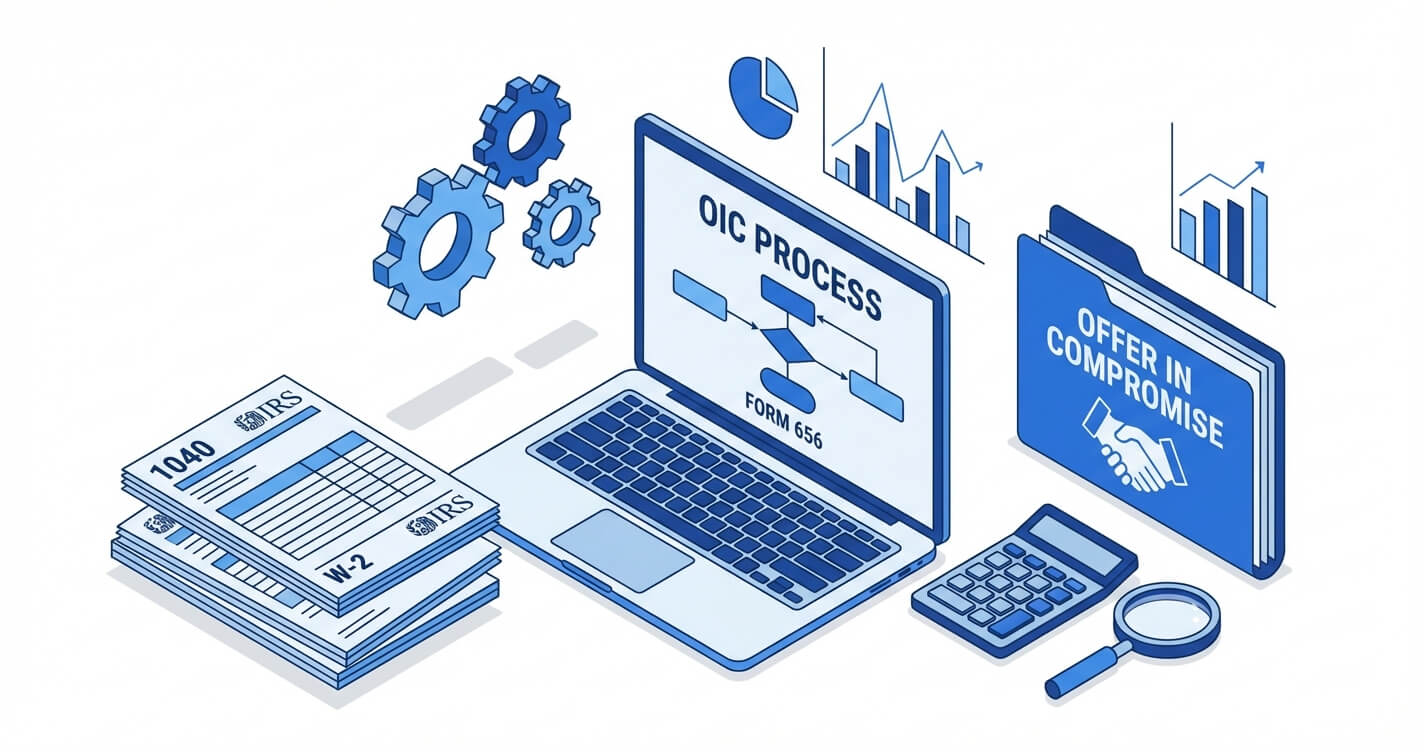
Form 656 is the legal offer contract. It specifies the offer amount, payment terms, and tax periods covered.
Form 433-A (OIC) and 433-B (OIC)
These forms disclose detailed financial information for individuals and businesses. Accuracy and completeness are critical.
Application fees and initial payments
The standard application fee is $205, waived for qualifying low-income taxpayers. Initial payments are required unless exempt.
How the IRS Evaluates and Responds to an OIC
IRS review process
OICs are assigned to specialized examiners who validate RCP calculations and documentation.
Reviews commonly take 6–12 months.
Acceptance, rejection, and appeal rights
Rejections often stem from understated income or asset values. Appeals must be filed within 30 days.
Post-acceptance compliance obligations
Accepted taxpayers must remain compliant for 5 years. Default reinstates the full liability.
Common OIC Mistakes Preparers Should Avoid
Calculation and documentation errors
Undervaluing assets or overstating expenses leads to rejection and credibility loss.
Incomplete disclosures can trigger expanded IRS scrutiny.
Client expectation management
Ethically, you must screen out non-viable cases.
Set expectations early: OICs are math-driven, not negotiation-driven.
Conclusion
For Indian CAs offering US tax services, mastering Offer in Compromise work strengthens your advisory profile and deepens client trust. The key is disciplined pre-screening, accurate RCP calculation, and realistic client guidance.
By treating OICs as a technical resolution tool rather than a marketing promise, you can avoid low-probability cases and focus on defensible, high-quality submissions. Building this capability alongside compliance and planning positions your practice for more complex and higher-value US engagements.
FAQ
Is an Offer in Compromise suitable for most IRS debt cases?
No. Most cases with stable income and assets are better handled through installment agreements. OICs work only when RCP is materially lower than the liability. Pre-screening is essential.
Can a client apply for an OIC with unfiled returns?
No. All required returns must be filed before submission. The IRS will return the offer without review if compliance is missing.
How long does the IRS take to process an OIC?
Typical processing time ranges from 6 to 12 months. Complex cases may take longer. Collection activity is generally suspended during review.
Does submitting an OIC stop IRS collections?
Most enforced collection actions are paused, but interest continues to accrue. Liens usually remain in place until acceptance.
Can self-employed expenses be fully deducted in RCP calculations?
No. Only ordinary and necessary expenses are allowed. Excess or discretionary expenses are often disallowed.
What happens if the IRS rejects the OIC?
You can appeal within 30 days. Alternatively, you may pursue other resolution options like installment agreements.
Are retirement accounts always included in asset calculations?
Generally yes, though the IRS may discount for tax and early withdrawal penalties. Exclusion is rare.
Can a taxpayer submit multiple OICs?
Yes, but repeated weak submissions harm credibility. Only resubmit if facts materially change.
Is OIC work suitable for first-time US tax practitioners?
It requires strong technical understanding. Many firms start by partnering or using structured review processes.
What is the biggest mistake preparers make with OICs?
Submitting offers without validating RCP. Math errors, not paperwork, cause most rejections.