Key Takeaways
- An ITIN is mandatory for NRI clients with U.S. tax filing or reporting obligations when no SSN is available.
- Form W-7 must usually be filed along with a U.S. federal tax return, unless a specific IRS exception applies.
- IRS processing time for ITIN applications is typically 7–11 weeks, extending to 12+ weeks during peak season (January–April).
- Original passports are required only for direct filings; CAAs can verify certified copies, reducing document risk.
- ITINs expire if not used on a U.S. tax return for 3 consecutive years and must be renewed using Form W-7.
- Students on F-1/J-1 visas may qualify for ITIN using DS-2019 or I-20 certification for income-based filings.
Introduction
As Indian Chartered Accountants expand into U.S. tax compliance, ITIN applications become one of the most frequent—and error-prone—processes you will handle for NRI clients. Whether the client has U.S. rental income, investment income, or a filing requirement as a dependent or spouse, getting the ITIN right is foundational to every downstream compliance step.
This article is written from a practitioner’s perspective: how to evaluate eligibility, prepare Form W-7 correctly, choose the right submission method, and manage client expectations on timelines and renewals. The focus is not on theory, but on execution—what commonly goes wrong and how Indian CAs can structure a reliable ITIN workflow.
We will walk through the ITIN application process for NRI clients step by step, compare direct filing vs CAA-assisted applications, and highlight practical red flags. This knowledge directly improves turnaround time, reduces rejections, and positions your firm as a credible U.S. tax partner.
What Is an ITIN and Why It Matters for NRI Clients
Definition of ITIN
An Individual Taxpayer Identification Number (ITIN) is a 9-digit U.S. tax processing number issued by the IRS to individuals who are required to file or report U.S. taxes but are not eligible for a Social Security Number.
For Indian CAs, ITINs are most commonly encountered when onboarding NRI clients with U.S.-source income or reporting obligations. The IRS provides detailed IRS guidance on obtaining an ITIN from abroad, which forms the basis of all filings.
Practitioner Tip: Always validate whether the client genuinely needs an ITIN or qualifies for an SSN—misclassification leads to automatic rejection.
ITIN vs SSN: Key Differences
An SSN is issued for employment and social security benefits, while an ITIN exists solely for tax administration. Holding an ITIN does not grant work authorization, visa benefits, or immigration status.
NRIs on employment visas may transition from ITIN to SSN later. In such cases, the ITIN must be disclosed to the IRS to consolidate tax records.
Who Needs an ITIN? Common Scenarios for NRIs
NRIs with U.S. Income or Investments
Most ITIN applications arise because an NRI has U.S.-source income requiring a federal tax return. Common triggers include rental income from U.S. property, capital gains from U.S. securities, dividend or interest income, and partnership or LLC pass-through income.
Even when tax is fully withheld at source, filing obligations may still exist, making ITIN issuance unavoidable.
ITIN for Spouses, Dependents, and Students
Spouses and dependents claimed on U.S. tax returns need an ITIN if they are ineligible for an SSN. This frequently applies in married filing jointly elections or dependency claims.
For students on F-1 or J-1 visas, ITINs are issued only if there is a tax filing requirement. Certification may rely on DS-2019 or I-20 documents to establish visa status and eligibility.
Foreign Business Owners and Property Owners
NRIs owning U.S. LLCs, partnerships, or real estate often require ITINs to report effectively connected income. This is especially relevant where withholding exemptions or treaty positions are claimed.
Practitioner Tip: Always align ITIN applications with the first year of U.S. filing to avoid standalone W-7 rejections.
Documents Required for ITIN Application from India
Form W-7 Overview
Form W-7 is the core ITIN application and must be completed with precision. The IRS expects consistency between W-7, the attached tax return, and supporting documents.
The latest Form W-7 instructions from the IRS should always be referenced before filing.
Proof of Identity and Foreign Status
A valid passport is the only standalone document that proves both identity and foreign status. If a passport is unavailable, a combination of documents such as national ID cards and birth certificates may be used, depending on the applicant category.
Original passports are required only for direct filings. CAAs can certify copies, significantly reducing risk for Indian clients.
U.S. Federal Tax Return Requirement
In most cases, Form W-7 must be attached to a completed U.S. federal tax return. Exceptions exist for certain withholding, treaty, or informational reporting cases.
Practitioner Tip: Clearly document the exception category in your workpapers to support IRS review.
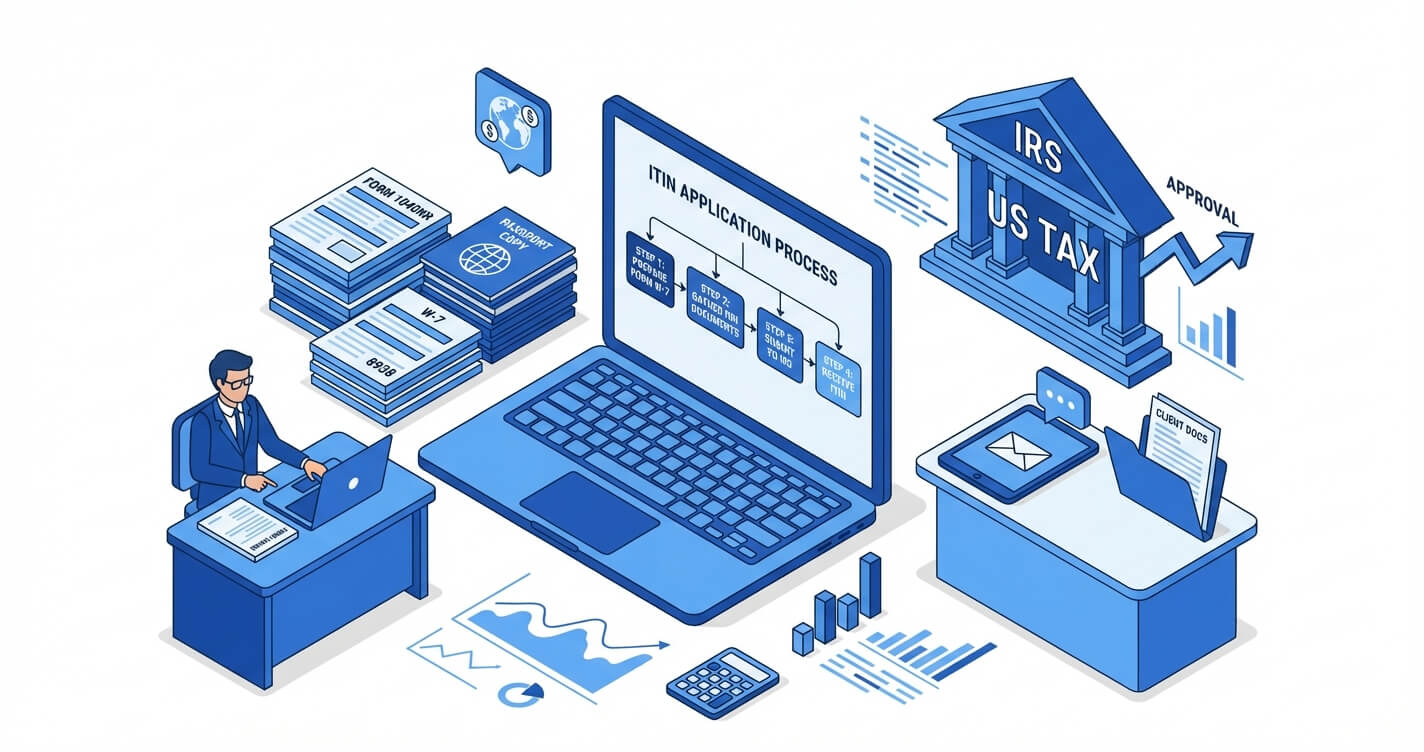
Step-by-Step W-7 Filing Guide for NRI Clients
Step 1: Determine Eligibility and ITIN Category
Select the correct reason code on Form W-7 (A through H). This is the most common rejection point, especially for dependents and business owners.
Step 2: Complete Form W-7 Correctly
Ensure name formatting matches the passport exactly. Address fields should reflect the foreign residential address unless a U.S. mailing address is required.
Practitioner Tip: Inconsistent name order for Indian passports is a frequent issue—standardize across all forms.
Step 3: Attach Supporting Documents
Attach certified or original documents as required. For students, include DS-2019 or I-20 where applicable.
Step 4: Submit to the IRS
Mail the complete package to the Austin Service Center. Use a trackable international courier and retain copies of all documents.
IRS acknowledgment is not immediate; tracking is your primary proof of submission.
How to Apply for ITIN from India: Submission Methods Compared
Direct Application to the IRS
Direct filing involves mailing Form W-7, tax return, and original identification documents. While cost-effective, it carries document loss risk.
Applying Through a CAA (Certifying Acceptance Agent)
CAAs verify documents and submit certified copies, reducing risk and rejection rates. This is often preferred for high-value clients.
| Criteria | Direct Filing | CAA-Assisted |
|---|---|---|
| Document Risk | High | Low |
| Processing Time | Standard | Standard |
| Cost | Lower | Higher |
U.S. Embassy or Consulate Option
Some consulates provide document certification, but availability is limited and appointments are difficult to secure.
How Long Does ITIN Take? Processing Time and Tracking
Standard IRS Processing Timelines
Average processing time is 7–11 weeks. During peak season, expect delays beyond 12 weeks.
Peak Season Delays and Common Red Flags
Missing signatures, incorrect reason codes, and mismatched documents cause delays. Be cautious of service providers promising expedited ITINs.
How to Track or Follow Up on an ITIN Application
Follow up via IRS helpline after 8 weeks. Maintain proof of mailing and copies for reference.
ITIN Validity, Renewal, and Practical Tips for NRIs
ITIN Expiry and Renewal Process
ITINs expire if not used on a tax return for 3 consecutive years. Renewal requires filing Form W-7 without a tax return.
Best Practices to Avoid Rejection
Ensure document certification is compliant and forms are fully completed. Avoid handwritten corrections.
Using ITIN for Ongoing U.S. Compliance
Once issued, ITINs support annual filings, refunds, and information reporting. Many firms use structured workflows and online preparation tools to manage volume efficiently.
For CAs building deeper U.S. capability, understanding credential pathways like the Enrolled Agent exam for Indian CA can complement ITIN work.
Conclusion
For Indian CAs, mastering the ITIN application process is a practical gateway into U.S. tax compliance services. From identifying who needs an ITIN to selecting the right filing method and managing renewals, each step directly impacts client experience and compliance outcomes.
A disciplined, documented approach reduces rejections and builds credibility with NRI clients. As your U.S. tax practice scales, consider aligning with qualified CAAs and leveraging standardized preparation tools.
If you encounter complex cases—such as multi-year filings, students, or business owners—consulting a qualified CAA or experienced U.S. tax professional can provide valuable, case-specific guidance.
FAQs
Can an Indian CA sign Form W-7 for a client?
No. Only the applicant, an authorized representative, or a CAA can sign Form W-7. Indian CAs can prepare but not certify unless separately authorized.
Is a tax return always mandatory with Form W-7?
In most cases, yes. Exceptions apply for specific withholding or reporting categories defined by the IRS.
Can one ITIN be used for multiple U.S. filings?
Yes. An ITIN is permanent unless expired and is used across all U.S. tax filings for that individual.
What happens if an ITIN expires?
An expired ITIN cannot be used for filing or refunds. Renewal via Form W-7 is required before filing.
Are ITINs required for U.S. LLC owners?
Yes, if the LLC income flows to the individual and requires personal tax reporting.
Can students apply for ITIN without income?
No. There must be a filing or reporting requirement supported by income or withholding.
How do we handle rejected ITIN applications?
Review the IRS notice, correct errors, and resubmit. Do not file a new application without addressing the stated issue.
Is notarization of passport copies sufficient?
No. The IRS accepts only certified copies from issuing agencies or CAAs.
Can ITIN applications be filed electronically?
No. Form W-7 must be physically mailed to the IRS.
Should ITINs be renewed proactively?
Yes, if the client plans to file after a period of non-use. Early renewal avoids filing delays.