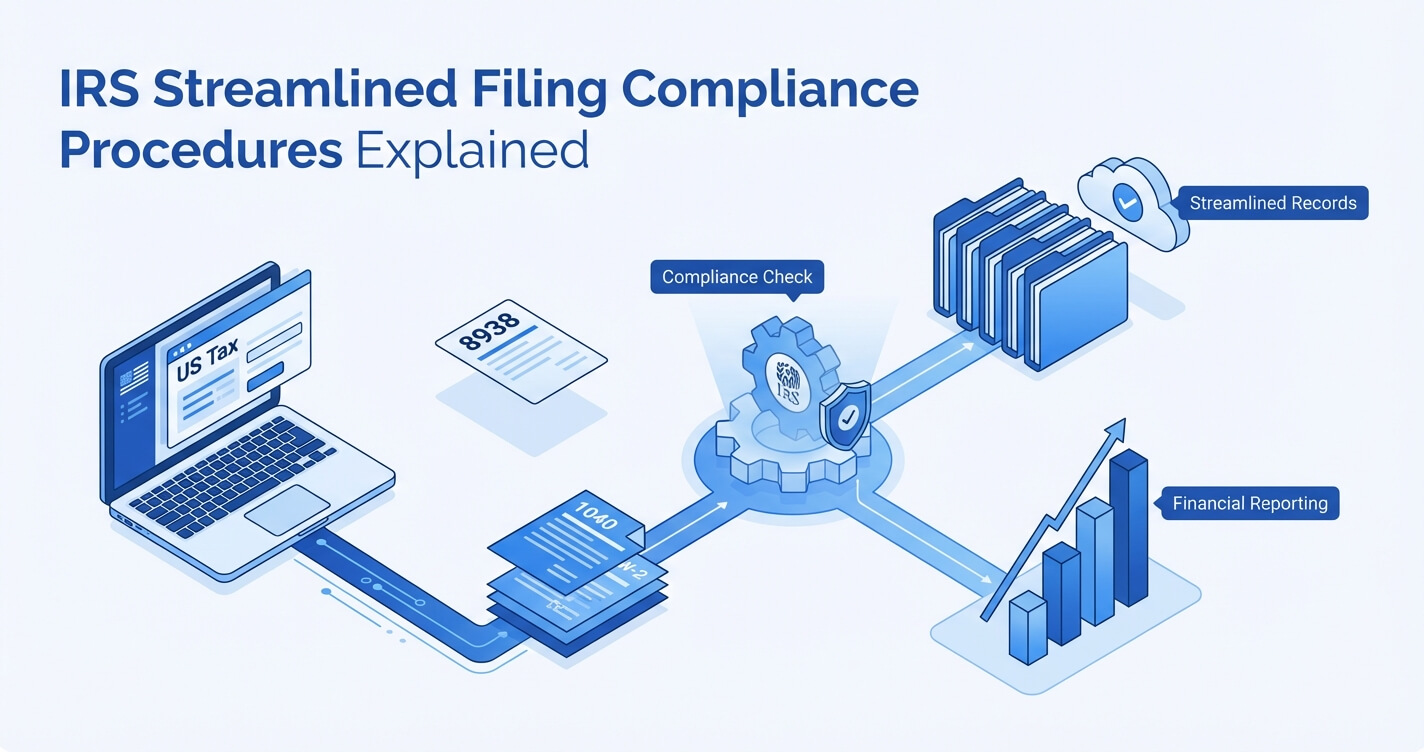
IRS Streamlined Filing Compliance Procedures Explained

Content
Contents

Key Takeaways

  • Streamlined filing generally requires 3 years of amended or delinquent Form 1040 returns and 6 years of FBARs.
  • Only taxpayers with non-willful compliance failures qualify; willful cases must use other disclosure paths.
  • Foreign streamlined filings eliminate all offshore penalties, while domestic streamlined filings impose a 5% miscellaneous offshore penalty.
  • Forms 14653 (foreign) and 14654 (domestic) are critical and frequently audited for consistency.
  • Typical IRS processing timelines range from 6–18 months with no formal acceptance letter issued.
  • Failure to use streamlined procedures can expose clients to FBAR penalties up to USD 10,000 per violation or higher if deemed willful.

Introduction

For Indian Chartered Accountants building or scaling a U.S. tax practice, few areas are as sensitive—and valuable—as offshore compliance remediation. Clients often approach years after missing U.S. filings, expecting a clean fix without excessive penalties.

The IRS Streamlined Filing Compliance Procedures are the primary tool you will rely on for such cases. Used correctly, they allow eligible taxpayers to come back into compliance while significantly reducing penalty exposure.

This article explains streamlined filing from a practitioner’s perspective: how it works, who qualifies, how to draft defensible non-willful certifications, and where CAs commonly make mistakes. We also cover timelines, cost expectations, and how streamlined compares with other IRS disclosure options—so you can confidently advise clients and structure your U.S. compliance workflows.

Introduction to IRS Streamlined Filing Compliance Procedures

What is streamlined filing?

Streamlined filing compliance procedures are an IRS program designed to help taxpayers correct past failures to report foreign income, assets, or information returns when those failures were non-willful.

Why the IRS created streamlined procedures

The IRS recognized that many offshore non-compliance cases stemmed from ignorance of complex international reporting rules rather than intentional evasion. Streamlined procedures reduce penalties while encouraging voluntary compliance.

Who this guide is for

This guide is for Indian CAs advising U.S. individual clients, expatriates, and cross-border taxpayers on offshore compliance remediation and penalty mitigation.

What Is Streamlined Filing and How Does It Work?

Core concept of Streamlined Filing

At its core, streamlined filing is a standardized submission package to correct prior non-compliance while certifying non-willful behavior.

What years are covered

Taxpayers must file 3 years of amended or delinquent Form 1040 returns and 6 years of FBARs (FinCEN Form 114).

What streamlined filing is not

It is not an amnesty program and does not protect willful taxpayers. It differs from delinquent FBAR procedures and the IRS voluntary disclosure program, which carry higher scrutiny and penalties.

Practitioner Tip: Position streamlined filing to clients as a penalty-reduction framework, not a guarantee of zero penalties.

Who Qualifies for Streamlined Filing? (Eligibility Checklist)

No prior IRS contact requirement

Taxpayers must not be under IRS examination, audit, or criminal investigation. Even informal IRS notices related to offshore compliance can disqualify eligibility.

Non-willful conduct requirement

Non-willfulness means conduct due to negligence, inadvertence, or misunderstanding of legal requirements.

Residency and presence tests

Residency determines whether the taxpayer qualifies for domestic or foreign streamlined procedures.

  • Was there any IRS audit or offshore compliance notice?
  • Were offshore accounts omitted due to misunderstanding?
  • Did the taxpayer meet foreign residency thresholds?

Non-Willful Certification Explained (Forms 14653 and 14654)

What is non-willfulness?

Non-willfulness is a factual and legal standard. The IRS evaluates intent based on actions, not just statements.

Form 14653 vs Form 14654

Form 14653 applies to foreign streamlined cases, while Form 14654 applies to domestic cases and computes the 5% penalty.

Sample non-willfulness statement

“The failure to file FBARs and report foreign income resulted from a misunderstanding of U.S. tax rules applicable to foreign financial accounts. At no time did I intend to conceal assets or evade tax.”

Common errors: vague language, blaming advisors without evidence, or inconsistencies with filed returns.

Domestic vs Foreign Streamlined Procedures: Key Differences

Streamlined Foreign Offshore Procedures

Available to taxpayers meeting foreign residency tests and eliminates all offshore penalties.

Streamlined Domestic Offshore Procedures

Applies to U.S. residents and imposes a 5% penalty on the highest aggregate value of specified foreign assets.

The 5% Penalty explained

AspectForeignDomestic
ResidencyOutside U.S.U.S.
Penalty0%5%
Assets includedN/AFBAR & FATCA assets

Refer to IRS streamlined filing FAQs for foreign residents for clarification.

Forms, Documentation, and Filing Requirements

Core tax forms and amended returns

Form 1040, 1040X, and relevant schedules must be complete and consistent.

International information returns and FBARs

Common forms include FBAR, Form 8938, 5471, 3520, and 8865. See our FBAR FATCA compliance guide for Indian accountants for deeper context.

Where and how to file

FBARs are filed via FinCEN BSA E-Filing. Streamlined packages are mailed, not e-filed. Cryptocurrency accounts held offshore may also trigger reporting.

Timeline, Costs, and What Happens After Filing

Processing timeline and IRS review

IRS processing typically takes 6–18 months. There is no formal acceptance notice.

Professional fee expectations

Professional fees vary widely based on years involved, number of accounts, and complexity. Expect higher costs where Forms 5471 or 3520 are involved.

After achieving compliance

Outcomes include penalty elimination, assessment of the 5% penalty, or IRS follow-up queries.

Soft CTA: Many firms streamline their streamlined filings by partnering with platforms like FlowTax.ai for automation, review support, and quality control—without disrupting client relationships.

Common Mistakes and How to Avoid Them

Certification errors

Overly generic narratives and inconsistent facts are the top rejection triggers.

Incomplete disclosures

Omitting even dormant accounts can expose clients to full FBAR penalties.

Strategic missteps

Delaying filing increases the risk of IRS contact, which disqualifies streamlined eligibility.

Conclusion

For Indian CAs offering U.S. tax services, streamlined filing compliance procedures are foundational. Mastery of eligibility, documentation, and non-willful certification allows you to protect clients from severe offshore penalties while building a defensible compliance practice.

As you scale, focus on standardized checklists, consistent narratives, and strong review processes. Leveraging technology and expert review support—such as FlowTax.ai’s white-label U.S. tax platform—can help you deliver streamlined filings efficiently and confidently.

FAQs

Can a taxpayer with IRS notices still use streamlined filing?

Generally no. Any audit, examination, or offshore-related notice can disqualify eligibility. Always confirm the nature of IRS contact. When in doubt, assume disqualification.

Is the 5% penalty negotiable?

No. The 5% penalty under domestic streamlined procedures is fixed. It is calculated on the highest aggregate asset balance.

Do crypto assets trigger FBAR or FATCA?

Foreign-held crypto accounts may trigger reporting depending on custody and structure. Conservative disclosure is advisable. IRS guidance continues to evolve.

What happens if streamlined filing is rejected?

The IRS may assess full penalties or recommend alternative disclosure programs. Professional judgment is critical. Appeals are limited.

Can prior delinquent FBAR submissions block streamlined filing?

They may, depending on facts. Analyze timing and intent carefully. Documentation consistency matters.

Is there a deadline to use streamlined procedures?

No formal deadline exists. However, IRS contact before filing eliminates eligibility. Urgency is practical, not statutory.

Are amended returns always required?

Yes, if prior returns were filed incorrectly. Delinquent returns apply where no filing occurred. Accuracy is essential.

How do you document non-willfulness?

Through consistent facts, credible explanations, and supporting records. Avoid boilerplate language. Tailor each narrative.

Can CAs in India sign Forms 14653/14654?

The taxpayer must sign. CAs can prepare and advise. Ensure proper authorization via Form 2848 if representing.

When should voluntary disclosure be considered instead?

When facts suggest potential willfulness. Voluntary disclosure offers protection from criminal prosecution but at higher cost.

Key Takeaways

  • Streamlined filing generally requires 3 years of amended or delinquent Form 1040 returns and 6 years of FBARs.
  • Only taxpayers with non-willful compliance failures qualify; willful cases must use other disclosure paths.
  • Foreign streamlined filings eliminate all offshore penalties, while domestic streamlined filings impose a 5% miscellaneous offshore penalty.
  • Forms 14653 (foreign) and 14654 (domestic) are critical and frequently audited for consistency.
  • Typical IRS processing timelines range from 6–18 months with no formal acceptance letter issued.
  • Failure to use streamlined procedures can expose clients to FBAR penalties up to USD 10,000 per violation or higher if deemed willful.

Introduction

For Indian Chartered Accountants building or scaling a U.S. tax practice, few areas are as sensitive—and valuable—as offshore compliance remediation. Clients often approach years after missing U.S. filings, expecting a clean fix without excessive penalties.

The IRS Streamlined Filing Compliance Procedures are the primary tool you will rely on for such cases. Used correctly, they allow eligible taxpayers to come back into compliance while significantly reducing penalty exposure.

This article explains streamlined filing from a practitioner’s perspective: how it works, who qualifies, how to draft defensible non-willful certifications, and where CAs commonly make mistakes. We also cover timelines, cost expectations, and how streamlined compares with other IRS disclosure options—so you can confidently advise clients and structure your U.S. compliance workflows.

Introduction to IRS Streamlined Filing Compliance Procedures

What is streamlined filing?

Streamlined filing compliance procedures are an IRS program designed to help taxpayers correct past failures to report foreign income, assets, or information returns when those failures were non-willful.

Why the IRS created streamlined procedures

The IRS recognized that many offshore non-compliance cases stemmed from ignorance of complex international reporting rules rather than intentional evasion. Streamlined procedures reduce penalties while encouraging voluntary compliance.

Who this guide is for

This guide is for Indian CAs advising U.S. individual clients, expatriates, and cross-border taxpayers on offshore compliance remediation and penalty mitigation.

What Is Streamlined Filing and How Does It Work?

Core concept of Streamlined Filing

At its core, streamlined filing is a standardized submission package to correct prior non-compliance while certifying non-willful behavior.

What years are covered

Taxpayers must file 3 years of amended or delinquent Form 1040 returns and 6 years of FBARs (FinCEN Form 114).

What streamlined filing is not

It is not an amnesty program and does not protect willful taxpayers. It differs from delinquent FBAR procedures and the IRS voluntary disclosure program, which carry higher scrutiny and penalties.

Practitioner Tip: Position streamlined filing to clients as a penalty-reduction framework, not a guarantee of zero penalties.

Who Qualifies for Streamlined Filing? (Eligibility Checklist)

No prior IRS contact requirement

Taxpayers must not be under IRS examination, audit, or criminal investigation. Even informal IRS notices related to offshore compliance can disqualify eligibility.

Non-willful conduct requirement

Non-willfulness means conduct due to negligence, inadvertence, or misunderstanding of legal requirements.

Residency and presence tests

Residency determines whether the taxpayer qualifies for domestic or foreign streamlined procedures.

  • Was there any IRS audit or offshore compliance notice?
  • Were offshore accounts omitted due to misunderstanding?
  • Did the taxpayer meet foreign residency thresholds?

Non-Willful Certification Explained (Forms 14653 and 14654)

What is non-willfulness?

Non-willfulness is a factual and legal standard. The IRS evaluates intent based on actions, not just statements.

Form 14653 vs Form 14654

Form 14653 applies to foreign streamlined cases, while Form 14654 applies to domestic cases and computes the 5% penalty.

Sample non-willfulness statement

“The failure to file FBARs and report foreign income resulted from a misunderstanding of U.S. tax rules applicable to foreign financial accounts. At no time did I intend to conceal assets or evade tax.”

Common errors: vague language, blaming advisors without evidence, or inconsistencies with filed returns.

Domestic vs Foreign Streamlined Procedures: Key Differences

Streamlined Foreign Offshore Procedures

Available to taxpayers meeting foreign residency tests and eliminates all offshore penalties.

Streamlined Domestic Offshore Procedures

Applies to U.S. residents and imposes a 5% penalty on the highest aggregate value of specified foreign assets.

The 5% Penalty explained

AspectForeignDomestic
ResidencyOutside U.S.U.S.
Penalty0%5%
Assets includedN/AFBAR & FATCA assets

Refer to IRS streamlined filing FAQs for foreign residents for clarification.

Forms, Documentation, and Filing Requirements

Core tax forms and amended returns

Form 1040, 1040X, and relevant schedules must be complete and consistent.

International information returns and FBARs

Common forms include FBAR, Form 8938, 5471, 3520, and 8865. See our FBAR FATCA compliance guide for Indian accountants for deeper context.

Where and how to file

FBARs are filed via FinCEN BSA E-Filing. Streamlined packages are mailed, not e-filed. Cryptocurrency accounts held offshore may also trigger reporting.

Timeline, Costs, and What Happens After Filing

Processing timeline and IRS review

IRS processing typically takes 6–18 months. There is no formal acceptance notice.

Professional fee expectations

Professional fees vary widely based on years involved, number of accounts, and complexity. Expect higher costs where Forms 5471 or 3520 are involved.

After achieving compliance

Outcomes include penalty elimination, assessment of the 5% penalty, or IRS follow-up queries.

Soft CTA: Many firms streamline their streamlined filings by partnering with platforms like FlowTax.ai for automation, review support, and quality control—without disrupting client relationships.

Common Mistakes and How to Avoid Them

Certification errors

Overly generic narratives and inconsistent facts are the top rejection triggers.

Incomplete disclosures

Omitting even dormant accounts can expose clients to full FBAR penalties.

Strategic missteps

Delaying filing increases the risk of IRS contact, which disqualifies streamlined eligibility.

Conclusion

For Indian CAs offering U.S. tax services, streamlined filing compliance procedures are foundational. Mastery of eligibility, documentation, and non-willful certification allows you to protect clients from severe offshore penalties while building a defensible compliance practice.

As you scale, focus on standardized checklists, consistent narratives, and strong review processes. Leveraging technology and expert review support—such as FlowTax.ai’s white-label U.S. tax platform—can help you deliver streamlined filings efficiently and confidently.

FAQs

Can a taxpayer with IRS notices still use streamlined filing?

Generally no. Any audit, examination, or offshore-related notice can disqualify eligibility. Always confirm the nature of IRS contact. When in doubt, assume disqualification.

Is the 5% penalty negotiable?

No. The 5% penalty under domestic streamlined procedures is fixed. It is calculated on the highest aggregate asset balance.

Do crypto assets trigger FBAR or FATCA?

Foreign-held crypto accounts may trigger reporting depending on custody and structure. Conservative disclosure is advisable. IRS guidance continues to evolve.

What happens if streamlined filing is rejected?

The IRS may assess full penalties or recommend alternative disclosure programs. Professional judgment is critical. Appeals are limited.

Can prior delinquent FBAR submissions block streamlined filing?

They may, depending on facts. Analyze timing and intent carefully. Documentation consistency matters.

Is there a deadline to use streamlined procedures?

No formal deadline exists. However, IRS contact before filing eliminates eligibility. Urgency is practical, not statutory.

Are amended returns always required?

Yes, if prior returns were filed incorrectly. Delinquent returns apply where no filing occurred. Accuracy is essential.

How do you document non-willfulness?

Through consistent facts, credible explanations, and supporting records. Avoid boilerplate language. Tailor each narrative.

Can CAs in India sign Forms 14653/14654?

The taxpayer must sign. CAs can prepare and advise. Ensure proper authorization via Form 2848 if representing.

When should voluntary disclosure be considered instead?

When facts suggest potential willfulness. Voluntary disclosure offers protection from criminal prosecution but at higher cost.

Latest from our blogs

Latest from our blogs

View All
]