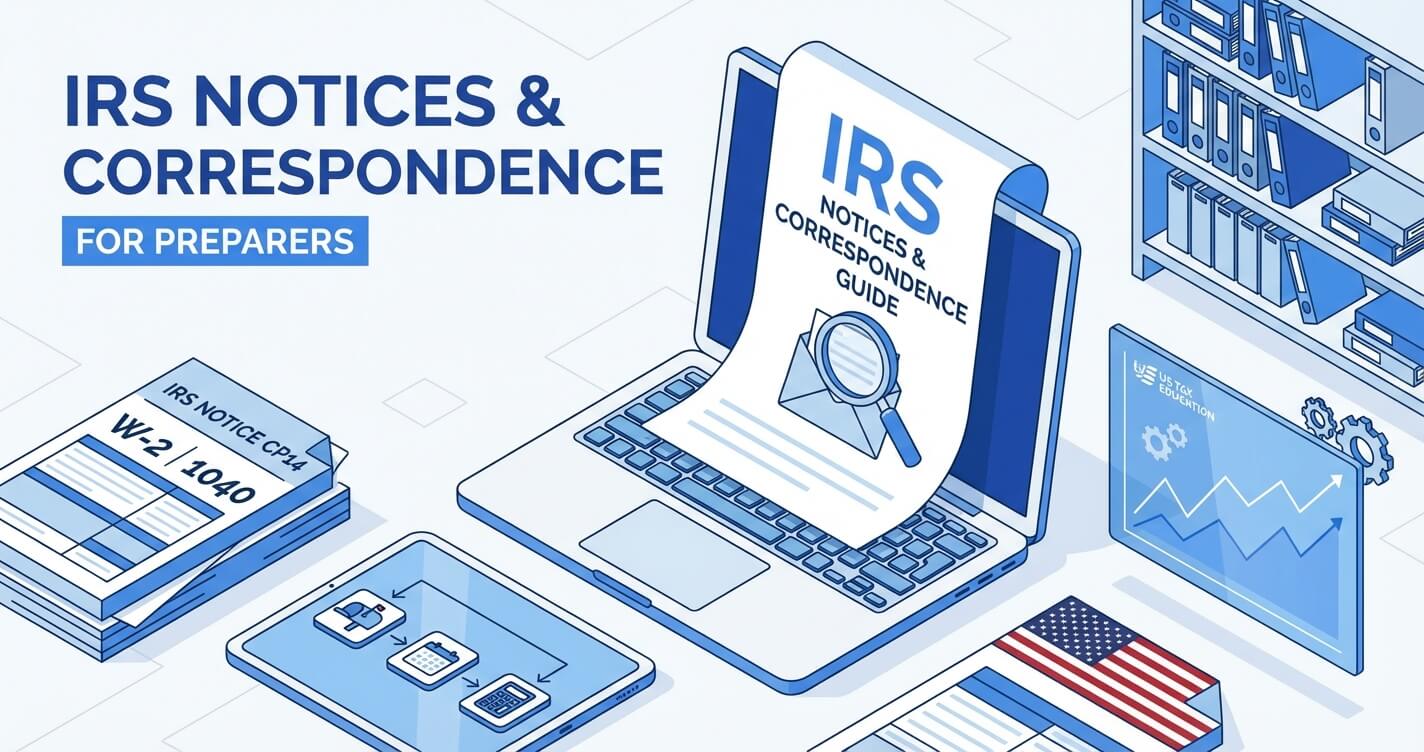
IRS Notices and Correspondence Guide for Preparers

Content
Contents

Key Takeaways

  • Most IRS notices have a 30-day response window; missed deadlines can trigger penalties, interest, or enforced collection.
  • CP2000 notices are not audits but automated underreporter mismatches based on W-2/1099 data.
  • Identity verification letters (5071C, 18C, 86C) can freeze refunds for 60–180 days if not handled correctly.
  • Form 2848 Power of Attorney is mandatory for practitioner-led responses and must be completed without errors to avoid rejection.
  • IRS response cycles typically range from 30–90–180 days, depending on notice type and IRS backlog.
  • Parallel IRS and state notices (FTB, NY, etc.) must be tracked separately to avoid inconsistent positions.
  • Standardized SOPs and templates significantly reduce turnaround time and repeat notices in notice-heavy practices.

Introduction

For Indian Chartered Accountants building or scaling US tax practices, IRS notices are no longer edge cases. With increased e-filing, automated matching, and compliance filters, even cleanly prepared returns can generate multiple IRS communications post-filing.

This article is written for preparers—not taxpayers. As a US tax practitioner, you are expected to interpret notices, protect deadlines, manage correspondence, and represent clients before the IRS with confidence.

An unstructured response process leads to missed deadlines, unnecessary penalties, and frustrated clients. A systematic approach, on the other hand, turns IRS correspondence into a value-added service.

This IRS notices and correspondence guide for preparers covers notice types, CP2000 handling, response workflows, documentation standards, timelines, representation rules, and internal SOPs—so you can handle notices efficiently and at scale.

Understanding IRS Notices and Correspondence Basics

What is an IRS notice vs. IRS letter?

An IRS Notice (usually CP-series) is system-generated communication triggered by IRS computers. An IRS Letter (LTR-series) is typically manual and often requires taxpayer or practitioner interaction.

Notices are commonly informational, balance due, or compliance-related. Letters are used for audits, identity verification, and procedural matters.

Where to find notice numbers and response deadlines

The notice or letter number appears on the top right corner (for example, CP2000 or Letter 5071C). Response deadlines are usually 30 days from the notice date, not the date received.

Always log the notice date, tax year, and response-by date immediately upon receipt.

Taxpayer rights under IRS Publication 1

IRS Publication 1 outlines the Taxpayer Bill of Rights, including the right to be informed, to challenge the IRS, and to representation. As preparers, you operationalize these rights for your clients.

For an overview of how the IRS structures notices, refer to Understanding your IRS notice or letter.

Practitioner Tip: Informational notices do not require responses, but must still be logged to prevent future escalations.

Types of IRS Notices and Correspondence (Reference Guide)

CP Notices (Computer Paragraph Notices)

CP notices are automated and cover underreporting (CP2000), balance due (CP14), reminders (CP501), and enforcement warnings.

Balance Due and Collection Notices

These include CP14 (initial balance), CP501/503 (reminders), and CP504 (intent to levy). Failure to act can lead to liens or levies.

Identity Verification and RIVO Letters

The Return Integrity Verification Operations (RIVO) unit issues Letters 5071C, 18C, and 86C when refunds are flagged for fraud or identity issues.

Audit and Examination Letters

Letters initiating correspondence audits or examinations require formal responses and often escalate if ignored.

Practitioner Tip: Enforcement generally begins only after multiple ignored notices—early intervention prevents downstream damage.

Common IRS Notices Every Preparer Should Know

CP2000 – Underreported Income Notice

CP2000 is not an audit. It is an automated mismatch between reported income and IRS third-party data (W-2, 1099, brokerage reports).

Common triggers include missing 1099-NEC income, incorrect cost basis, or omitted stock sales.

CP504 – Intent to Levy Notice

CP504 warns of levy action if the balance remains unpaid. While it does not immediately levy assets, it signals escalation.

At this stage, options include payment plans or resolution strategies such as those outlined in our IRS installment agreement setup guide.

Letter 5071C – Identity Verification

This letter requires identity verification online or by phone. Refunds remain frozen until verification is complete.

Other frequent notices (CP14, CP501, CP523)

NoticeIssueActionDeadline
CP14Initial balance duePay or respond30 days
CP501Balance reminderResolve balance30 days
CP523Installment defaultReinstate planImmediate

Practitioner Tip: Always reconcile CP2000 figures before agreeing—IRS data is often incomplete.

How to Respond to IRS Letters: Step-by-Step for Preparers

Initial triage: read, log, and calendar deadlines

Create a centralized intake. Log notice number, tax year, IRS contact details, and response deadline.

Verify IRS data against client records

Reconcile IRS figures with source documents, brokerage statements, and prior workpapers.

Decide: agree, partially agree, or disagree

Your response strategy determines whether you pay, explain differences, or contest adjustments.

Prepare and send a complete response

Use certified mail or IRS upload portals. Partial or undocumented responses cause delays.

Practitioner Tip: Never send original documents—only copies with clear annotations.

Response Templates and Documentation Standards

Standard response letter structure

A professional response includes taxpayer details, notice reference, position taken, and supporting explanation.

Supporting schedules and reconciliations

Include annotated schedules clearly tying client numbers to IRS discrepancies.

When amended returns are required

Form 1040-X is appropriate only when the original return was incorrect—not merely mismatched.

Practitioner Tip: Unnecessary amendments often complicate CP2000 resolutions.

Timeline Expectations: What Happens After You Respond

IRS processing timelines by notice type

Most notices take 30–90 days. RIVO cases can extend to 180 days.

When and how to follow up

Follow up after 60 days if no response. Maintain call logs and submission proof.

Interest, penalties, and holds during review

Interest accrues unless waived. Refunds may remain on hold during reviews.

Practitioner Tip: Proactively explain timelines to clients to reduce anxiety.

How to Represent Clients Before the IRS

Who can represent taxpayers

CPAs, EAs, and attorneys can represent clients before the IRS. Indian CAs typically partner or operate under permitted credentials.

Power of Attorney explained

Form 2848 authorizes you to receive notices, respond, and negotiate on behalf of clients.

Using Form 2848 correctly

Common errors include missing tax years or incorrect representative details. Refer to IRS Form 2848 Power of Attorney.

Practitioner Tip: Always confirm CAF number linkage before calling the IRS.

Advanced Scenarios and Coordination Issues

RIVO correspondence (Letters 18C, 86C)

These letters confirm receipt of identity documents. No action is required unless additional information is requested.

Coordination with state tax agencies (FTB, NY, etc.)

States often issue parallel notices based on IRS data. California FTB and New York require separate responses.

IRS office communication best practices

Written responses are preferred. Escalate prolonged delays through the Taxpayer Advocate Service when justified.

Practitioner Tip: Never assume IRS resolution automatically flows to state agencies.

Internal Firm Playbooks for IRS Notice Management

Centralized notice intake and tracking

Use a single tracker with status, deadlines, and responsibility assignments.

Client communication workflows

Standardized emails and expectation-setting reduce inbound follow-ups.

Scaling notice handling without burnout

Templates, automation, and backend review support reduce load. Some firms use white-label partners like FlowTax.ai to manage volume without increasing headcount.

Practitioner Tip: Track root causes to reduce repeat notices year-over-year.

Conclusion

IRS notices are inevitable in US tax practices—but chaos is optional. For Indian CAs, mastering notice handling transforms a reactive task into a structured, billable service.

By understanding notice types, enforcing deadlines, using proper representation, and building internal SOPs, you protect clients and strengthen trust.

If you are scaling US tax services and want backend support for preparation, review, or notice-heavy workflows, FlowTax.ai can act as a quiet enabler—letting you focus on client relationships while maintaining technical control.

FAQs

Do all IRS notices require a response?

No. Informational notices do not require action. However, all notices should be logged and reviewed to prevent escalation.

Is CP2000 considered an audit?

No. CP2000 is an automated underreporter notice. It becomes an audit only if unresolved and escalated.

What is the standard response deadline for IRS notices?

Most notices require response within 30 days of the notice date. Always verify the specific deadline mentioned.

Can Indian CAs sign Form 2848?

Only authorized representatives can sign. Indian CAs typically operate through partnerships or permitted credentials.

How long do identity verification cases take?

RIVO cases can take 60–180 days. Refunds remain frozen during this period.

Should I file Form 1040-X for every CP2000?

No. Amend only if the original return was incorrect. Mismatch cases often resolve without amendments.

What happens if a CP504 is ignored?

Ignoring CP504 can lead to liens or levies. Immediate action is required at this stage.

Do state tax agencies automatically follow IRS corrections?

No. States like FTB and NY require separate responses and filings.

When should I involve the Taxpayer Advocate Service?

Use TAS when delays cause financial hardship or IRS processes break down.

How can firms reduce IRS notice volume?

Better reconciliation, standardized reviews, and backend quality control significantly reduce repeat notices.

Key Takeaways

  • Most IRS notices have a 30-day response window; missed deadlines can trigger penalties, interest, or enforced collection.
  • CP2000 notices are not audits but automated underreporter mismatches based on W-2/1099 data.
  • Identity verification letters (5071C, 18C, 86C) can freeze refunds for 60–180 days if not handled correctly.
  • Form 2848 Power of Attorney is mandatory for practitioner-led responses and must be completed without errors to avoid rejection.
  • IRS response cycles typically range from 30–90–180 days, depending on notice type and IRS backlog.
  • Parallel IRS and state notices (FTB, NY, etc.) must be tracked separately to avoid inconsistent positions.
  • Standardized SOPs and templates significantly reduce turnaround time and repeat notices in notice-heavy practices.

Introduction

For Indian Chartered Accountants building or scaling US tax practices, IRS notices are no longer edge cases. With increased e-filing, automated matching, and compliance filters, even cleanly prepared returns can generate multiple IRS communications post-filing.

This article is written for preparers—not taxpayers. As a US tax practitioner, you are expected to interpret notices, protect deadlines, manage correspondence, and represent clients before the IRS with confidence.

An unstructured response process leads to missed deadlines, unnecessary penalties, and frustrated clients. A systematic approach, on the other hand, turns IRS correspondence into a value-added service.

This IRS notices and correspondence guide for preparers covers notice types, CP2000 handling, response workflows, documentation standards, timelines, representation rules, and internal SOPs—so you can handle notices efficiently and at scale.

Understanding IRS Notices and Correspondence Basics

What is an IRS notice vs. IRS letter?

An IRS Notice (usually CP-series) is system-generated communication triggered by IRS computers. An IRS Letter (LTR-series) is typically manual and often requires taxpayer or practitioner interaction.

Notices are commonly informational, balance due, or compliance-related. Letters are used for audits, identity verification, and procedural matters.

Where to find notice numbers and response deadlines

The notice or letter number appears on the top right corner (for example, CP2000 or Letter 5071C). Response deadlines are usually 30 days from the notice date, not the date received.

Always log the notice date, tax year, and response-by date immediately upon receipt.

Taxpayer rights under IRS Publication 1

IRS Publication 1 outlines the Taxpayer Bill of Rights, including the right to be informed, to challenge the IRS, and to representation. As preparers, you operationalize these rights for your clients.

For an overview of how the IRS structures notices, refer to Understanding your IRS notice or letter.

Practitioner Tip: Informational notices do not require responses, but must still be logged to prevent future escalations.

Types of IRS Notices and Correspondence (Reference Guide)

CP Notices (Computer Paragraph Notices)

CP notices are automated and cover underreporting (CP2000), balance due (CP14), reminders (CP501), and enforcement warnings.

Balance Due and Collection Notices

These include CP14 (initial balance), CP501/503 (reminders), and CP504 (intent to levy). Failure to act can lead to liens or levies.

Identity Verification and RIVO Letters

The Return Integrity Verification Operations (RIVO) unit issues Letters 5071C, 18C, and 86C when refunds are flagged for fraud or identity issues.

Audit and Examination Letters

Letters initiating correspondence audits or examinations require formal responses and often escalate if ignored.

Practitioner Tip: Enforcement generally begins only after multiple ignored notices—early intervention prevents downstream damage.

Common IRS Notices Every Preparer Should Know

CP2000 – Underreported Income Notice

CP2000 is not an audit. It is an automated mismatch between reported income and IRS third-party data (W-2, 1099, brokerage reports).

Common triggers include missing 1099-NEC income, incorrect cost basis, or omitted stock sales.

CP504 – Intent to Levy Notice

CP504 warns of levy action if the balance remains unpaid. While it does not immediately levy assets, it signals escalation.

At this stage, options include payment plans or resolution strategies such as those outlined in our IRS installment agreement setup guide.

Letter 5071C – Identity Verification

This letter requires identity verification online or by phone. Refunds remain frozen until verification is complete.

Other frequent notices (CP14, CP501, CP523)

NoticeIssueActionDeadline
CP14Initial balance duePay or respond30 days
CP501Balance reminderResolve balance30 days
CP523Installment defaultReinstate planImmediate

Practitioner Tip: Always reconcile CP2000 figures before agreeing—IRS data is often incomplete.

How to Respond to IRS Letters: Step-by-Step for Preparers

Initial triage: read, log, and calendar deadlines

Create a centralized intake. Log notice number, tax year, IRS contact details, and response deadline.

Verify IRS data against client records

Reconcile IRS figures with source documents, brokerage statements, and prior workpapers.

Decide: agree, partially agree, or disagree

Your response strategy determines whether you pay, explain differences, or contest adjustments.

Prepare and send a complete response

Use certified mail or IRS upload portals. Partial or undocumented responses cause delays.

Practitioner Tip: Never send original documents—only copies with clear annotations.

Response Templates and Documentation Standards

Standard response letter structure

A professional response includes taxpayer details, notice reference, position taken, and supporting explanation.

Supporting schedules and reconciliations

Include annotated schedules clearly tying client numbers to IRS discrepancies.

When amended returns are required

Form 1040-X is appropriate only when the original return was incorrect—not merely mismatched.

Practitioner Tip: Unnecessary amendments often complicate CP2000 resolutions.

Timeline Expectations: What Happens After You Respond

IRS processing timelines by notice type

Most notices take 30–90 days. RIVO cases can extend to 180 days.

When and how to follow up

Follow up after 60 days if no response. Maintain call logs and submission proof.

Interest, penalties, and holds during review

Interest accrues unless waived. Refunds may remain on hold during reviews.

Practitioner Tip: Proactively explain timelines to clients to reduce anxiety.

How to Represent Clients Before the IRS

Who can represent taxpayers

CPAs, EAs, and attorneys can represent clients before the IRS. Indian CAs typically partner or operate under permitted credentials.

Power of Attorney explained

Form 2848 authorizes you to receive notices, respond, and negotiate on behalf of clients.

Using Form 2848 correctly

Common errors include missing tax years or incorrect representative details. Refer to IRS Form 2848 Power of Attorney.

Practitioner Tip: Always confirm CAF number linkage before calling the IRS.

Advanced Scenarios and Coordination Issues

RIVO correspondence (Letters 18C, 86C)

These letters confirm receipt of identity documents. No action is required unless additional information is requested.

Coordination with state tax agencies (FTB, NY, etc.)

States often issue parallel notices based on IRS data. California FTB and New York require separate responses.

IRS office communication best practices

Written responses are preferred. Escalate prolonged delays through the Taxpayer Advocate Service when justified.

Practitioner Tip: Never assume IRS resolution automatically flows to state agencies.

Internal Firm Playbooks for IRS Notice Management

Centralized notice intake and tracking

Use a single tracker with status, deadlines, and responsibility assignments.

Client communication workflows

Standardized emails and expectation-setting reduce inbound follow-ups.

Scaling notice handling without burnout

Templates, automation, and backend review support reduce load. Some firms use white-label partners like FlowTax.ai to manage volume without increasing headcount.

Practitioner Tip: Track root causes to reduce repeat notices year-over-year.

Conclusion

IRS notices are inevitable in US tax practices—but chaos is optional. For Indian CAs, mastering notice handling transforms a reactive task into a structured, billable service.

By understanding notice types, enforcing deadlines, using proper representation, and building internal SOPs, you protect clients and strengthen trust.

If you are scaling US tax services and want backend support for preparation, review, or notice-heavy workflows, FlowTax.ai can act as a quiet enabler—letting you focus on client relationships while maintaining technical control.

FAQs

Do all IRS notices require a response?

No. Informational notices do not require action. However, all notices should be logged and reviewed to prevent escalation.

Is CP2000 considered an audit?

No. CP2000 is an automated underreporter notice. It becomes an audit only if unresolved and escalated.

What is the standard response deadline for IRS notices?

Most notices require response within 30 days of the notice date. Always verify the specific deadline mentioned.

Can Indian CAs sign Form 2848?

Only authorized representatives can sign. Indian CAs typically operate through partnerships or permitted credentials.

How long do identity verification cases take?

RIVO cases can take 60–180 days. Refunds remain frozen during this period.

Should I file Form 1040-X for every CP2000?

No. Amend only if the original return was incorrect. Mismatch cases often resolve without amendments.

What happens if a CP504 is ignored?

Ignoring CP504 can lead to liens or levies. Immediate action is required at this stage.

Do state tax agencies automatically follow IRS corrections?

No. States like FTB and NY require separate responses and filings.

When should I involve the Taxpayer Advocate Service?

Use TAS when delays cause financial hardship or IRS processes break down.

How can firms reduce IRS notice volume?

Better reconciliation, standardized reviews, and backend quality control significantly reduce repeat notices.

Latest from our blogs

Latest from our blogs

View All
]