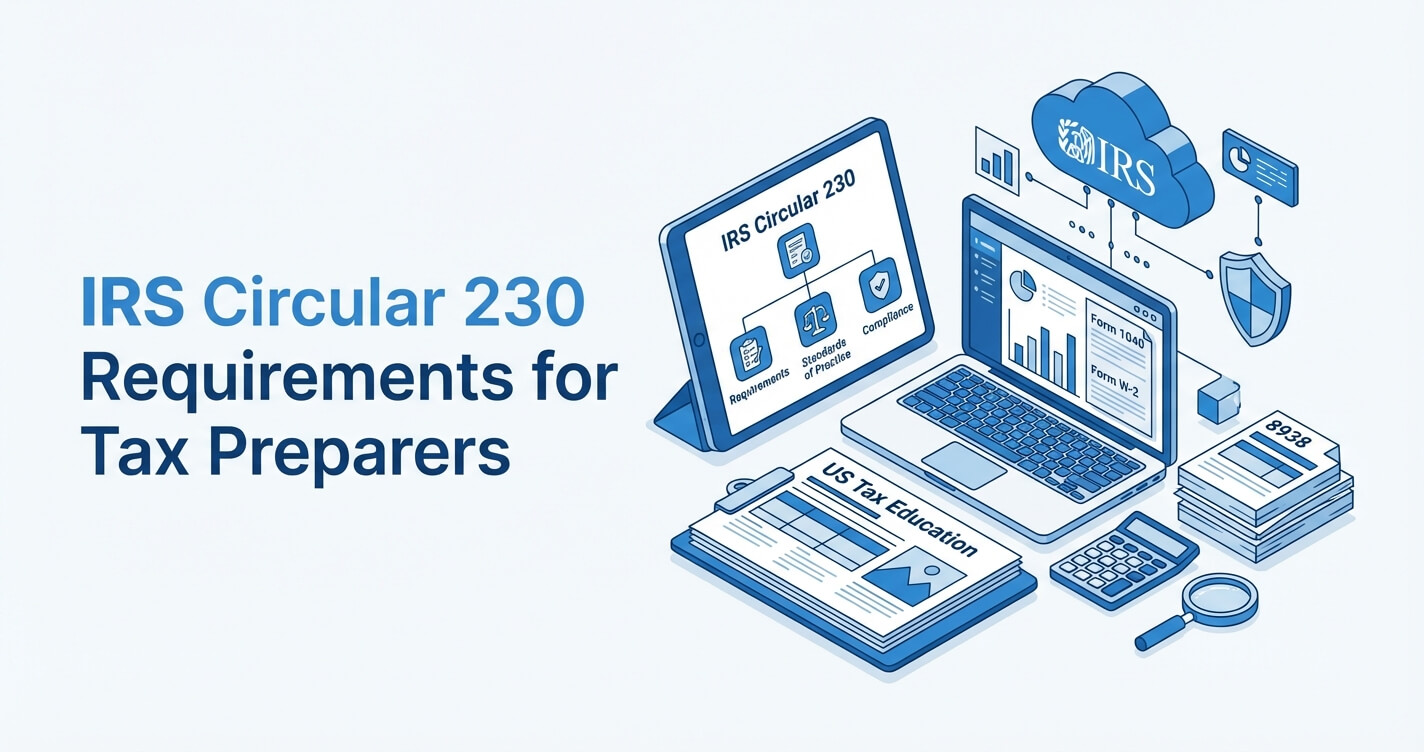
IRS Circular 230 Requirements for Tax Preparers

Content
Contents

Key Takeaways

  • IRS Circular 230 governs all paid US tax return preparers with a PTIN, including Indian CAs working offshore.
  • Due diligence under §10.22 requires reasonable care, follow-up on red flags, and documented client communication.
  • PTIN registration is mandatory every calendar year for anyone preparing US returns for compensation, regardless of location.
  • OPR sanctions include censure, suspension, disbarment, and monetary penalties, even without a client complaint.
  • Firm owners have explicit supervisory responsibilities under §10.36 for offshore and remote teams.
  • Preparers must respond to IRS information requests promptly and completely under §10.20.

Introduction

As Indian Chartered Accountants increasingly build US tax practices, regulatory compliance becomes as critical as technical accuracy. Many CAs focus on Internal Revenue Code provisions but overlook the professional conduct rules that govern how US tax work must be performed. IRS Circular 230 is the primary regulation that defines these expectations.

This article is written from a practitioner-to-practitioner perspective. It explains how IRS Circular 230 applies to Indian CA firms preparing US tax returns, delivering written advice, or managing offshore tax teams. The goal is not academic knowledge, but practical compliance you can implement in your firm.

You will learn who is covered by Circular 230, what “practice before the IRS” really means, how due diligence is evaluated, and where Indian preparers face the highest enforcement risk. We also address overlooked areas such as supervisory responsibility, technology competence, and engagement scoping so you can confidently scale US tax services.

What Is IRS Circular 230 and Why It Matters

Definition and legal authority

IRS Circular 230 is a set of Treasury Regulations issued under 31 U.S.C. §330 that governs practice before the Internal Revenue Service. It establishes enforceable standards of conduct for tax professionals who prepare returns, provide advice, or represent taxpayers.

The full text is published by the IRS and should be required reading for any firm offering US tax services. Refer to the Official IRS Circular 230 regulations for authoritative guidance.

Who is governed by Circular 230

Circular 230 applies to CPAs, Enrolled Agents, attorneys, and any paid tax return preparer with a PTIN. This includes preparers who do not sign returns but are substantially involved in preparation.

For Indian CA firms, this means both partners and staff preparing US returns are covered if they are compensated for that work.

Relationship between Circular 230 and the IRS Office of Professional Responsibility (OPR)

The IRS Office of Professional Responsibility enforces Circular 230. OPR investigates misconduct, conducts disciplinary proceedings, and imposes sanctions.

Practitioner Tip: OPR enforcement is independent of audits or penalties on clients. Even technically correct returns can lead to discipline if conduct standards are violated.

Practice Before the IRS: Scope and Applicability

What constitutes practice before the IRS

Practice before the IRS includes preparing or assisting with tax returns, providing written tax advice, communicating with the IRS on a client’s behalf, and representing taxpayers in examinations or appeals.

Even backend preparation or review performed offshore qualifies as practice when it directly affects a filed return.

PTIN requirements for tax preparers

A Preparer Tax Identification Number (PTIN) is mandatory for anyone preparing US tax returns for compensation. PTINs must be renewed annually.

Indian preparers can apply without US residency. For operational guidance, see this overview of the PTIN application for non-US residents.

Applicability to non-US and offshore preparers

Physical presence in the US is not required for Circular 230 to apply. Indian and other offshore preparers are fully subject once they prepare US returns.

Practitioner Tip: Do not assume enforcement is limited by geography. OPR actions regularly involve non-US preparers.

Due Diligence Requirements Under Circular 230

§10.22 Due Diligence standard

Section 10.22 requires practitioners to exercise reasonable care in preparing returns, determining correctness of representations, and advising clients.

This is a process-based standard. The IRS evaluates how you arrived at conclusions, not just the outcome.

Due diligence in preparing returns

Preparers cannot ignore inconsistencies or rely blindly on client-provided data. When information appears incorrect or incomplete, follow-up questions are mandatory.

Examples include mismatched income documents, unusually high deductions, or foreign disclosures that contradict prior-year filings.

Due diligence in representations to the IRS

Written or oral statements to the IRS must be accurate and not misleading. Silence can be misleading if it omits material facts.

Practitioner Tip: Document internal review notes. These records are critical if due diligence is later questioned.

Client notifications and reliance on information

Practitioners must advise clients promptly if they discover errors or omissions in filed returns. Continued representation without disclosure can trigger violations.

Reliance on third-party information is permitted only when it is reasonable under the circumstances.

Key Required and Prohibited Actions for Tax Preparers

Key required actions for preparers

Preparers must disclose non-frivolous positions when required and advise clients of potential penalties. Client records must be returned promptly upon request.

Copies of filed returns and supporting documents must be provided without unreasonable delay.

Key prohibited actions

Circular 230 prohibits frivolous positions, false statements, and any conduct intended to mislead the IRS.

Charging unconscionable fees or basing fees on refund amounts in restricted contexts is also prohibited.

Conflicts of interest and fee restrictions

Conflicts must be disclosed in writing, and informed client consent obtained where representation is still permissible.

Practitioner Tip: Use standardized conflict disclosures across US engagements to maintain consistency.

Penalties and Sanctions for Circular 230 Violations

Types of preparer penalties

Sanctions include censure, suspension, disbarment from practice before the IRS, and monetary penalties.

These are separate from Internal Revenue Code preparer penalties.

Sanctions imposed by OPR

OPR has broad discretion to impose discipline and publish outcomes. Guidance is available from the IRS Office of Professional Responsibility guidance.

Practitioner Tip: OPR cases often originate from IRS exams, not client complaints.

Examples of common violations

Common issues include lack of due diligence, failure to supervise staff, false statements, and ignoring IRS correspondence.

Additional Compliance Obligations and Emerging Gaps

Supervisory responsibilities (§10.36)

Firm owners and managers must ensure adequate procedures and supervision. This includes offshore and remote teams.

Failure to supervise is itself a violation, even if the underlying error was made by junior staff.

Best practices and quality control (§10.33)

Best practices include clear engagement letters, defined scopes of service, and documented review processes.

These practices are not optional when defending conduct before OPR.

Technological competency and data handling (§10.35)

Practitioners are expected to maintain technological competence, including secure data transmission and record retention.

Practitioner Tip: Weak data security controls can be cited as professional misconduct.

Responding to IRS document requests (§10.20)

Practitioners must respond to IRS requests for information promptly and completely, unless legally privileged.

Delays or partial responses are common triggers for OPR scrutiny.

Engagement letters and scope of services

Engagement letters should clearly define responsibilities, limitations, and reliance on client-provided information.

For firms building broader capability, align this with your overall US tax preparation guide for Indian chartered accountants.

Circular 230 Compliance Checklist for Indian Tax Preparers

Operational checklist for offshore teams

Ensure all preparers have valid PTINs and documented Circular 230 training. Maintain standardized workpapers.

Common risk areas for Indian preparers

High-risk areas include foreign asset disclosures, reliance on incomplete client data, and lack of supervision.

ITIN-related filings also require care; see the ITIN application process for NRI clients for procedural alignment.

Practical compliance tips

Implement review sign-offs, secure data systems, and written escalation procedures for red flags.

Practitioner Tip: Treat Circular 230 compliance as a firm-level control, not an individual obligation.

Conclusion

IRS Circular 230 is not a theoretical regulation. It directly governs how Indian CA firms prepare US returns, supervise teams, and interact with the IRS. Understanding its requirements protects your firm as much as it protects clients.

As you scale US tax services, focus on documented due diligence, clear engagement scoping, strong supervision, and timely IRS communication. These controls reduce enforcement risk and enhance credibility.

Building US tax capability is not just about technical knowledge. It is about operating at the professional standard expected by the IRS and OPR.

FAQs

Does IRS Circular 230 apply to Indian CAs working offshore?

Yes. Circular 230 applies to any paid US tax return preparer with a PTIN, regardless of location. Offshore preparation is considered practice before the IRS. Physical presence in the US is not required.

Is a PTIN mandatory for junior staff who do not sign returns?

Yes, if they are compensated and substantially involved in preparing returns. Signing authority is not the determining factor. Annual renewal is required.

Can OPR take action without a client complaint?

Yes. Many OPR cases arise from IRS audits or internal referrals. Client complaints are not required.

What documentation helps demonstrate due diligence?

Internal review notes, client questionnaires, follow-up emails, and checklists are critical. These show reasonable care under §10.22. Absence of documentation weakens defenses.

Are engagement letters mandatory under Circular 230?

They are not explicitly mandatory, but strongly support compliance with best practices. OPR expects clear scoping and responsibility allocation. Lack of engagement letters increases risk.

How does Circular 230 affect fee structures?

Unconscionable fees and certain contingent fees are prohibited. Fees must be reasonable relative to services provided. Refund-based fees are restricted.

What happens if staff violate Circular 230?

Individual staff can be sanctioned, but supervisors may also be penalized. Failure to supervise under §10.36 is a separate violation. Firm-level controls are essential.

Are technology failures considered violations?

They can be. Inadequate data protection or loss of records may be cited as lack of competence. Secure systems are part of professional responsibility.

How quickly must IRS document requests be answered?

Responses must be prompt and complete. There is no fixed number of days, but unreasonable delay is a violation. Extensions should be requested formally if needed.

Does Circular 230 apply to advisory work only, without filing?

Yes. Written tax advice and representations are covered. Filing a return is not required for applicability.

Key Takeaways

  • IRS Circular 230 governs all paid US tax return preparers with a PTIN, including Indian CAs working offshore.
  • Due diligence under §10.22 requires reasonable care, follow-up on red flags, and documented client communication.
  • PTIN registration is mandatory every calendar year for anyone preparing US returns for compensation, regardless of location.
  • OPR sanctions include censure, suspension, disbarment, and monetary penalties, even without a client complaint.
  • Firm owners have explicit supervisory responsibilities under §10.36 for offshore and remote teams.
  • Preparers must respond to IRS information requests promptly and completely under §10.20.

Introduction

As Indian Chartered Accountants increasingly build US tax practices, regulatory compliance becomes as critical as technical accuracy. Many CAs focus on Internal Revenue Code provisions but overlook the professional conduct rules that govern how US tax work must be performed. IRS Circular 230 is the primary regulation that defines these expectations.

This article is written from a practitioner-to-practitioner perspective. It explains how IRS Circular 230 applies to Indian CA firms preparing US tax returns, delivering written advice, or managing offshore tax teams. The goal is not academic knowledge, but practical compliance you can implement in your firm.

You will learn who is covered by Circular 230, what “practice before the IRS” really means, how due diligence is evaluated, and where Indian preparers face the highest enforcement risk. We also address overlooked areas such as supervisory responsibility, technology competence, and engagement scoping so you can confidently scale US tax services.

What Is IRS Circular 230 and Why It Matters

Definition and legal authority

IRS Circular 230 is a set of Treasury Regulations issued under 31 U.S.C. §330 that governs practice before the Internal Revenue Service. It establishes enforceable standards of conduct for tax professionals who prepare returns, provide advice, or represent taxpayers.

The full text is published by the IRS and should be required reading for any firm offering US tax services. Refer to the Official IRS Circular 230 regulations for authoritative guidance.

Who is governed by Circular 230

Circular 230 applies to CPAs, Enrolled Agents, attorneys, and any paid tax return preparer with a PTIN. This includes preparers who do not sign returns but are substantially involved in preparation.

For Indian CA firms, this means both partners and staff preparing US returns are covered if they are compensated for that work.

Relationship between Circular 230 and the IRS Office of Professional Responsibility (OPR)

The IRS Office of Professional Responsibility enforces Circular 230. OPR investigates misconduct, conducts disciplinary proceedings, and imposes sanctions.

Practitioner Tip: OPR enforcement is independent of audits or penalties on clients. Even technically correct returns can lead to discipline if conduct standards are violated.

Practice Before the IRS: Scope and Applicability

What constitutes practice before the IRS

Practice before the IRS includes preparing or assisting with tax returns, providing written tax advice, communicating with the IRS on a client’s behalf, and representing taxpayers in examinations or appeals.

Even backend preparation or review performed offshore qualifies as practice when it directly affects a filed return.

PTIN requirements for tax preparers

A Preparer Tax Identification Number (PTIN) is mandatory for anyone preparing US tax returns for compensation. PTINs must be renewed annually.

Indian preparers can apply without US residency. For operational guidance, see this overview of the PTIN application for non-US residents.

Applicability to non-US and offshore preparers

Physical presence in the US is not required for Circular 230 to apply. Indian and other offshore preparers are fully subject once they prepare US returns.

Practitioner Tip: Do not assume enforcement is limited by geography. OPR actions regularly involve non-US preparers.

Due Diligence Requirements Under Circular 230

§10.22 Due Diligence standard

Section 10.22 requires practitioners to exercise reasonable care in preparing returns, determining correctness of representations, and advising clients.

This is a process-based standard. The IRS evaluates how you arrived at conclusions, not just the outcome.

Due diligence in preparing returns

Preparers cannot ignore inconsistencies or rely blindly on client-provided data. When information appears incorrect or incomplete, follow-up questions are mandatory.

Examples include mismatched income documents, unusually high deductions, or foreign disclosures that contradict prior-year filings.

Due diligence in representations to the IRS

Written or oral statements to the IRS must be accurate and not misleading. Silence can be misleading if it omits material facts.

Practitioner Tip: Document internal review notes. These records are critical if due diligence is later questioned.

Client notifications and reliance on information

Practitioners must advise clients promptly if they discover errors or omissions in filed returns. Continued representation without disclosure can trigger violations.

Reliance on third-party information is permitted only when it is reasonable under the circumstances.

Key Required and Prohibited Actions for Tax Preparers

Key required actions for preparers

Preparers must disclose non-frivolous positions when required and advise clients of potential penalties. Client records must be returned promptly upon request.

Copies of filed returns and supporting documents must be provided without unreasonable delay.

Key prohibited actions

Circular 230 prohibits frivolous positions, false statements, and any conduct intended to mislead the IRS.

Charging unconscionable fees or basing fees on refund amounts in restricted contexts is also prohibited.

Conflicts of interest and fee restrictions

Conflicts must be disclosed in writing, and informed client consent obtained where representation is still permissible.

Practitioner Tip: Use standardized conflict disclosures across US engagements to maintain consistency.

Penalties and Sanctions for Circular 230 Violations

Types of preparer penalties

Sanctions include censure, suspension, disbarment from practice before the IRS, and monetary penalties.

These are separate from Internal Revenue Code preparer penalties.

Sanctions imposed by OPR

OPR has broad discretion to impose discipline and publish outcomes. Guidance is available from the IRS Office of Professional Responsibility guidance.

Practitioner Tip: OPR cases often originate from IRS exams, not client complaints.

Examples of common violations

Common issues include lack of due diligence, failure to supervise staff, false statements, and ignoring IRS correspondence.

Additional Compliance Obligations and Emerging Gaps

Supervisory responsibilities (§10.36)

Firm owners and managers must ensure adequate procedures and supervision. This includes offshore and remote teams.

Failure to supervise is itself a violation, even if the underlying error was made by junior staff.

Best practices and quality control (§10.33)

Best practices include clear engagement letters, defined scopes of service, and documented review processes.

These practices are not optional when defending conduct before OPR.

Technological competency and data handling (§10.35)

Practitioners are expected to maintain technological competence, including secure data transmission and record retention.

Practitioner Tip: Weak data security controls can be cited as professional misconduct.

Responding to IRS document requests (§10.20)

Practitioners must respond to IRS requests for information promptly and completely, unless legally privileged.

Delays or partial responses are common triggers for OPR scrutiny.

Engagement letters and scope of services

Engagement letters should clearly define responsibilities, limitations, and reliance on client-provided information.

For firms building broader capability, align this with your overall US tax preparation guide for Indian chartered accountants.

Circular 230 Compliance Checklist for Indian Tax Preparers

Operational checklist for offshore teams

Ensure all preparers have valid PTINs and documented Circular 230 training. Maintain standardized workpapers.

Common risk areas for Indian preparers

High-risk areas include foreign asset disclosures, reliance on incomplete client data, and lack of supervision.

ITIN-related filings also require care; see the ITIN application process for NRI clients for procedural alignment.

Practical compliance tips

Implement review sign-offs, secure data systems, and written escalation procedures for red flags.

Practitioner Tip: Treat Circular 230 compliance as a firm-level control, not an individual obligation.

Conclusion

IRS Circular 230 is not a theoretical regulation. It directly governs how Indian CA firms prepare US returns, supervise teams, and interact with the IRS. Understanding its requirements protects your firm as much as it protects clients.

As you scale US tax services, focus on documented due diligence, clear engagement scoping, strong supervision, and timely IRS communication. These controls reduce enforcement risk and enhance credibility.

Building US tax capability is not just about technical knowledge. It is about operating at the professional standard expected by the IRS and OPR.

FAQs

Does IRS Circular 230 apply to Indian CAs working offshore?

Yes. Circular 230 applies to any paid US tax return preparer with a PTIN, regardless of location. Offshore preparation is considered practice before the IRS. Physical presence in the US is not required.

Is a PTIN mandatory for junior staff who do not sign returns?

Yes, if they are compensated and substantially involved in preparing returns. Signing authority is not the determining factor. Annual renewal is required.

Can OPR take action without a client complaint?

Yes. Many OPR cases arise from IRS audits or internal referrals. Client complaints are not required.

What documentation helps demonstrate due diligence?

Internal review notes, client questionnaires, follow-up emails, and checklists are critical. These show reasonable care under §10.22. Absence of documentation weakens defenses.

Are engagement letters mandatory under Circular 230?

They are not explicitly mandatory, but strongly support compliance with best practices. OPR expects clear scoping and responsibility allocation. Lack of engagement letters increases risk.

How does Circular 230 affect fee structures?

Unconscionable fees and certain contingent fees are prohibited. Fees must be reasonable relative to services provided. Refund-based fees are restricted.

What happens if staff violate Circular 230?

Individual staff can be sanctioned, but supervisors may also be penalized. Failure to supervise under §10.36 is a separate violation. Firm-level controls are essential.

Are technology failures considered violations?

They can be. Inadequate data protection or loss of records may be cited as lack of competence. Secure systems are part of professional responsibility.

How quickly must IRS document requests be answered?

Responses must be prompt and complete. There is no fixed number of days, but unreasonable delay is a violation. Extensions should be requested formally if needed.

Does Circular 230 apply to advisory work only, without filing?

Yes. Written tax advice and representations are covered. Filing a return is not required for applicability.

Latest from our blogs

Latest from our blogs

View All
]