Form 1065 Partnership Return Preparation Guide

Content
Contents

Key Takeaways

  • Form 1065 is an informational return; partnerships generally pay no US income tax at the entity level.
  • Income, deductions, and credits flow through to partners via Schedule K-1, based on the Partnership Agreement.
  • Calendar-year partnerships must file by March 15, with an automatic extension to September 15.
  • Late filing penalties can reach $235 per partner per month for up to 12 months.
  • Partnerships with assets over $10 million may trigger Schedule M-3 reporting.
  • International activity often requires Schedule K-2 and K-3, even for US-based partnerships.

Introduction

For Indian Chartered Accountants expanding into US tax services, Form 1065 is one of the most operationally intensive returns you will handle. Partnership returns combine accounting accuracy, legal interpretation of the Partnership Agreement, and precise allocation mechanics across partners.

This guide is written for practitioners who prepare or review Form 1065 for clients, not for partners filing their own returns. It focuses on how to manage the end-to-end workflow, common risk areas the IRS scrutinizes, and how Schedule K-1 drives downstream partner compliance.

You will learn how partnership taxation works, how to structure a repeatable 1065 preparation process, and how to handle advanced requirements like Schedule M-3, K-2/K-3, and capital transactions. The goal is to help you confidently deliver US partnership compliance at scale.

Key Takeaways: Form 1065 at a Glance

Who must file Form 1065

Any entity classified as a partnership for US tax purposes must file Form 1065. This includes multi-member LLCs that have not elected corporate taxation. Filing requirements apply regardless of profitability.

What Form 1065 reports

Form 1065 reports the partnership’s income, deductions, credits, and balance sheet information. The IRS provides a high-level summary at the IRS overview of Form 1065.

How partners are taxed

Partners are taxed individually on their allocable share, reported through Schedule K-1. The partnership itself typically does not pay income tax.

How Partnership Taxation Works (Before You Start)

Pass-through taxation explained

US partnerships are pass-through entities. Taxable income is computed at the partnership level but taxed at the partner level. This avoids double taxation seen in C corporations.

Role of the Partnership Agreement

The Partnership Agreement governs profit-sharing ratios, guaranteed payments, and special allocations. As preparers, you must align tax allocations with the agreement and ensure they have substantial economic effect.

Practitioner Tip: Always request the executed Partnership Agreement, not a summary. Allocation errors are a leading cause of IRS notices.

Understanding partner basis

Partner basis starts with capital contributions and increases with income and additional contributions. It decreases with losses and distributions. Basis limits loss deductibility and distribution taxability.

Step-by-Step Form 1065 Workflow (Start to Finish)

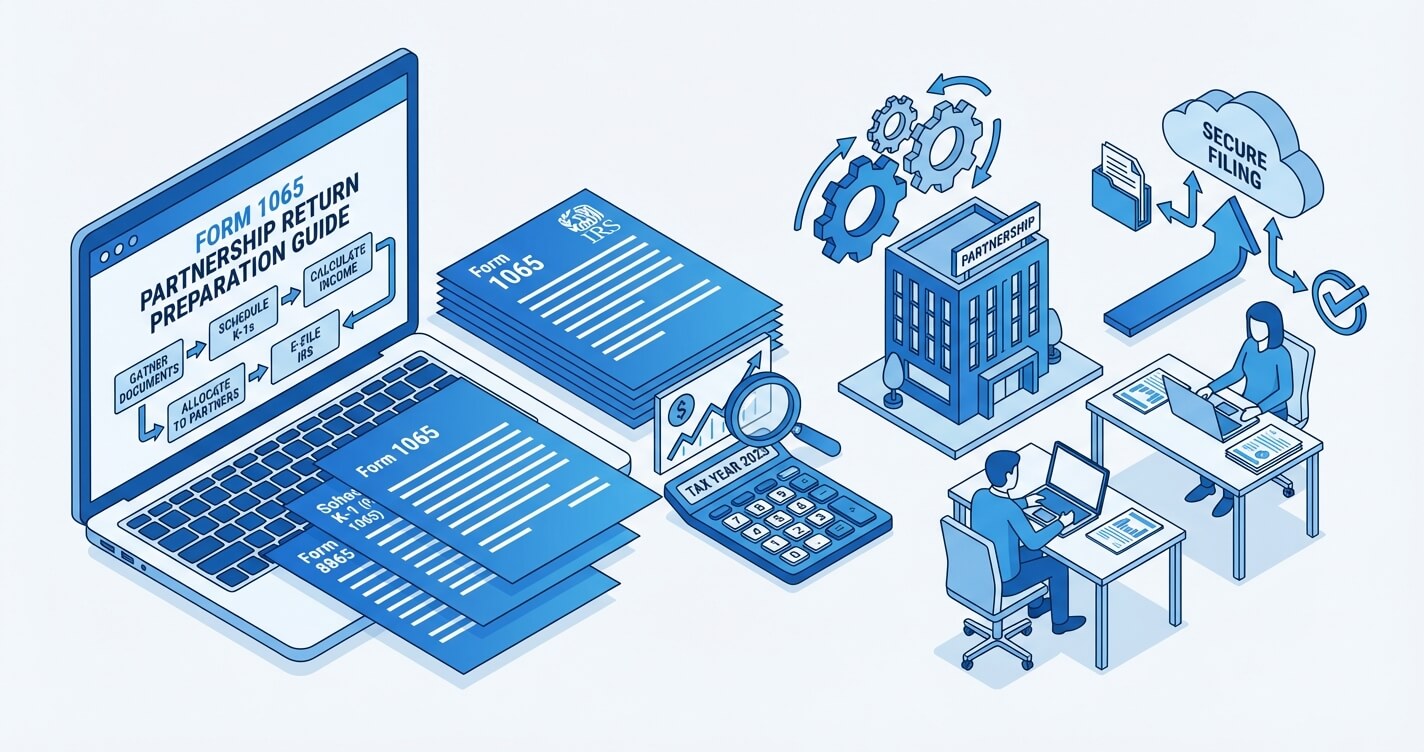
Step 1: Gather documents and financials

Collect the EIN, legal entity details, trial balance, general ledger, prior-year return, and partner information. Confirm ownership percentages and residency status.

Step 2: Review prior-year return and capital accounts

Reconcile beginning capital balances to the prior-year Schedule M-2 and K-1s. Differences here will cascade through the return.

Step 3: Validate allocations and partner data

Check that allocations follow the Partnership Agreement. Validate guaranteed payments, profit-sharing ratios, and any mid-year ownership changes.

Step 4: Prepare Form 1065 and schedules

Prepare the core return, then complete Schedules K, K-1, L, M-1, and M-2. Address any international or capital transaction disclosures.

Step 5: Review, reconcile, and e-file

Perform a top-down review. Reconcile ordinary income to Schedule K and ensure capital accounts roll forward correctly.

Practitioner Tip: Use standardized checklists when handling multiple partnerships to reduce review time.

General Information Section of Form 1065

Basic partnership details

Lines A–K capture the partnership name, address, EIN, principal activity, and business code. Errors here often delay processing.

Accounting method and business activity

Most small partnerships use the cash method. Once selected, consistency is required unless IRS approval is obtained.

Schedule B: Other Information

Schedule B includes yes/no questions on ownership, foreign partners, and the centralized partnership audit regime. You must designate a Partnership Representative who has authority to bind the partnership in audits.

Income, Deductions, and Ordinary Business Income

Income section overview

Report gross receipts and other income. Avoid netting expenses against income lines.

Deductions and common adjustments

Common deductions include salaries, rent, depreciation, and professional fees. Guaranteed payments to partners are deducted here but separately stated.

Line 22: Ordinary business income (loss)

Line 22 flows directly to Schedule K and then to each partner’s Schedule K-1.

Required Schedules Explained (K, K-1, L, M-1, M-2)

Schedule K: Partnership-level allocations

Schedule K summarizes all items allocated to partners. Accuracy here drives K-1 correctness.

Schedule K-1: Partner-level reporting

Each partner receives a K-1 reporting their share of income, deductions, and credits.

Schedule L: Balance sheet

Required if partnership assets exceed $250,000. Balance sheet must reconcile to books.

Schedule M-1: Book-to-tax reconciliation

Schedule M-1 reconciles financial statement income to tax income.

Schedule M-2: Analysis of partners’ capital

Tracks capital contributions, income, and distributions.

Refer to the IRS Instructions for Form 1065 for detailed line guidance.

What Is Schedule K-1? Allocation Examples That Make It Clear

What partners use Schedule K-1 for

Partners use K-1 data to prepare their individual or corporate returns.

Profit, loss, and special allocation examples

Example: Partner A owns 60%, Partner B owns 40%. The partnership earns $100,000 and pays Partner A a $20,000 guaranteed payment. Ordinary income of $80,000 is allocated 60/40 after the guaranteed payment.

Basis limitations and K-1 reporting

If Partner B’s basis is only $10,000, losses allocated beyond that are suspended.

Practitioner Tip: Always review partner basis schedules when losses are allocated.

Advanced & Often-Missed Requirements

Schedule M-3 for large partnerships

Partnerships with total assets over $10 million must file Schedule M-3 instead of M-1.

Schedule K-2 and K-3 for international items

Foreign taxes, income, or partners may require K-2 and K-3 reporting, even if amounts are small.

Capital gains and Form 8949 considerations

Capital transactions flow through Schedule K-1 and may require partners to file Form 8949.

Filing Deadlines, Extensions, and Penalties Calendar

Standard due dates

Form 1065 is due by March 15 for calendar-year partnerships.

Extensions and partner delivery timelines

Form 7004 extends filing to September 15. K-1s should be delivered promptly.

Late filing penalties

Penalty is $235 per partner per month, up to 12 months.

Electronic Filing, Review, and Scaling 1065 Prep

IRS e-file requirements

Most partnerships must e-file unless specifically exempt.

Common review checkpoints

Review allocations, capital accounts, and consistency across schedules.

Scaling partnership return preparation

Standardized workflows and automation help firms handle 50–1,000+ Form 1065 filings efficiently. Many firms also cross-train teams on related returns like the Form 1120-S S corporation tax return guide and entity classification topics such as LLC taxation options for Indian business owners.

If you are exploring ways to streamline 1065 preparation, it may be worth reviewing automated workflows or requesting a walkthrough of a white-label process before the next busy season.

Conclusion

Form 1065 preparation requires more than data entry. It demands a clear understanding of partnership taxation, allocation mechanics, and IRS reporting expectations. For Indian CAs, mastering this return opens the door to serving a wide range of US clients.

By building a repeatable workflow and focusing on high-risk areas like capital accounts and K-1 allocations, firms can deliver accurate partnership returns at scale. As volumes grow, technology-enabled processes and experienced review layers become essential.

FAQ

Do all multi-member LLCs have to file Form 1065?

Yes, unless they elect to be taxed as a corporation. By default, multi-member LLCs are treated as partnerships for US tax purposes.

Can a partnership have a foreign partner?

Yes, but additional reporting and withholding obligations may apply. Schedule K-2 and K-3 are commonly triggered.

What is a guaranteed payment?

A guaranteed payment is compensation to a partner for services or capital. It is deductible by the partnership and taxable to the partner.

Is Schedule L always required?

No, it is generally required when partnership assets exceed $250,000. Smaller partnerships may be exempt.

What happens if K-1s are issued late?

Late or incorrect K-1s can trigger penalties and delay partners’ filings. Timely delivery is critical.

When is Schedule M-3 required?

Schedule M-3 is required when total partnership assets exceed $10 million at year-end.

Who is the Partnership Representative?

The Partnership Representative is the person authorized to deal with the IRS during audits. This role replaces the old tax matters partner.

Can losses on K-1 always be claimed?

No, losses are limited by basis, at-risk, and passive activity rules.

Are capital gains reported at the partnership level?

They are reported on Schedule K and passed through to partners via K-1.

How can Indian CA firms scale Form 1065 preparation?

By using standardized workflows, checklists, and automation tools. White-label service models can also help manage volume efficiently.

Key Takeaways

  • Form 1065 is an informational return; partnerships generally pay no US income tax at the entity level.
  • Income, deductions, and credits flow through to partners via Schedule K-1, based on the Partnership Agreement.
  • Calendar-year partnerships must file by March 15, with an automatic extension to September 15.
  • Late filing penalties can reach $235 per partner per month for up to 12 months.
  • Partnerships with assets over $10 million may trigger Schedule M-3 reporting.
  • International activity often requires Schedule K-2 and K-3, even for US-based partnerships.

Introduction

For Indian Chartered Accountants expanding into US tax services, Form 1065 is one of the most operationally intensive returns you will handle. Partnership returns combine accounting accuracy, legal interpretation of the Partnership Agreement, and precise allocation mechanics across partners.

This guide is written for practitioners who prepare or review Form 1065 for clients, not for partners filing their own returns. It focuses on how to manage the end-to-end workflow, common risk areas the IRS scrutinizes, and how Schedule K-1 drives downstream partner compliance.

You will learn how partnership taxation works, how to structure a repeatable 1065 preparation process, and how to handle advanced requirements like Schedule M-3, K-2/K-3, and capital transactions. The goal is to help you confidently deliver US partnership compliance at scale.

Key Takeaways: Form 1065 at a Glance

Who must file Form 1065

Any entity classified as a partnership for US tax purposes must file Form 1065. This includes multi-member LLCs that have not elected corporate taxation. Filing requirements apply regardless of profitability.

What Form 1065 reports

Form 1065 reports the partnership’s income, deductions, credits, and balance sheet information. The IRS provides a high-level summary at the IRS overview of Form 1065.

How partners are taxed

Partners are taxed individually on their allocable share, reported through Schedule K-1. The partnership itself typically does not pay income tax.

How Partnership Taxation Works (Before You Start)

Pass-through taxation explained

US partnerships are pass-through entities. Taxable income is computed at the partnership level but taxed at the partner level. This avoids double taxation seen in C corporations.

Role of the Partnership Agreement

The Partnership Agreement governs profit-sharing ratios, guaranteed payments, and special allocations. As preparers, you must align tax allocations with the agreement and ensure they have substantial economic effect.

Practitioner Tip: Always request the executed Partnership Agreement, not a summary. Allocation errors are a leading cause of IRS notices.

Understanding partner basis

Partner basis starts with capital contributions and increases with income and additional contributions. It decreases with losses and distributions. Basis limits loss deductibility and distribution taxability.

Step-by-Step Form 1065 Workflow (Start to Finish)

Step 1: Gather documents and financials

Collect the EIN, legal entity details, trial balance, general ledger, prior-year return, and partner information. Confirm ownership percentages and residency status.

Step 2: Review prior-year return and capital accounts

Reconcile beginning capital balances to the prior-year Schedule M-2 and K-1s. Differences here will cascade through the return.

Step 3: Validate allocations and partner data

Check that allocations follow the Partnership Agreement. Validate guaranteed payments, profit-sharing ratios, and any mid-year ownership changes.

Step 4: Prepare Form 1065 and schedules

Prepare the core return, then complete Schedules K, K-1, L, M-1, and M-2. Address any international or capital transaction disclosures.

Step 5: Review, reconcile, and e-file

Perform a top-down review. Reconcile ordinary income to Schedule K and ensure capital accounts roll forward correctly.

Practitioner Tip: Use standardized checklists when handling multiple partnerships to reduce review time.

General Information Section of Form 1065

Basic partnership details

Lines A–K capture the partnership name, address, EIN, principal activity, and business code. Errors here often delay processing.

Accounting method and business activity

Most small partnerships use the cash method. Once selected, consistency is required unless IRS approval is obtained.

Schedule B: Other Information

Schedule B includes yes/no questions on ownership, foreign partners, and the centralized partnership audit regime. You must designate a Partnership Representative who has authority to bind the partnership in audits.

Income, Deductions, and Ordinary Business Income

Income section overview

Report gross receipts and other income. Avoid netting expenses against income lines.

Deductions and common adjustments

Common deductions include salaries, rent, depreciation, and professional fees. Guaranteed payments to partners are deducted here but separately stated.

Line 22: Ordinary business income (loss)

Line 22 flows directly to Schedule K and then to each partner’s Schedule K-1.

Required Schedules Explained (K, K-1, L, M-1, M-2)

Schedule K: Partnership-level allocations

Schedule K summarizes all items allocated to partners. Accuracy here drives K-1 correctness.

Schedule K-1: Partner-level reporting

Each partner receives a K-1 reporting their share of income, deductions, and credits.

Schedule L: Balance sheet

Required if partnership assets exceed $250,000. Balance sheet must reconcile to books.

Schedule M-1: Book-to-tax reconciliation

Schedule M-1 reconciles financial statement income to tax income.

Schedule M-2: Analysis of partners’ capital

Tracks capital contributions, income, and distributions.

Refer to the IRS Instructions for Form 1065 for detailed line guidance.

What Is Schedule K-1? Allocation Examples That Make It Clear

What partners use Schedule K-1 for

Partners use K-1 data to prepare their individual or corporate returns.

Profit, loss, and special allocation examples

Example: Partner A owns 60%, Partner B owns 40%. The partnership earns $100,000 and pays Partner A a $20,000 guaranteed payment. Ordinary income of $80,000 is allocated 60/40 after the guaranteed payment.

Basis limitations and K-1 reporting

If Partner B’s basis is only $10,000, losses allocated beyond that are suspended.

Practitioner Tip: Always review partner basis schedules when losses are allocated.

Advanced & Often-Missed Requirements

Schedule M-3 for large partnerships

Partnerships with total assets over $10 million must file Schedule M-3 instead of M-1.

Schedule K-2 and K-3 for international items

Foreign taxes, income, or partners may require K-2 and K-3 reporting, even if amounts are small.

Capital gains and Form 8949 considerations

Capital transactions flow through Schedule K-1 and may require partners to file Form 8949.

Filing Deadlines, Extensions, and Penalties Calendar

Standard due dates

Form 1065 is due by March 15 for calendar-year partnerships.

Extensions and partner delivery timelines

Form 7004 extends filing to September 15. K-1s should be delivered promptly.

Late filing penalties

Penalty is $235 per partner per month, up to 12 months.

Electronic Filing, Review, and Scaling 1065 Prep

IRS e-file requirements

Most partnerships must e-file unless specifically exempt.

Common review checkpoints

Review allocations, capital accounts, and consistency across schedules.

Scaling partnership return preparation

Standardized workflows and automation help firms handle 50–1,000+ Form 1065 filings efficiently. Many firms also cross-train teams on related returns like the Form 1120-S S corporation tax return guide and entity classification topics such as LLC taxation options for Indian business owners.

If you are exploring ways to streamline 1065 preparation, it may be worth reviewing automated workflows or requesting a walkthrough of a white-label process before the next busy season.

Conclusion

Form 1065 preparation requires more than data entry. It demands a clear understanding of partnership taxation, allocation mechanics, and IRS reporting expectations. For Indian CAs, mastering this return opens the door to serving a wide range of US clients.

By building a repeatable workflow and focusing on high-risk areas like capital accounts and K-1 allocations, firms can deliver accurate partnership returns at scale. As volumes grow, technology-enabled processes and experienced review layers become essential.

FAQ

Do all multi-member LLCs have to file Form 1065?

Yes, unless they elect to be taxed as a corporation. By default, multi-member LLCs are treated as partnerships for US tax purposes.

Can a partnership have a foreign partner?

Yes, but additional reporting and withholding obligations may apply. Schedule K-2 and K-3 are commonly triggered.

What is a guaranteed payment?

A guaranteed payment is compensation to a partner for services or capital. It is deductible by the partnership and taxable to the partner.

Is Schedule L always required?

No, it is generally required when partnership assets exceed $250,000. Smaller partnerships may be exempt.

What happens if K-1s are issued late?

Late or incorrect K-1s can trigger penalties and delay partners’ filings. Timely delivery is critical.

When is Schedule M-3 required?

Schedule M-3 is required when total partnership assets exceed $10 million at year-end.

Who is the Partnership Representative?

The Partnership Representative is the person authorized to deal with the IRS during audits. This role replaces the old tax matters partner.

Can losses on K-1 always be claimed?

No, losses are limited by basis, at-risk, and passive activity rules.

Are capital gains reported at the partnership level?

They are reported on Schedule K and passed through to partners via K-1.

How can Indian CA firms scale Form 1065 preparation?

By using standardized workflows, checklists, and automation tools. White-label service models can also help manage volume efficiently.

Latest from our blogs

Latest from our blogs

View All
]