Key Takeaways
- Remote NRI relationships require stricter structure because there is no in-person trust buffer and higher sensitivity around data and money.
- Set response-time expectations upfront (for example, 24–48 business hours during non-peak season and 72 hours during peak filing periods).
- Engagement letters must clearly define scope, timelines, and client responsibilities before any document exchange.
- Simulating in-office hours using shared calendars and fixed availability windows reduces anxiety for overseas clients.
- Use secure client portals instead of email or WhatsApp for collecting tax documents and SSNs.
- Consistency in small commitments—meeting times, follow-ups, summaries—builds long-term trust faster than credentials alone.
Introduction
As more Indian CA firms expand into US tax preparation, NRI clients are often the first overseas segment they encounter. On paper, the work looks straightforward. In practice, managing NRI clients remotely introduces communication, trust, and expectation challenges that are very different from local engagements.
When clients sit thousands of miles away, every missed response, unclear email, or vague engagement scope feels riskier to them. This is especially true in US tax matters where penalties, deadlines, and compliance standards are unforgiving. For Indian CAs, the ability to manage these relationships professionally often determines whether an NRI becomes a long-term client or a one-season filing.
This article focuses on how practitioners should handle NRI client relationships remotely. We will cover expectation-setting, communication frameworks, engagement letters, and tools that help you appear reliable and structured—even as a growing firm. The goal is simple: help you deliver US tax services confidently while building trust without ever meeting the client in person.
Why Building NRI Client Relationships Remotely Is Different
Time zones, cultural context, and compliance expectations
NRI clients operate across time zones, legal systems, and service expectations. A US-based client may expect same-day acknowledgements even if full responses take longer. Indian business norms around informal follow-ups do not always translate well in regulated US tax work.
From a compliance perspective, NRIs are more sensitive to deadlines, penalties, and documentation accuracy. They often compare your processes to US CPAs, not local CAs. This gap makes structured communication essential from the first interaction.
Why trust matters more without in-person meetings
Without face-to-face meetings, clients assess credibility through responsiveness, clarity, and consistency. Any ambiguity around scope, pricing, or timelines increases perceived risk. For overseas clients, trust is built less on relationships and more on process.
Practitioner Tip: Treat every written communication as an audit trail. Assume it may be re-read months later during a compliance issue.
Setting Clear Expectations From the First Interaction
Kickoff meetings and discovery calls
The first video call sets the tone for the entire engagement. Run it like a professional kickoff, not an informal chat. Share an agenda in advance covering client background, filing obligations, timelines, and next steps.
Use screen sharing to explain how information will be collected and reviewed. This immediately reduces anxiety and positions you as process-driven.
Defining communication tools and response times
NRI clients want predictability. Clearly define which channels are used for what purpose—email for documentation, portal messages for tasks, and calls for decisions. Document expected response times in writing.
For example, state 24–48 business hours during non-peak months and slower responses during March–April. This prevents frustration later.
Scope clarity using engagement letters
An engagement letter is not a formality for overseas clients; it is reassurance. It should define what is included, what is excluded, and what information the client must provide.
Well-written engagement letters also protect you when clients assume advisory services that were never agreed upon.
Practitioner Tip: Walk through the engagement letter on a call. Clients value the explanation more than the document itself.
How to Build Trust With Overseas Clients
Reliability and consistency
Trust is built by delivering on small promises. If you commit to a follow-up email, send it the same day. If a return review will take five days, do not stretch it to eight.
Consistency signals control, which overseas clients associate with compliance safety.
Using video conferencing to humanize relationships
Video calls reduce distance. Keep cameras on, share an agenda, and close with a recap of decisions. These simple habits humanize the relationship and reduce misunderstandings.
Always send a written summary after the call to reinforce clarity.
Transparency around process and pricing
Explain your US tax workflow step-by-step, including review layers and filing checks. Transparency reduces fear of errors.
Where possible, reference formal standards like IRS Circular 230 responsibilities for tax professionals instead of generic assurances.
Practitioner Tip: Clients trust processes more than promises. Show the system, not just your experience.
Communication Best Practices for Remote Client Communication
Creating a communication plan
Not every engagement needs the same frequency. Ongoing compliance clients may need monthly check-ins, while one-time filings can be milestone-based.
Document the cadence so silence is never misinterpreted as neglect.
Choosing the right channels for the right message
Email works best for documentation and formal instructions. Chat tools are useful for quick clarifications. Calls should be reserved for decisions and complex explanations.
Mixing channels without rules creates confusion and missed information.
Simulating in-office availability remotely
Use shared calendars and fixed virtual office hours to simulate walk-in availability. Even two hours twice a week reassures overseas clients.
When communication rules break during peak season, proactively reset expectations rather than going silent.
Practitioner Tip: A visible calendar reduces follow-ups more effectively than repeated reminders.
What Communication Tools Work Best for NRI Clients
Video conferencing for consultations
Zoom, Google Meet, and Teams all work well. Choose one platform and standardize it. Consistency matters more than features.
| Tool | Best Use | Key Advantage |
|---|---|---|
| Zoom | Client consultations | Ease of use |
| Google Meet | Quick reviews | No downloads |
| Teams | Long-term clients | Integrated chat |
Client portals for document collection
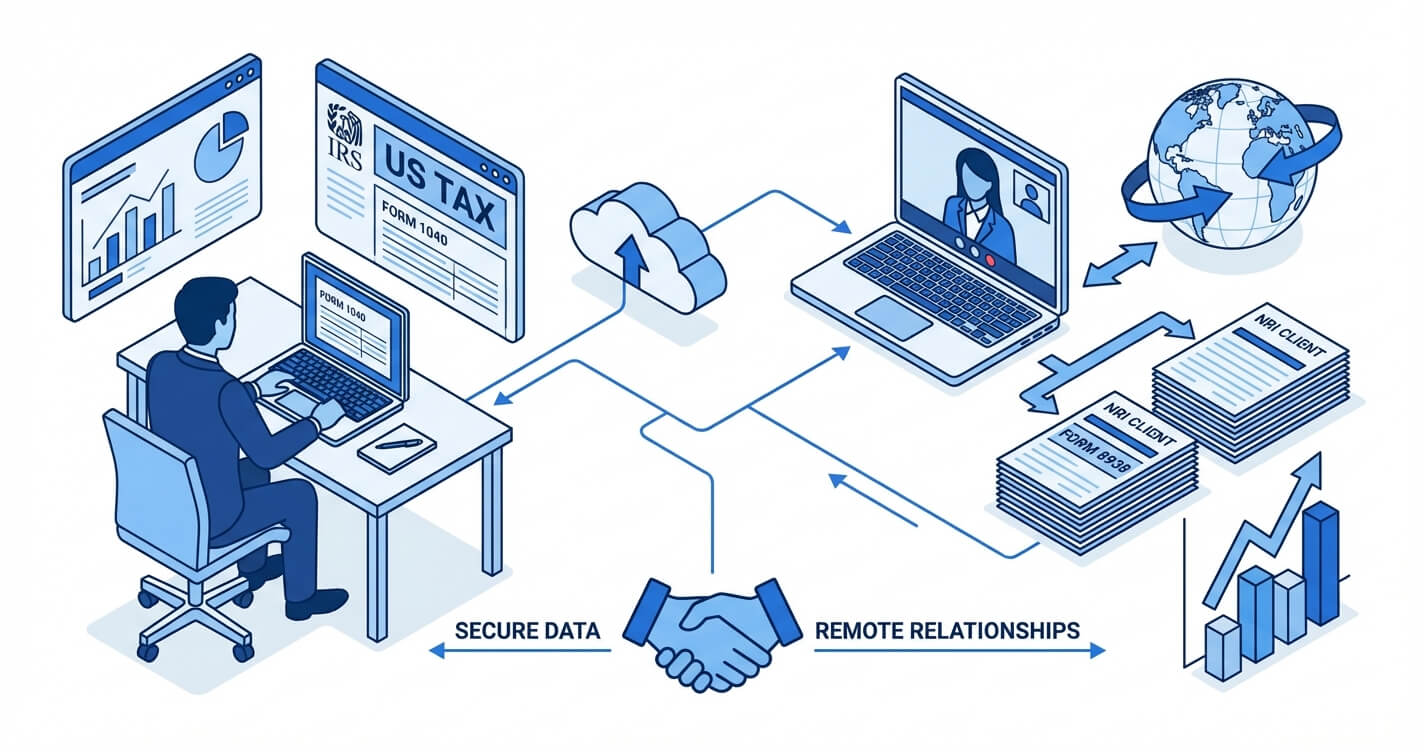
Secure portals are non-negotiable for US tax work. Email and WhatsApp are risky for SSNs and financial data.
Portals also provide status visibility, reducing repeated follow-ups.
Internal systems to avoid follow-ups
Use internal tracking and alerts to monitor missing documents or client changes. Automation helps small firms appear larger and more reliable.
This becomes critical as your US client base grows. Related reading on systems selection can be found in this US tax software comparison for Indian CA firms.
Handling Remote Consultations Professionally
Pre-call preparation
Send an agenda and document checklist before the call. This sets expectations and shortens call time.
Prepared clients perceive higher professionalism.
Running efficient consultation calls
Structure calls clearly: problem identification, clarification, recommendation, and next steps. Avoid jumping straight to solutions.
This mirrors how US CPAs operate and builds confidence.
Post-call follow-ups and summaries
Share written notes within 24 hours. Summaries prevent misunderstandings and serve as reference points.
Consistent follow-ups often convert consultations into long-term engagements.
Engagement Letter Templates That Strengthen Remote Relationships
Must-have clauses for overseas clients
Engagement letters should clearly define scope, client responsibilities, communication boundaries, and timelines. Include data security and portal usage clauses.
Standardized templates reduce errors as your practice scales.
Explaining engagement letters to build confidence
Do not just send the letter—explain it. Walking clients through key clauses builds credibility.
Referencing recognized standards such as AICPA engagement letter guidance reinforces professionalism.
Practitioner Tip: An explained engagement letter prevents 80% of future scope disputes.
Conclusion
Building NRI client relationships remotely is less about geography and more about discipline. Clear expectations, structured communication, and strong engagement letters replace the trust that in-person meetings once provided.
For Indian CAs expanding into US tax services, mastering these practices reduces risk while increasing client retention. Focus on systems, not ad-hoc communication. Simulate availability, document everything, and standardize your approach.
As your NRI base grows, these foundations will support more complex US compliance work and open doors to broader client acquisition strategies, including those discussed in finding US tax clients for Indian CA firms.
FAQ
How do Indian CAs manage time zone differences with US-based NRI clients?
Set fixed availability windows that overlap with US mornings or evenings. Share these slots in advance using a calendar. Predictability matters more than flexibility.
Should engagement letters differ for NRI clients compared to local clients?
Yes. Overseas clients need more explicit scope, timelines, and data security clauses. Assumptions common in local engagements should be written out clearly.
What response times do NRI clients typically expect?
Acknowledgement within 24 hours is usually sufficient. Full responses can take longer if documented upfront. Silence creates distrust.
Is WhatsApp acceptable for communicating with NRI tax clients?
It can be used for scheduling or quick clarifications. Never use it for receiving tax documents or personal identifiers.
How can small CA firms appear reliable to overseas clients?
Use standardized templates, portals, and structured calls. Systems create confidence regardless of firm size.
What should be done when communication breaks down during peak season?
Reset expectations proactively. Send a status update explaining delays and revised timelines. Transparency preserves trust.
How detailed should post-call summaries be?
Include decisions made, pending items, and next deadlines. Four to five bullet points are usually enough.
Do NRI clients expect knowledge of US professional standards?
Yes. Referencing IRS and AICPA standards reassures them that your work aligns with US norms.
How often should check-ins be scheduled for ongoing clients?
Monthly check-ins work well for compliance clients. Increase frequency during filing season.
Can monitoring tools really reduce client follow-ups?
Yes. Alerts for missing documents and status dashboards significantly cut repetitive client emails.